Laparoscopic Devices Market Trends.
If robotic surgery is expanding, why is the laparoscopic devices market still growing?
The answer lies in how surgical workflows are evolving. Rather than replacing laparoscopy, new technologies are reshaping how it is used. Hospitals are increasingly adopting hybrid approaches, where traditional laparoscopic tools remain essential even in robotic-assisted procedures.
At the same time, rising procedure volumes and global demand for minimally invasive surgery continue to support steady market growth.
Find growth niches in minutes, not months.
Explore quick, actionable insights from the select markets.
Table of Contents
➜ Laparoscopic devices market size and forecast to 2032
➜ Why minimally invasive surgery drives laparoscopic devices market growth
➜ Laparoscopic devices market regional analysis: North America, Asia-Pacific, Europe
➜ Emerging technologies in laparoscopic devices market
➜ How robotic-assisted surgery impacts laparoscopic devices market
➜ FAQ: Laparoscopic devices market trends
Key Takeaways
- The laparoscopic devices market reached over $12.6 billion in 2025 and may approach $15.8 billion.
- Closure devices and direct energy devices remain the largest segments.
- North America and Asia-Pacific lead global demand due to volume and infrastructure.
- New technologies are enhancing workflows rather than replacing laparoscopic systems.
Laparoscopic devices market size and forecast to 2032
The global laparoscopic devices market is valued at over $12.6 billion in 2025 and is projected to reach nearly $15.8 billion, growing at a CAGR of 3.2%.
This growth reflects stable demand across general surgery, gynecology, and urology.
Core product categories such as closure devices and direct energy systems continue to dominate due to their essential role in most procedures.
From an operational perspective, this suggests that while innovation is ongoing, foundational technologies remain central to surgical workflows and purchasing decisions.
Why minimally invasive surgery drives laparoscopic devices market growth
Minimally invasive surgery is driving laparoscopic device demand by enabling faster recovery, shorter hospital stays, and higher surgical throughput.
In practice, this is visible in health systems addressing surgical backlogs by increasing laparoscopic procedure capacity.
For example, many health systems in Canada and the UK have expanded minimally invasive surgical programs to address surgical backlogs that grew during the pandemic. By enabling faster recovery and shorter inpatient stays, laparoscopic procedures allow hospitals to treat more patients within the same infrastructure.
This creates a consistent and repeatable demand for core laparoscopic tools such as access devices, insufflation systems, and closure technologies.
As these procedures become standard, consistent and easy-to-integrate laparoscopic systems may play a larger role in maintaining efficiency across surgical teams.
Laparoscopic devices market regional analysis: North America, Asia-Pacific, Europe
North America, Asia-Pacific, and Western Europe dominate the laparoscopic devices market due to high procedure volumes, infrastructure maturity, and demographic demand.
Each region reflects different adoption drivers.
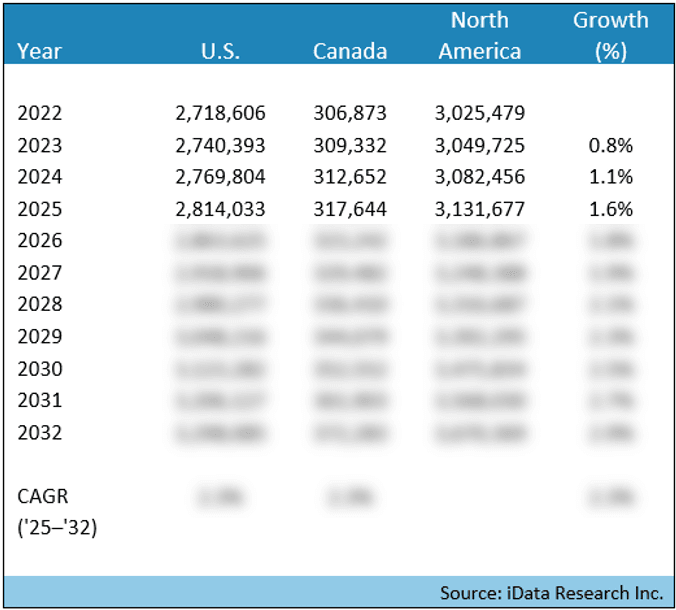
Laparoscopic Procedures by Country, North America 2022 – 2032 – iData Research
Laparoscopic procedure volumes in North America grew from 3.03 million in 2022 to over 3.13 million in 2025, reflecting steady demand.
North America emphasizes efficiency and advanced technology integration.
The U.S. continues to dominate with over 2.8 million procedures, while Canada shows consistent growth. Year-over-year growth increased from 0.8% to 1.6%, suggesting gradual recovery and expansion in minimally invasive surgery.

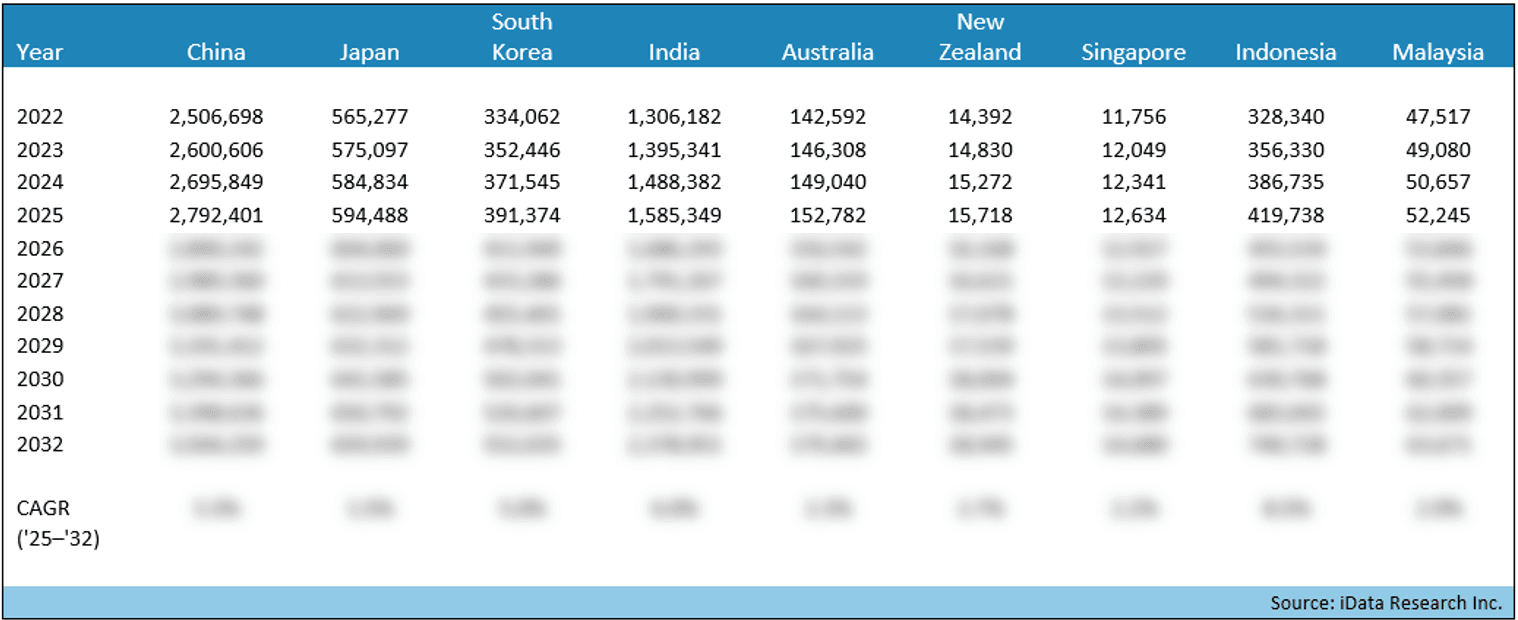
Laparoscopic Procedures by Country, Asia Pacific 2022 – 2032 – iData Research
Laparoscopic procedure volumes across Asia-Pacific show strong and consistent growth, led by high-volume countries such as China and India. China increased from approximately 2.5 million procedures in 2022 to nearly 2.8 million in 2025, while India grew from 1.3 million to over 1.58 million in the same period.
Other markets, including Japan, South Korea, and Southeast Asian countries, also demonstrate steady upward trends, reflecting broader regional expansion in minimally invasive surgery.
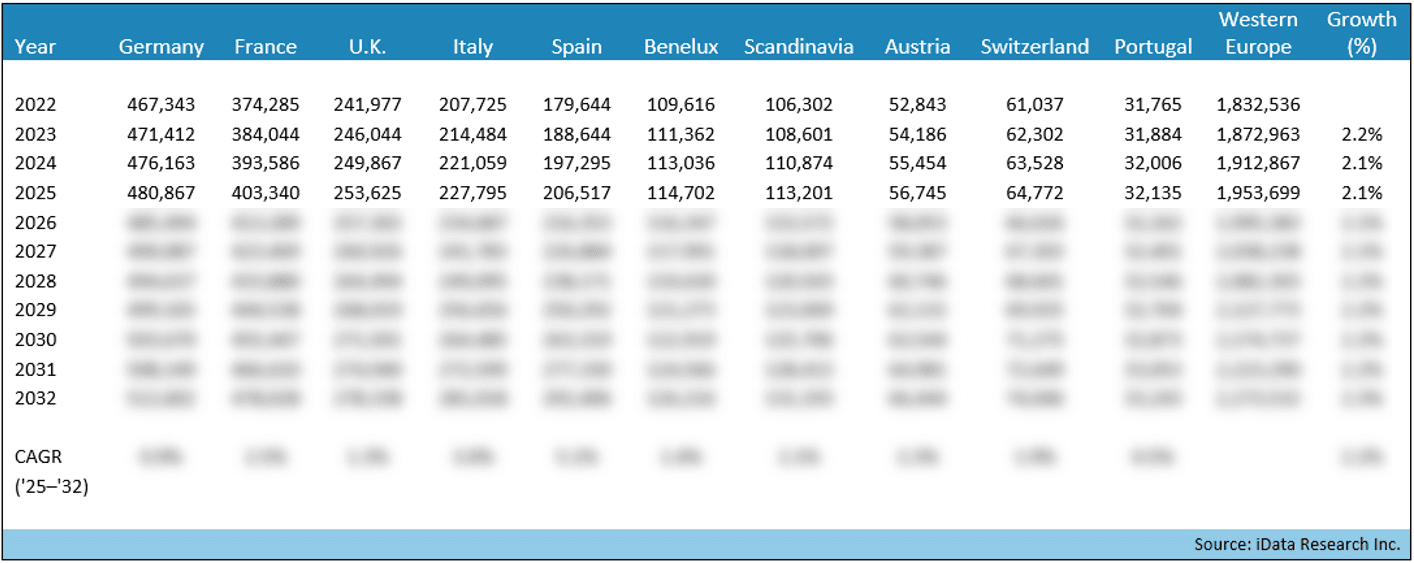
Laparoscopic Procedures by Country, Western Europe 2022 – 2032 – iData Research
Laparoscopic procedure volumes in Western Europe increased from approximately 1.83 million in 2022 to nearly 1.95 million in 2025, reflecting steady regional growth.
Germany, France, and the U.K. continue to account for a significant share of procedures, while countries such as Spain and Italy show consistent expansion. Annual growth rates remain stable at just over 2%, suggesting a mature but steadily increasing market.
📋 Get more regional insights from our 2026 Laparoscopic Devices Market Report
Emerging technologies in laparoscopic devices market
Dual-tube smoke evacuation systems in laparoscopic devices market
Dual-tube smoke evacuation systems improve surgical visibility by enabling continuous smoke removal without interrupting insufflation.
These systems are gaining traction as awareness of surgical smoke risks increases.
In many laparoscopic procedures, especially those involving energy devices, smoke can build up quickly and obscure visibility. Traditionally, this might require pausing to clear the field, even briefly. Dual-tube systems address this by allowing smoke to be removed continuously while maintaining stable insufflation.
In longer procedures, such as bariatric or colorectal surgeries, this can mean fewer interruptions and a more stable rhythm in the operating room.
Over the course of a full surgical schedule, these small efficiencies can add up, particularly in high-volume settings where consistency matters just as much as speed.
AI-enhanced visualization systems in laparoscopic devices market
AI-enhanced visualization systems support image clarity, workflow consistency, and surgical training.
In practice, image quality can vary depending on equipment, lighting, and user experience.
AI-enabled systems help reduce that variability by automatically adjusting contrast, brightness, and clarity in real time.
In some cases, they can also assist in highlighting anatomical structures.
This becomes particularly relevant in teaching hospitals or complex procedures, where multiple team members may be involved.
A more consistent visual field can help align the surgical team and reduce uncertainty, especially during delicate steps.
Over time, the ability to review and organize recorded procedures may also support training and knowledge sharing across teams.
Advanced vessel sealing systems in laparoscopic devices market
Advanced vessel sealing systems improve precision by enabling consistent sealing while minimizing thermal damage.
In procedures where access is limited and angles are not always ideal, achieving a secure seal on the first attempt can make a meaningful difference.
Newer systems are built to handle these conditions more consistently, even when working around complex anatomy.
For example, in gynecologic or colorectal cases, where precision is critical, improved control over thermal spread may help reduce unintended effects on surrounding tissue.
In high-volume environments, this kind of reliability can contribute to smoother procedures, fewer adjustments, and a more predictable workflow from case to case.
Compatibility with existing laparoscopic systems also allows hospitals to adopt these technologies without major infrastructure changes, which may be particularly relevant in markets where robotic adoption is still developing.
How robotic-assisted surgery impacts laparoscopic devices market
Robotic-assisted surgery is expanding laparoscopic demand by creating hybrid surgical workflows rather than replacing traditional techniques.
Many robotic procedures still rely on laparoscopic infrastructure, including access devices and insufflation systems. This is leading to operating rooms that support both approaches simultaneously.
This shift may influence how hospitals evaluate flexibility, compatibility, and long-term investment in surgical technologies.
👉 Learn more in the Global Surgical Robotics and Navigation Market Report.
FAQ: Laparoscopic devices market trends
What is the current size of the laparoscopic devices market?
The market is valued at over $12.6 billion in 2025 and is projected to reach nearly $15.8 billion.
What is driving growth in the laparoscopic devices market?
Growth is driven by increased adoption of minimally invasive surgery, rising procedure volumes, and ongoing technological advancements.
Which regions dominate the laparoscopic devices market?
North America, Asia-Pacific, and Western Europe lead due to strong healthcare infrastructure and high surgical demand.
What are the key emerging technologies in laparoscopic devices?
Key technologies include dual-tube smoke evacuation systems, AI-enhanced visualization platforms, and advanced vessel sealing devices.
How is robotic surgery affecting laparoscopic devices?
Robotic surgery is increasing demand for laparoscopic tools by supporting hybrid workflows rather than replacing traditional laparoscopy.
What technologies are influencing purchasing decisions in laparoscopic devices?
Factors such as system compatibility, workflow efficiency, and ability to support both laparoscopic and robotic procedures are becoming increasingly important.
Turn market painpoints into opportunities
Explore how procedure trends and competitor positioning create clear openings for industry experts in the market.
Related News
If you enjoyed this post, explore these related insights next:
(POPULAR) Medical Market Research: Complete Guide to Methods, Companies, and Market Applications
Healthcare Market Research Explained: Why It Matters More Than Ever
How Healthcare Market Research Helps MedTech Companies Grow Revenue


