
Medical market research is becoming harder and more critical at the same time.
Many companies are expanding into new clinical areas, and investors want faster insights backed by solid evidence. Teams now need reliable methods and trusted sources to guide product decisions.
This guide brings together the top methods, the main types of research partners, and the most common use cases to help MedTech companies improve decision-making in 2025.
Find growth niches in minutes, not months.
Explore quick, actionable insights from the select markets.
Table of Contents
➜ What does medical market research include?
➜ What are the top medical market research methods used today?
➜ Which medical market research methods are most reliable for MedTech?
➜ How top medical device companies use market research to stay ahead
➜ How medical market research helps MedTech companies launch successful products
➜ Medical market research applications across the product lifecycle
➜ How investors use medical market research to size growth opportunities
➜ How to choose the right medical market research company
➜ Medical Market Research: Complete Guide Summary
Key Takeaways
- Market research today focuses on precise procedure counts, competitor shares, and technology adoption trends.
- Claims data, regulatory databases, and surgeon-level interviews are becoming key sources of reliable evidence.
- Companies use market research for strategy, R&D, forecasting, and competitive planning.
- Investors rely on medical market research to understand risk and growth signals early.
- Choosing the right research partner reduces delays and costly product misalignment.
What does medical market research include?
Medical market research covers several core areas that support decision-making across the MedTech ecosystem.
Medical market research usually includes four main areas:
- Market sizing and growth rates
- Procedure volume modeling to track clinical activity
- Competitive landscape analysis
- Regulatory and reimbursement intelligence
First, it includes market sizing and procedure volume analysis, which help companies understand which clinical areas are expanding. Even small increases matter.
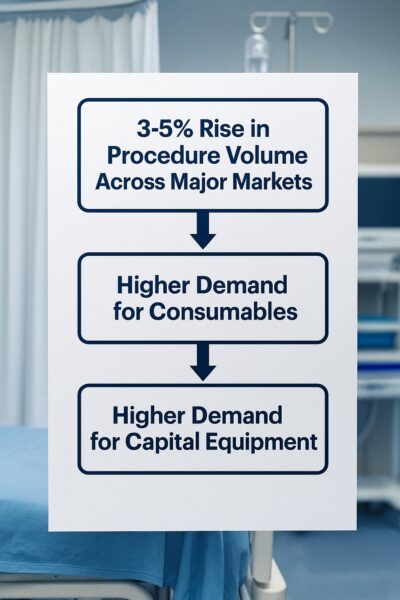
For example, a 3–5% rise in procedure volume across major markets can shift demand for consumables and capital equipment. These changes can also affect sales targets and inventory planning.
The field also includes competitive analysis, which identifies strengths, weaknesses, and potential openings for new entrants. Companies track product portfolios, approvals, recalls, and clinical evidence to understand where competitors may gain or lose traction.
The final piece of modern research is regulatory and reimbursement intelligence.
Agencies such as the FDA or European authorities publish approvals, clinical guidance, and safety notices that often signal future growth trends.
Why accuracy matters
Accuracy is critical because even small differences in assumptions can cascade into major planning errors, especially in today’s fast-moving MedTech environment.
Several trends make precise models more important than ever:
- More complex regulatory requirements: Agencies like the FDA are demanding stronger evidence packages, with post-market surveillance now a key factor in long-term approval. Inaccurate models risk delays or outright rejection.
- Faster competitor launches: Innovation cycles are shortening, meaning that misjudging timelines or demand can leave companies behind.
- Higher hospital cost sensitivity: With operating margins tightening, procurement teams scrutinize every purchase. Forecasting errors can result in lost contracts or stalled adoption.
- Greater regional differences in adoption: Markets vary widely in reimbursement and clinical practice, so global models must be precise to avoid costly misalignment.
- Rising chronic disease prevalence: WHO and NIH data show continued increases in cardiovascular and metabolic conditions, which directly drive demand for diagnostics and interventions.
A 2024 FDA update emphasized that “device complexity continues to increase, and companies must be prepared for more evidence requirements”.
This explains why consistent, transparent data models are essential: they help companies stay aligned with regulatory expectations, anticipate competitor moves, and avoid costly redesigns or failed launches.
What are the top medical market research methods used today?
Companies use both quantitative and qualitative methods to understand clinical realities and forecast demand.
Each method answers a different type of question. Many teams now blend methods to create more reliable models across global markets.
Quantitative Research in MedTech
Quantitative research focuses on measurable evidence. The most common methods include:
- Procedure-based forecasting models
- Claims data analysis
- Hospital procurement datasets
- Regulatory approvals and clinical trial databases
- Public financial disclosures
Quantitative methods include large-scale market modeling based on hospital data, procedure volumes, FDA databases, and financial disclosures.
Qualitative Research in MedTech
These include:
- Surgeon and clinician interviews
- Hospital workflow observations
- KOL advisory panels
- Usability and ergonomic testing
Pros:
- Captures unmet needs
- Provides early signals
- Guides feature prioritization
- Helps shape launch messaging
Cons:
- Smaller sample sizes
- More subjective
- Harder to generalize
Qualitative insights are often most useful during early development or in markets undergoing rapid change.
These methods help remove guesswork and support long-term planning.
Claims databases are playing a bigger role because they offer millions of records and reflect actual treatment patterns.
Many companies also use regulatory datasets to track approval pipelines. Together, these methods help companies see real demand rather than relying solely on self-reported numbers.
This blended approach is becoming standard for MedTech teams as they search for clear, repeatable signals.
Which medical market research methods are most reliable for MedTech?
Different questions require different methods, but some sources consistently deliver stronger insights.
Procedure-based models are often considered the strongest because they link population trends to clinical activity. When companies know how many procedures are performed each year, they can build more realistic forecasts.
For example, when a device category shows stable procedure growth around 4%, product teams know adoption is steady and competition may increase.
Hospital-level surveys are also reliable when they focus on purchasing patterns or device usage. These give companies a view of what influences procurement decisions. Another dependable method is clinician interviewing.
When interviews include diverse specialists across major regions, companies get early signals about shifts in practice. These methods help reduce uncertainty and prevent costly misalignment between product features and clinical needs.
How to evaluate research reliably
Companies can evaluate research partners and models by asking:
- Which primary sources support the model?
- How often are datasets updated?
- Is the forecasting method transparent?
- Does the model include multiple triangulation steps?
- Are regional differences accounted for?
A Journal of Medical Systems review found that transparent forecasting models consistently produce higher accuracy across medical device categories.
How top medical device companies use market research to stay ahead
Large MedTech companies rely on market research to monitor competitive pressure and guide long-term innovation.
They use procedure models to understand where demand is rising and where pricing pressure may appear.
For example, if a market grows only 1–2% while competitors launch multiple new devices, companies know pricing will tighten and differentiation must improve.
Top companies also track regulatory pipelines to see when rival devices approach approval. A single approval can shift hospital preferences. Research also helps global teams understand which regions will drive future revenue.
When certain countries show high procedure growth, companies can prioritize distribution, training, and sales expansion. These insights help teams maintain performance against well-funded competitors.
Using regulatory intelligence to predict competitor moves
Regulatory databases reveal early signals about future product competition. FDA’s De Novo and PMA pathways show a steady increase in novel device submissions.
Tracking these trends helps companies prepare new features, plan launch timing, or adjust messaging.
Geographic insights for global planning
Different regions show different patterns of demand. OECD data shows rising healthcare spending in the U.S. Europe and parts of Asia-Pacific, while some Latin American markets face cost constraints.
Teams use these insights to adjust strategy:
- Expanding training programs in high-growth regions
- Adjusting marketing messages based on workflows
- Planning inventory and distribution more precisely
- Tracking reimbursement changes by country
These differences matter because they shape adoption speed and market share growth.
How medical market research helps MedTech companies launch successful products
Product launches depend heavily on accurate, targeted research.
Companies study procedure volumes to estimate demand and plan inventory. They also look at clinical adoption trends to design features that meet current practice.
For example, if 60–70% of surgeons in a specialty prefer minimally invasive approaches, companies know their devices must support smaller incisions or faster setup times.
Validating clinical need before development
Early-stage validation reduces risk. NIH and WHO data show steady increases in chronic diseases such as cardiovascular and metabolic conditions, which raise demand for diagnostics and interventions.
Research helps teams identify:
- Workflow bottlenecks
- Safety concerns
- Usability issues
- Features clinicians value most
Pricing, reimbursement, and early adoption signals
Research also guides pricing. Teams analyze hospital budgets and competitor prices to set levels that encourage early adoption.
Teams watch:
- Average selling price ranges
- Budget planning cycles
- Capital vs. consumable cost trade-offs
- Regional differences in reimbursement
- Early user feedback on outcomes
Launch teams also track which features attract clinicians. When research shows certain features reduce operating time, these become strong selling points in marketing.
Effective research reduces delays, improves product-market fit, and supports faster adoption in hospitals and clinics.
Medical market research applications across the product lifecycle
Medical market research supports every stage of the device lifecycle.
Early-stage R&D and concept testing
Early-stage R&D in medical devices benefits enormously from engaging clinicians during concept testing, as their input helps teams prioritize features and validate real-world needs before costly development begins.
For example, a 2024 case study highlighted how a company designing a minimally invasive surgical tool involved surgeons early through advisory boards and workflow observations, which revealed ergonomic issues and usability gaps that would have required expensive redesigns if discovered later.
By integrating this feedback, the company refined its prototype to better align with surgical practice, reduced development costs, and accelerated regulatory approval by demonstrating clinician buy-in.
Similarly, Boyd Biomedical emphasized that early patient and clinician engagement validates assumptions and reduces risk, ensuring devices are designed around actual user needs rather than abstract models.
These examples show that embedding clinician voices into R&D not only improves product-market fit but also strengthens launch success and long-term adoption.
In mature markets, research identifies opportunities for upgrades, new accessories, or adjacent product lines. It also helps companies plan for regulatory changes.
For example, when authorities tighten safety requirements or shift reimbursement rules, teams use market research to predict how these changes will affect demand. This ensures products remain aligned with clinical and regulatory expectations throughout their lifecycle.
Post-market monitoring and competitive tracking
Once products launch, post-market signals become important. FDA MAUDE data, safety notices, and recalls can shift clinician confidence.
Competitive launches can change pricing or shift hospital preferences.
Teams track:
- Safety alerts
- Outcomes data
- Competitor approvals
- Pricing changes
- Usage feedback
How investors use medical market research to size growth opportunities
Investors rely on medical market research to understand risk and future value.
They study procedure trends, regulatory patterns, and technology shifts to identify markets with consistent growth.
When a sector shows stable procedure increases around 3–6%, investors see this as a sign of healthy demand. Strong regulatory pipelines also signal that innovation is active.
Market research also helps investors assess competitive landscapes. If a device category has many small players, consolidation may increase. If a market is dominated by two or three large companies, new entrants may face slower adoption.
Investors use these insights to estimate returns and guide portfolio decisions.
Clear, data-based research reduces uncertainty and supports stronger investment outcomes.
How to choose the right medical market research company
Selecting the right research partner is critical.
Essential questions to ask
Ask potential partners:
- How often do you update your datasets?
- Which primary sources do you use?
- Do you include procedure-based models?
- Is the methodology transparent?
- Do you cover global regions?
- Can analysts explain the assumptions?
These questions help separate reliable partners from superficial ones.
Companies should first check whether a research firm provides procedure-based models rather than relying on broad estimates.
Firms with access to regulatory databases, hospital sources, and clinician panels deliver more reliable results. Buyers should also look for transparent methodology. Clear, repeatable methods are essential for accurate forecasting.
Research teams must also have strong coverage across global markets. Many MedTech companies operate in Europe, Asia-Pacific, and Latin America, so research must reflect these regions.
Another key factor is how often the data is updated. Markets shift fast, and annual updates may not be enough for some categories. Teams should also consider customer support, access to analysts, and customization options.
These features help companies interpret data correctly and apply it to their strategy.
Medical Market Research: Complete Guide Summary
Medical market research gives MedTech companies a clearer view of clinical demand, competitor activity, and regulatory changes.
When teams use reliable models and high-quality sources, they make better decisions across product development, marketing, and investment planning. Strong research helps companies manage risk, identify growth opportunities, and maintain long-term competitiveness.
To go deeper, explore the full suite of MedTech market intelligence, including forecasts, procedure volumes, and competitor shares.
The iData MedTech Market Research Reports provide detailed competitor shares, procedure forecasts, and growth trends you can act on.
About iData Research
iData Research is a premium market intelligence firm headquartered in Canada with offices across North America and Europe.
Over the last 20 years, the company has specialized in device-level sizing, procedure models, pricing trends, and competitive share across MedTech.
Since 2005, iData has supported global OEMs, mid-market innovators, and investors with triangulated data based on units and ASPs, with country-level forecasts and analyst access across Europe, North America, Latin America, the Middle East, Africa, and APAC.
Reports are available with flexible licensing to fit commercial, strategy, and investment workflows.
Turn market painpoints into opportunities
Explore how procedure trends and competitor positioning create clear openings for industry experts in the market.


