
Minimally Invasive Spine Surgery (MISS) is transforming spinal procedures by offering patients reduced recovery times and fewer complications compared to traditional open surgeries.
This article delves into the specifics of MISS, its techniques, recovery expectations, market trends, and future outlook.
Find growth niches in minutes, not months.
Explore quick, actionable insights from the select markets.
Table of Contents
➜ Understanding Minimally Invasive Spine Surgery (MISS)
➜ Popularity and Market Trends of MIS Spine Surgery
➜ Global Leaders in MIS Spine Surgery
➜ Future Outlook of MIS Spine Procedures
➜ Get the Full 2024–2030 U.S. Minimally Invasive Spinal Implant Market Report Today
Key Takeaways
- Minimally Invasive Spine Surgery (MISS) uses small incisions, endoscopic tools, and imaging guidance to reduce tissue disruption and shorten recovery times.
- Common MISS techniques include tubular retractor systems, percutaneous screw placement, and endoscopic discectomy.
- The global MIS spine surgery market is valued at approximately $3 billion in 2024 and is projected to reach nearly $5 billion by 2031.
- Medtronic, DePuy Synthes, and NuVasive lead the global MIS spinal implant market, each with specialized technologies and strong product portfolios.
- North America is the largest regional market for MIS spine, but Asia-Pacific is growing faster with a low double-digit CAGR. Africa is the fastest-growing region globally.
- Innovations like robotic-assisted navigation, AI-powered surgical planning, and 3D-printed implants are driving the next wave of MISS.
- Countries such as Germany, South Korea, and the United States are leading the adoption of advanced minimally invasive spine techniques.
- The future of MISS includes increased automation, better patient-specific solutions, and greater global accessibility through training and cost reduction.
Understanding Minimally Invasive Spine Surgery (MISS)
@ladyspinedoc Endoscopic fusion explained #spinalfusion #minimallyinvasivesurgery #spinehealth #backpain #neurosurgeon #spinefusion #spineology #optimesh #endolif ♬ FEEL THE GROOVE – Queens Road, Fabian Graetz
What is Minimally Invasive Spine Surgery (MISS)?
Minimally Invasive Surgery (MIS) for the spine is a modern surgical approach designed to treat various spinal conditions with minimal disruption to the body. Unlike traditional open surgeries, which require large incisions and significant muscle retraction, MISS uses small incisions and advanced tools to access the spine.
Common Minimally Invasive Spine Surgery Techniques

Techniques commonly used in minimally invasive spine surgery (MISS) are designed to reduce tissue damage and enhance precision:
- Tubular Retractor Systems: Create a narrow channel to the spine by gently dilating muscles, minimizing disruption in procedures like discectomies and decompressions.
- Endoscopic Spine Surgery: Uses a camera-equipped endoscope through a small incision for precise, minimally invasive tissue removal.
- Percutaneous Screw Placement: Inserts screws via small incisions with imaging guidance to stabilize the spine during fusion surgeries.
- Microsurgical Tools: Enable precise work around delicate nerves, ensuring accuracy and reducing complications in various MISS procedures.
These techniques are versatile and can be applied to a variety of procedures, including discectomies, laminectomies, and spinal fusions. They offer significant benefits, such as reduced postoperative pain, shorter hospital stays, and quicker recovery times.
📌Find out more about Spinal Implants. Read:
Advantages of Minimally Invasive Spine Surgery Over Traditional Surgery
MISS offers several benefits compared to traditional open spine surgery:
- Smaller Incisions: Result in reduced scarring and less postoperative pain.
- Less Bleeding: Minimizes blood loss during surgery.
- Shorter Hospital Stays: Many procedures are performed on an outpatient basis, allowing patients to return home the same day.

Popularity and Market Trends of MIS Spine Surgery
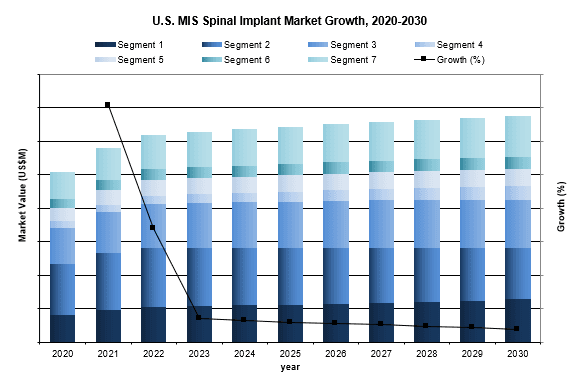
(Note: to see the full graph, download our U.S. Minimally Invasive Spinal Implant Market Report)
Growing Adoption Rates
The adoption of minimally invasive surgery (MIS) techniques is steadily increasing, fueled by several key factors:
- Technological Advancements: Continuous innovations in surgical instruments, imaging technologies, and robotic systems have significantly enhanced the precision, safety, and efficiency of MIS procedures.
- Patient Demand: Patients are increasingly seeking surgical options that offer shorter recovery times, less postoperative pain, and fewer complications. MIS techniques align with these preferences, providing a less invasive alternative to traditional open surgeries.
Additionally, the rising prevalence of chronic conditions, such as spinal disorders and cardiovascular diseases, has further contributed to the adoption of MIS techniques.
Healthcare providers are also embracing these methods due to their cost-effectiveness and ability to improve patient satisfaction.
📌 Interested in learning about Robotic Surgery? Read:
➜ Robotic Surgery: Minimally Invasive Procedures on the Rise
Market Growth
The MIS market is experiencing year-over-year growth, with the highest growth occurring in the spine endoscope market.
Market Size: Valued at approximately USD $3 billion in 2024, projected to reach USD around $5 billion by 2031.
Global Leaders in MIS Spine Surgery

In 2024, Medtronic led the global MIS spinal implant market, driven by its dominance in the pedicle screw segment and strong performance in MIS interbody devices. Key technologies include the DLIF® procedure and MAST™ systems, with additional support from devices like the X-Stop® interspinous spacer.
DePuy Synthes held the second-largest share globally, supported by its MIS lateral platform, percutaneous pedicle screws, and leadership in facet fixation. The FACET WEDGE system and the VIPER® F2 transfacet pedicular screw model positioned the company as a front-runner in less invasive stabilization techniques.
NuVasive ranked third overall but led the MIS interbody device market. The company also held strong positions in spinous process fixation and pedicle screw technologies, reinforcing its role as a key innovator in minimally invasive spinal fusion.
Countries Leading in MIS Adoption
As of 2024, North America remains the largest MIS spine market but shows modest growth. Asia-Pacific is gaining momentum with a low double-digit CAGR, while Western Europe sees steady mid-single-digit growth. Emerging regions like Latin America, the Middle East, and Africa are expanding rapidly, with Africa projected to be the fastest-growing due to low current adoption and increasing demand.
Innovative Techniques
Minimally invasive spine surgery (MISS) has reached new heights with cutting-edge advancements such as:
- Biportal Endoscopic Spine Surgery: Utilizes two small incisions for improved visibility and flexibility during procedures, reducing recovery time and tissue damage.
- Robotic-Assisted Spine Surgery: Employs systems like MazorX for precise navigation, enhancing accuracy and minimizing errors in complex spinal surgeries.
- Patient-Specific 3D-Printed Implants: Offers customized implants tailored to individual spinal anatomy, improving fit and surgical success.
- Neuromodulation Devices: Provides electrical stimulation to block pain signals, revolutionizing chronic pain management without compromising mobility.
- TESSYS Method: A transforaminal endoscopic technique that removes herniated disc tissue via millimeter-sized access tubes, preserving surrounding tissue and spinal stability.
- AI-Powered Surgical Planning: Harnesses artificial intelligence to optimize preoperative planning and predict outcomes for personalized surgical strategies.
Countries like Germany and South Korea are at the forefront of developing innovative MIS techniques, such as the TESSYS method, which allows for the removal of herniated disc material through a minimally invasive transforaminal approach.
📌 Want to learn more about Robotic Surgery? Read:
➜ Hospital Adoption of Surgical Robotics in 2025: Key Drivers & Challenges
➜ Revolutionizing Orthopedics: Robotics for Large Joint Replacements
Future Outlook of MIS Spine Procedures
The future of MIS in spinal procedures is promising, with ongoing advancements aimed at further reducing invasiveness and improving patient outcomes. Emerging technologies, including robotic assistance and enhanced imaging systems, are expected to play a significant role in the evolution of MIS techniques.
As MIS becomes more commonplace, continued innovation and training will be essential to maximize its benefits and accessibility to patients worldwide.
📌 Learn more about Robotic Surgery Advancements. Read:
Turn market painpoints into opportunities
Explore how procedure trends and competitor positioning create clear openings for industry experts in the market.


