
iData Research’s Robotic Surgery Growth insights reveal a market undergoing rapid transformation. The surgical robotics market is accelerating worldwide, with emerging regions playing a pivotal role in driving adoption beyond traditional strongholds like North America and Western Europe.
In this Robotic Surgery Growth article, we explore the regions where surgical robotics is expanding the fastest and highlight key market trends to watch in the coming years.
Find growth niches in minutes, not months.
Explore quick, actionable insights from the select markets.
Table of Contents
➜ The Growing Popularity of Robotic Surgery
➜ How Is Robotic Surgery Used in Surgery?
➜ Robotic Surgery Growth Forecast and Trends
➜ Where Are Surgical Robotics Expanding the Fastest?
➜ Robotic Surgery Growth Summary
➜ Comprehensive Global Surgical Robotics and Navigation Market Report
Key Takeaways
- The global surgical robotics market is projected to grow from $11B (2024) to $30B, led by MIS systems.
- Asia-Pacific is the fastest-growing large region, driven by volume and localization.
- The Middle East shows high CAGR, supported by premium hospital investment and tourism strategy.
- Latin America is expanding through cost-adaptive strategies in the private sector.
- The U.S. leads in installations and procedures, but regional demand is shifting, especially in APAC and Western Europe.
- Technology convergence (robotics + AI + imaging) is fueling new system designs and regional accessibility.
The Growing Popularity of Robotic Surgery
With adoption gaining traction outside of North America, emerging regions like Asia-Pacific, the Middle East, and Latin America are shaping the next chapter of growth. Better healthcare infrastructure and increased investments in new technologies are speeding up their adoption. Partnerships between global companies and local healthcare providers are also helping these regions become key players in robotic surgery’s future.
How Is Robotic Surgery Used in Surgery?
@nicolebasamd Is this Sci-Fi? No!!! This is what I do every week! Robotic Surgery is Amazing!!! When I started my surgical residency over 20 years ago I NEVER thought 💭 I would operate like this!!! Robotic surgery is so very safe and more meticulous than performing surgery open or even laparoscopic. You can move the fine tips of the instruments which oftentimes are only around a cm long to carefully handle organs gently. I’ve been doing robotics for so long that I actually can feel but with my eyes 👀 not my hands! Our brains are amazing that way!!! The great thing with robotics (since I am a control freak) is that I can control the camera 🎥 and the three working arms. I can do this all with 3D vision at the console. Although it looks scary that the patient is alone at the bedside they are not. The anesthesia provider is at the head of the bed and the surgical technologist and first assistant is at the bedside. There are so many fail safes built into the robot 🤖 that it cannot make any movements not directly controlled by me otherwise it will shut down. What it does allow me to do is access areas that once were difficult to reach even open and do fine dissections especially at the diaphragm right next to heart, aorta, esophagus with amazing precision!!! #roboticsurgery #robotics #roboticbariatricsurgery #roboticsurgeon #vsg #vsgcommunity #femalesurgeon #womensurgeons #operatingroom #bariatricsurgery #bariatricsleeve #gastricsleeve #gastricsleevesurgery #keepingitsafe #doctorsofinstagram #orlife #lifechanging #nicolebasamd #austintx #austintexas #surgicalweightloss #cedarparktx #cuttingedge #gastricbypass #gettinghealthy #gettinghealthier #bariatricsurgeon #bestbariatricsurgeon #bamedicalcenter
Surgical robots help perform minimally invasive procedures by improving precision, visibility, and control. They also enhance recovery times and reduce complications after surgery.
These systems are commonly used in:
- Urology, gynecology, general surgery, and orthopedics
- Spine and neurological procedures (increasingly supported by robotic navigation)
- Single-incision and natural orifice surgeries, where smaller or no external cuts are made
Today, robots like Intuitive Surgical’s da Vinci® or Medtronic’s Hugo™ system allow surgeons to operate with ultra-fine control – reducing complications, pain, and hospital stays.
📌Want to Learn More About Minimally Invasive Procedures? Read:
➜ Robotic Surgery: Minimally Invasive Procedures on the Rise
Robotic Surgery Growth Forecast and Trends
Is the Robotics Industry Growing?
Yes. Across MedTech, surgical robotics is among the fastest-growing segments, driven by demand for minimally invasive techniques and increasing hospital investment in digital surgery.
The global surgical robotics market was valued at $11 billion in 2024, with the Minimally Invasive Surgery (MIS) segment representing over 70% of the total Robotics and Navigation market. By 2030, the market is forecast to exceed $30 billion.

How Big Is the Surgical Robotics Market in 2025?
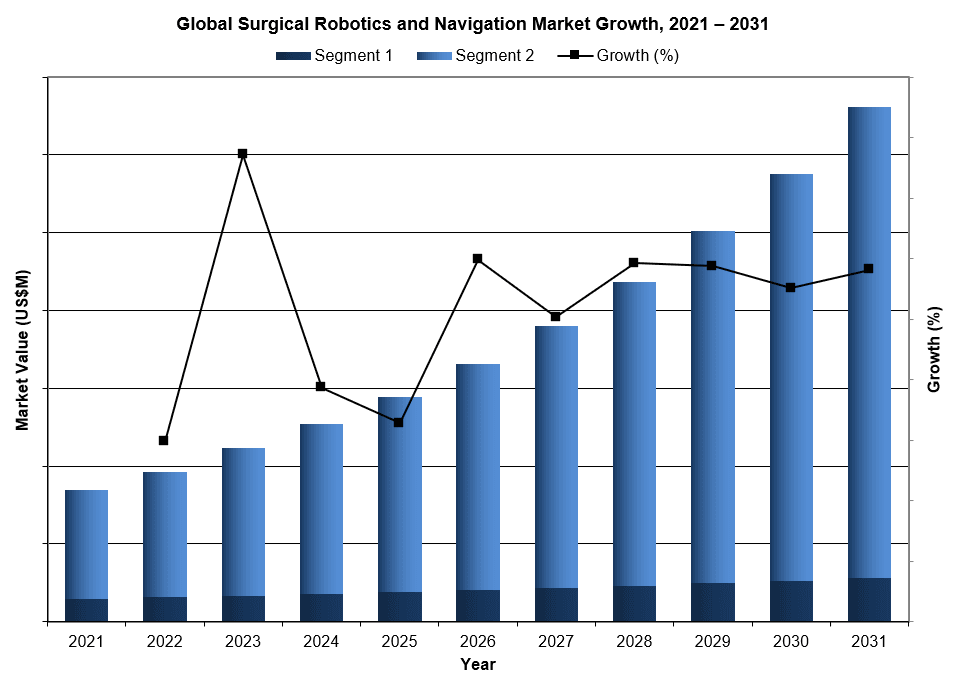
(Note: to see the full graph, download our Global Surgical Robotics and Navigation Market Report)
The market cap of robotic surgery is expected to approach $13 billion in 2025, driven by increasing system installations, procedure volume growth, and recurring revenue from disposables, service contracts, and training programs.
[[
Which Countries Are Leading in Robotic System Development?
- United States: Home to Intuitive Surgical, Medtronic (post-Mazor acquisition), and Stryker (MAKO).
- Germany and France: Strong R&D presence with companies like Zimmer Biomet and Medtech (now part of Zimmer Biomet).
- China: A growing number of domestic robotics firms backed by state funding.
What Are The Robotic Surgery Growth Key Trends?
- M&A activity is reshaping the competitive landscape. Major implant manufacturers like Stryker, Zimmer Biomet, and Medtronic have acquired robotics companies to control the full surgical ecosystem.
- Flexibility and size: New entrants are developing compact and mobile platforms to reduce operating room footprint.
- Single-port and natural orifice surgery: Robots are evolving to further minimize invasiveness.
- AI and imaging integration: Advanced navigation, real-time feedback, and predictive analytics are being embedded in next-gen systems.
📌Want to Learn More About Hospital Adoption of Surgical Robotics in 2025? Read:
➜ Hospital Adoption of Surgical Robotics in 2025: Key Drivers & Challenges
Where Are Surgical Robotics Expanding the Fastest?

Asia-Pacific (APAC): Rapid Demand and Domestic Innovation
APAC was the second-largest surgical robotics market in 2024 – and is currently growing at a double-digit CAGR.
Key Drivers:
- High procedure volume growth in China, India, Japan, and South Korea
- Government support for digital health transformation
- Local innovation in robotic systems to reduce reliance on imported technology
Middle East: Fastest-Growing Small Market
Though the Middle East represents a smaller market by value, it has one of the fastest projected CAGRs in the sector.
Key Drivers:
- High-end surgical centers in UAE, Saudi Arabia, and Qatar
- Strategic initiatives to position hospitals as medical tourism hubs
- Increased investment in robotics training and infrastructure
Latin America: Targeted Expansion in Private Care
While adoption has historically been slower due to budget constraints, Brazil, Mexico, and Chile are seeing measured growth.
Key Drivers:
- Private hospital investments in high-end technologies
- Increased use of leasing models and per-use payment structures
- Focus on gynecology and urology as entry points for robotic procedures
Robotic Surgery Growth Summary
Emerging regions such as Asia-Pacific, the Middle East, and Latin America are driving global growth in surgical robotics through diversified strategies.
Manufacturers are adopting flexible pricing models, like leasing and pay-per-procedure, to address budget constraints.
Training and education hubs are being established to develop skilled robotic surgeons, while regulatory advancements in countries like China and the UAE are reducing time-to-market for innovative systems.
These initiatives are shaping the next chapter of expansion in the surgical robotics landscape.
📌Want to Learn More About Minimally Invasive Procedures? Read:
➜ Robotic Surgery: Minimally Invasive Procedures on the Rise
Turn market painpoints into opportunities
Explore how procedure trends and competitor positioning create clear openings for industry experts in the market.


