
Surgical robotics are rapidly transforming the way surgeries are performed, offering greater precision, reduced recovery times, and minimally invasive procedures. But how widely have hospitals adopted robotic-assisted surgery, and what’s driving or slowing its expansion?
As AI-powered surgical systems and robotic-assisted procedures become more advanced, hospitals worldwide are either investing heavily in robotics or cautiously evaluating their cost-effectiveness.
This blog explores the state of robotic surgery adoption in hospitals, major players leading the industry, and what the future holds.
Find growth niches in minutes, not months.
Explore quick, actionable insights from the select markets.
Table of Contents
➜ Hospital Adoption of Surgical Robotics: U.S. and Global Expansion
➜ Who Is Leading the Surgical Robotics Market?
➜ Are Surgical Robotics the Future?
➜ Challenges Slowing Surgical Robotics Adoption in Hospitals
Key Takeaways
- Robotic-assisted surgery is expanding rapidly, with over 6,700 robotic surgery systems installed worldwide.
- The U.S. leads in hospital adoption, but Canada and Europe are catching up.
- Intuitive Surgical, Medtronic, and CMR Surgical are key players in the market.
- Cost, training, and regulatory hurdles are slowing adoption in some regions.
- Minimally invasive robotic procedures are becoming the standard for certain surgeries, such as prostatectomy and gynecologic procedures.
What Do Surgical Robots Do?

Surgical robots are revolutionizing modern operating rooms, allowing surgeons to perform complex procedures with unprecedented accuracy. These robotic systems are designed to enhance human skill, not replace it—providing greater precision, control, and consistency than traditional manual techniques.
Unlike conventional surgery, where a surgeon relies solely on hand movements, robot-assisted surgery uses robotic arms controlled by a surgeon via a console. These robotic systems provide magnified 3D visualization, finer instrument movement, and improved access to hard-to-reach areas.
Here’s how surgical robots improve patient outcomes:
- Enhanced Precision – Robotic systems allow surgeons to make ultra-fine movements beyond human capability.
- Minimally Invasive Surgery (MIS) – Small incisions lead to faster patient recovery and less pain.
- Improved Outcomes – Reduced complications and higher surgical success rates.
The da Vinci Surgical System: The Most Widely Used Surgical Robot

One of the most well-known robotic surgery platforms is the da Vinci Surgical System, developed by Intuitive Surgical. Used in more than 8.5 million procedures globally, da Vinci is a multi-armed robotic system that enhances surgeon dexterity, control, and visualization.
Hospital Adoption of Robotic Surgery: U.S. and Global Expansion
Robotic Surgery in North America
- The North American market had the largest revenue share of about 51% in 2024. Additionally, as of 2020, over 5,500 da Vinci systems were installed in hospitals across the United States. Over 2,000 hospitals now use robotic surgical systems, making the U.S. a significant, if not the largest, market for robotic surgical systems.
- More than 15% of general surgeries were robotic-assisted in 2023, with projections to double in five years.
- da Vinci Surgical System leads adoption, but Medtronic’s Hugo RAS and CMR Surgical’s Versius are expanding competition.
- Prostatectomy, gynecologic surgeries, and hernia repair are the most common robotic procedures.
While these procedures are indeed common, it’s worth noting that other procedures such as colorectal surgeries, gastrointestinal surgeries, and cardiothoracic surgeries are also frequently performed using robotic systems.
📌 Find out more about the 2024 – 2030 U.S. Surgical Robotics and Navigation Market
Robotic Surgery in Europe & Beyond
- Europe is catching up, with Germany, France, and the U.K. leading adoption.
- Asia-Pacific & the Middle East are seeing high growth, fueled by government investments.
- Canada has 40+ hospitals using robotics, but cost remains a limiting factor.
Despite high costs and training barriers, robotic-assisted surgery is becoming the global standard for precision and minimally invasive procedures.

Who Is Leading the Surgical Robotics Market?

Several major players are driving hospital adoption of robotic-assisted surgery, continuously advancing AI-driven automation, precision enhancements, and cost-effective solutions. As the demand for minimally invasive procedures grows, these companies are shaping the future of surgical robotics.
Key Companies Leading the Surgical Robotics Market:
- Intuitive Surgical (da Vinci Surgical System) – The market leader, responsible for over 1.8 million robotic-assisted procedures annually.
- Medtronic (Hugo RAS System) – Competing with a more cost-effective alternative to da Vinci.
- CMR Surgical (Versius) – Expanding in Europe, India, and Latin America.
- Johnson & Johnson (OTTAVA Surgical Robot) – Working on a next-generation robotic system.
📌 Find out more about the Top 8 Robotic Surgery Companies in the United States
How These Companies Are Innovating
The future of surgical robotics is being shaped by:
- AI-driven automation – Robots with real-time decision-making and predictive analytics.
- Haptic feedback – Improving surgeon control and sensory response.
- Cost-effective systems – Making robotic surgery more accessible for hospitals worldwide.
With rising demand and fierce competition, expect faster advancements and new players entering the market in the coming years.
Are Surgical Robotics the Future?
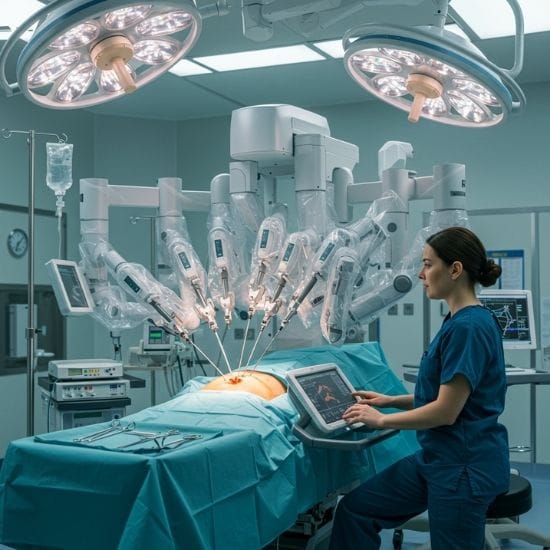
Yes—but widespread adoption still faces challenges. While hospitals are increasingly investing in robotic-assisted surgery, factors such as high costs, surgeon training requirements, and regulatory hurdles continue to slow expansion.
However, as technology advances, robotic surgery is expected to become the standard for many procedures, improving patient outcomes, surgical precision, and overall hospital efficiency.
What’s Driving Growth in Surgical Robotics?
- Improved patient outcomes – Lower infection rates, less pain, and shorter hospital stays.
- Surgeon demand for precision tools – Robotic assistance reduces fatigue and increases accuracy.
- AI and Machine Learning – Newer robotic systems integrate AI to enhance decision-making during surgery.
Challenges Slowing Adoption in Hospitals
Despite its potential, surgical robotics still faces significant hurdles that slow its adoption in hospitals worldwide. While robot-assisted surgery is gaining traction, cost, training, and regulatory challenges remain key barriers.
- High Cost – A single robotic system costs $1.5M–$2M, plus maintenance and training expenses.
- Surgeon Training Required – Not all hospitals have the resources to train surgeons in robotic techniques.
- Regulatory Approval Delays – Some countries have longer approval processes before hospitals can adopt new surgical robots.
Surgical Robotics Adoption Future Outlook:
The global surgical robotics market is projected to grow from $11 billion in 2024 to $30 billion by 2031, driven by AI advancements, increased hospital adoption, and cost-effective robotic platforms.
As costs decline, automation improves, and training programs expand, robotic-assisted surgery is set to become the standard in hospitals worldwide.
The next generation of surgical robots will feature greater automation, real-time data analytics, and enhanced surgeon control, making them more accessible and efficient across various medical fields.
Turn market painpoints into opportunities
Explore how procedure trends and competitor positioning create clear openings for industry experts in the market.


