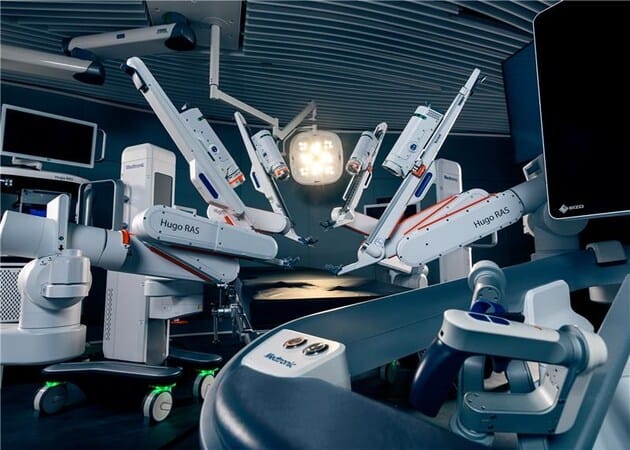
Medtronic Hugo and Intuitive Surgical’s Da Vinci SP both won major FDA decisions in December 2025, and together they reset the robotic surgery race.
Medtronic gained clearance for urologic procedures, Intuitive Surgical added three new indications to its single-port platform, and CMR Surgical cleared a soft-tissue robot in the same month.
iData Research values the global minimally invasive surgery robotic system market at about $9 billion in 2025, heading past $22 billion by 2031.
Here is how the two headline platforms compare and who else is moving.
Find growth niches in minutes, not months.
Explore quick, actionable insights from the select markets.
Table of Contents
➜ Who is winning the robotic surgery race in 2026
➜ What is the Medtronic Hugo robotic surgery system
➜ What makes Da Vinci SP a leading robotic platform
➜ How does Medtronic Hugo compare with Da Vinci SP
➜ Which other companies are entering the robotic surgery race
➜ How big is the robotic surgery market in 2026
Key Takeaways
- Intuitive Surgical still holds the dominant installed base, but Medtronic Hugo and CMR Surgical are closing the gap on cost and footprint.
- Medtronic received FDA clearance for the Hugo robotic-assisted surgery system for urologic procedures in December 2025.
- Intuitive Surgical’s Da Vinci SP won three new FDA indications in December 2025 covering inguinal hernia repair, gallbladder removal and appendectomy.
- The Expand URO trial reported a 98.5% surgical success rate across 137 patients at six U.S. centers.
- iData Research expects the robotic system market to pass $22 billion by 2031, with disposables growing faster than capital equipment.
- Robotic growth reshapes laparoscopic device demand rather than eliminating it, because robotic cases still use access, insufflation, energy and closure products.
Who is winning the robotic surgery race in 2026?
Intuitive Surgical is still winning on installed base, but Medtronic Hugo is the first credible full-scale challenger to reach the U.S. market.
iData Research reports that Intuitive Surgical maintains a dominant installed base, while alternative platforms from Medtronic and CMR Surgical increase competitive pressure by targeting cost sensitivity, footprint constraints and hybrid laparoscopic-robotic workflows.
Three FDA decisions in December 2025 changed the shape of the field at once.
Medtronic received clearance for the Hugo robotic-assisted surgery system for urologic surgical procedures.
Intuitive Surgical won three new indications for Da Vinci SP, and CMR Surgical gained clearance for a new soft-tissue surgical robot platform.
The practical effect is that U.S. hospitals now have real alternatives to evaluate for the first time in general and urologic soft-tissue robotics.
What is the Medtronic Hugo robotic surgery system?
Medtronic Hugo is a modular, multi-arm robotic-assisted surgery platform built for a wide range of soft tissue procedures.
Rather than a single integrated cart, the system uses separate arm modules and an open surgeon console, a design intended to fit varied operating room layouts and support communication across the surgical team.
That modularity is the core of the Medtronic pitch. Hospitals with footprint constraints or limited capital can configure the system to the room they already have.
The clinical evidence has caught up quickly. In April 2025, Medtronic reported that the Expand URO investigational device exemption study met both primary safety and effectiveness endpoints.
The prospective, multi-center trial enrolled 137 patients across six U.S. centers for prostatectomy, nephrectomy and cystectomy, and reported a 98.5% overall surgical success rate against a performance goal of 85%.
Major complication rates came in at 3.7% for prostatectomy, 1.9% for nephrectomy and 17.9% for cystectomy, all below the prespecified goals.
Independent work supports the picture. A 2025 prospective single-center study of 50 radical prostatectomies at a London teaching hospital reported no conversions to another robotic platform, laparoscopy or open surgery, with a mean operative time of 148 minutes and a mean length of stay of 1.5 days. It is indexed on PubMed.
What makes Da Vinci SP a leading robotic platform?
Da Vinci SP is Intuitive Surgical’s single-port system, and its advantage is anatomical access rather than raw arm count.
The platform delivers three instruments and a camera through one cannula, which suits confined operative fields and reduces the number of incisions.
Its December 2025 clearance for inguinal hernia repair, gallbladder removal and appendectomy is the more consequential development, because those are high-volume general surgery procedures rather than specialist cases.
That move takes Da Vinci SP out of its original niche and into direct competition for everyday operating room throughput.
Intuitive Surgical also benefits from an advantage that no clearance can replicate quickly, which is the size of its trained surgeon base and its existing service and disposables footprint.

How does Medtronic Hugo compare with Da Vinci SP?
The two systems are not really competing for the same case. Medtronic Hugo is a multi-port, multi-quadrant workhorse, while Da Vinci SP is a single-port specialist that Intuitive Surgical is now broadening.
On architecture, Hugo separates its arms into independent modules, and Da Vinci SP consolidates instruments through one port.
On indications, Medtronic Hugo currently holds U.S. clearance for urologic procedures, while Da Vinci SP now covers hernia, gallbladder and appendectomy work alongside its earlier indications.
On evidence depth, Intuitive Surgical has decades of published outcomes across specialties, while the Hugo evidence base is newer but expanding quickly through trials such as Expand URO.
On commercial position, Intuitive Surgical leads on installed systems and Medtronic competes on flexibility and total cost of ownership.
For hospitals, the choice usually comes down to case mix. High-volume urology programs and centers with tight operating room space have a stronger reason to evaluate Medtronic Hugo, while programs built around single-incision approaches favor Da Vinci SP.
Which other companies are entering the robotic surgery race?
CMR Surgical is the third named platform competitor, having gained FDA clearance in December 2025 for a surgical robot aimed at soft-tissue procedures.
iData Research groups CMR Surgical with Medtronic as the platforms applying the most pressure on Intuitive Surgical, specifically around cost and hybrid laparoscopic-robotic workflows.
Virtuoso Surgical received FDA Breakthrough Device Designation in September 2025 for a system designed to improve precision and dexterity in procedures performed through rigid endoscopes, including bladder lesion work.
Established laparoscopic manufacturers are not standing still either. Medtronic, Ethicon and Karl Storz lead the conventional laparoscopic device market, and robotic cases continue to consume the access, insufflation, energy and closure products those companies supply.
For a broader company-level view, see our breakdown of the top robotic surgery companies in the United States.
How big is the robotic surgery market in 2026?
According to iData Research, the global minimally invasive surgery robotic system market was valued at about $9 billion in 2025 and is expected to surge past $22 billion by 2031.
Growth is not evenly distributed across revenue types. Capital equipment is expected to grow at approximately 11.8%, while disposable instruments and service revenue grow at roughly 17.2% and 15.8% respectively.
That split tells hospitals and suppliers something useful. Revenue increasingly follows utilization on systems already installed rather than new system placements alone.
The conventional side keeps growing too. The global laparoscopic device and accessories market was valued at $12.6 billion in 2025 and is expected to reach nearly $15.8 billion at a 3.2% CAGR.
Adoption is also spreading geographically, with iData Research reporting the most advanced uptake outside the United States in Western Europe, Japan, South Korea and parts of the Middle East, and emerging uptake in China and Latin America.
For more on how purchasing decisions are actually being made, see our analysis of hospital adoption of surgical robotics.
Frequently asked questions about Medtronic Hugo and Da Vinci SP
Is the Medtronic Hugo system FDA-approved?
Medtronic received FDA clearance for the Hugo robotic-assisted surgery system for urologic surgical procedures in December 2025.
What is the difference between Medtronic Hugo and Da Vinci?
Hugo is a modular, multi-arm platform with an open surgeon console, while Da Vinci SP is a single-port system that delivers three instruments and a camera through one cannula. Hugo competes on flexibility and footprint, and Da Vinci SP competes on single-incision access.
What did the Expand URO trial show?
The Expand URO study enrolled 137 patients across six U.S. centers and reported a 98.5% overall surgical success rate, with major complication rates of 3.7% for prostatectomy, 1.9% for nephrectomy and 17.9% for cystectomy.
Which procedures can Da Vinci SP be used for?
In December 2025, Da Vinci SP gained FDA indications for inguinal hernia repair, gallbladder removal and appendectomy, broadening single-port robotics into high-volume general surgery.
Who leads the robotic surgery market?
Intuitive Surgical holds the dominant installed base, with Medtronic and CMR Surgical the closest named challengers, according to iData Research.
Does robotic surgery replace laparoscopic devices?
No. Robotic cases still rely on access devices, insufflation systems, energy platforms and closure tools, so robotic growth reshapes laparoscopic device demand rather than removing it.
For full market sizing, procedure volumes and competitive share analysis across robotic and laparoscopic platforms, see the iData Research Global Minimally Invasive Surgery Robotic System Market report and the Global Laparoscopic Device Market report.
Turn market painpoints into opportunities
Explore how procedure trends and competitor positioning create clear openings for industry experts in the market.


