Power Tool Market Size, Share & Trends Analysis | United States | 2025-2032 | MedSuite | Includes: Joint Power Tool, Trauma Power Tool, and Small Bone Power Tool

  • Year: 2026
  • Scope: 10 Years
  • Region: United States
  • Pages: 126
  • Published Date: 02/20/2026
  • Type: MedSuite

Product Description

Overall, the U.S. power tool market was valued at approximately $980 million in 2025. This is expected to increase over the forecast period at a CAGR of 5.6% to reach approximately $1.44 billion.

The full report suite on the U.S. market for power tools includes detailed analysis of capital handpieces, attachments and accessories across joint, trauma and small bone power tool segments. Each section provides market size, unit volumes, ASP trends, replacement cycles, installed base dynamics and competitive positioning through 2032.

Data Types Included

  • Unit SalesAverage Selling PricesMarket Size & Growth Trends
  • Procedure Numbers
  • Market Drivers & Limiters
  • Market Forecasts Until 2031, and Historical Data to 2024
  • Recent Mergers & Acquisitions
  • Company Profiles and Product Portfolios
  • Leading Competitors

U.S. Power Tool Market Trends
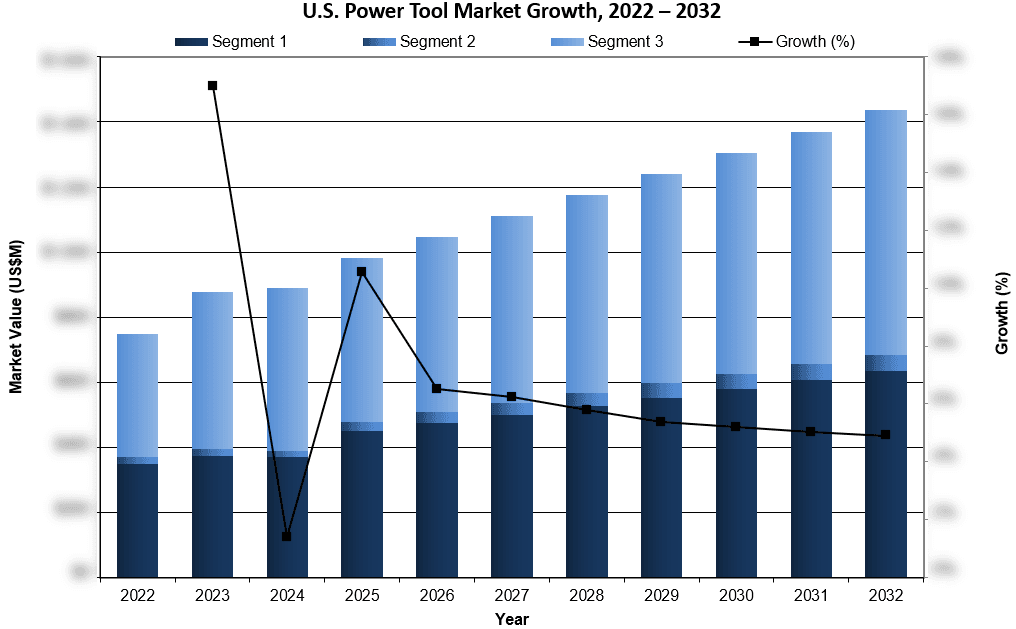
U.S. Power Tool Market Growth, 2022-2032 - iData Research

A major market driver is the steady growth in orthopedic procedure volumes, particularly joint arthroplasty and complex fracture fixation. The growing prevalence of osteoarthritis, osteoporosis and other degenerative musculoskeletal conditions continues to expand the addressable patient population. As the population ages and life expectancy rises, procedure volumes for hip, knee and shoulder reconstruction are increasing steadily. Because many joint and large bone procedures require powered resection, drilling and reaming, procedural growth directly translates into recurring demand for attachments and accessories, while also supporting long-term handpiece replacement.

U.S. Power Tool Market Share Insights

Top U.S. Power Tool Market Share Leaders - iData Research

  • Stryker was the overall share leader in the combined U.S. power tool market in 2025, maintaining dominant positions across both joint and trauma segments. In joint power tools, the company held near-total share in small and medium bone applications and a commanding majority in large bone, supported by broad adoption of its System 8 and System 9 platforms. In trauma, Stryker led the large bone segment and maintained a strong position in medium bone, reinforcing its scale advantage across hospital-based orthopedic programs. In high-speed drills, Stryker competes through its πDrive (Pi Drive) platform, used in neuro, spine and ENT applications requiring high rotational speed and precision. Although its high-speed drill share is smaller than the segment leader, πDrive complements Stryker’s broader powered instrumentation portfolio. The company’s leadership is underpinned by installed base penetration, platform standardization across service lines and long-standing hospital procurement relationships that support recurring attachment revenue and capital replacement cycles.
  • Medtronic was the leading competitor in the U.S. high-speed drill market in 2025, driven primarily by its Midas Rex™ platform. Midas Rex maintains deep penetration in neurosurgery, spine and ENT procedures where precision drilling is critical, securing Medtronic the largest share of the high-speed segment and a substantial position in the overall powered instrumentation landscape. While the company has limited exposure in joint arthroplasty power tools and traditional large bone trauma systems, its dominance in specialty surgical applications is highly defensible. Integration with Medtronic’s spine and neurosurgery portfolios supports procedural bundling, strong physician loyalty and sustained capital utilization within specialty service lines.
  • CONMED held a smaller but established position across multiple U.S. power tool segments in 2025. In joint power tools, the company maintained modest share in medium and large bone applications with limited participation in small bone. Across trauma and high-speed drill categories, CONMED competes through its Hall® line of products, which carries longstanding brand recognition in orthopedic and trauma settings. Although its total market share remains limited relative to Stryker and Medtronic, CONMED benefits from its broader orthopedic and sports medicine portfolio, enabling selective penetration in accounts that favor alternative suppliers or dual-vendor strategies and allowing continued participation in capital replacement and attachment-driven revenue cycles.

U.S. Power Tool Market Segmentation Summary

  • Joint Power Tool Market – Further Segmented Into:
    • Device type: Small, Medium, and Large Bone Joint Power Tool.
  • Trauma Power Tool Market – Further Segmented Into:
    • Device type: Small Bone Trauma Power Tool Accessory & Attachments, Medium, and Large Bone Trauma Power Tool.
  • Small Bone Power Tool Market – Further Segmented Into:
    • Device type: Power Console System, Small Bone Power Tool, and High-Speed Drill.

Research Scope Summary

Report Attribute Details
Region United States
Base Year 2025
Forecast 2026-2032
Historical Data 2022-2024
Quantitative Coverage Market Size, Market Shares, Market Forecasts, Market Growth Rates, Units Sold, and Average Selling Prices.
Qualitative Coverage Market Growth Trends, Market Limiters, Competitive Analysis & SWOT for Top Competitors, Mergers & Acquisitions, Company Profiles, Product Portfolios, FDA Recalls, Disruptive Technologies, Disease Overviews.
Data Sources Primary Interviews with Industry Leaders, Government Physician Data, Regulatory Data, Hospital Private Data, Import & Export Data, iData Research Internal Database.

CONTACT US FOR ADDITIONAL INFORMATION

For full segmentation and any questions regarding research coverage, please contact us for a complimentary demo of the full report.


FREE Sample Report

Table of Contents

TABLE of CONTENTS
List of Figures
List of Charts
executive summary
U.S. Power Tool Market Overview
Competitive Analysis
Market Trends
Market Developments
Procedure Segmentation
Procedure Codes Investigated
Market Segmentation
Version History
research methodology
Step 1: Project Initiation & Team Selection
Step 2: Prepare Data Systems and Perform Secondary Research
Step 3: Preparation for Interviews & Questionnaire Design
Step 4: Performing Primary Research
Step 5: Research Analysis: Establishing Baseline Estimates
Step 6: Market Forecast and Analysis
Step 7: Identify Strategic Opportunities
Step 8: Final Review and Market Release
Step 9: Customer Feedback and Market Monitoring
IMPACT OF GLOBAL TariffS
U.S. Power Tool Market Overview
3.1 Introduction
3.2 Market Overview & Trend Analysis
3.3 Drivers and Limiters
3.3.1 Market Drivers
3.3.2 Market Limiters
3.4 Competitive Market Share Analysis
3.5 Mergers and Acquisitions
Procedure Numbers
4.1 Introduction
4.2 Procedures
4.2.1 Procedure Overview
4.2.2 Hip Replacement Procedures
4.2.3 Knee Replacement Procedures
4.2.4 Shoulder Procedures
4.2.5 Elbow Procedures
4.2.6 Hand and Wrist Procedures
4.2.7 Primary Ankle Replacement
Joint Power Tool Market
5.1 Introduction
5.2 Market Overview
5.3 Market Analysis and Forecast
5.3.1 Small Bone Joint Power Tool Accessory Market
5.3.2 Medium Bone Joint Power Tool Market
5.3.2.1 Medium Bone Joint Power Tool Hand Piece Market
5.3.2.2 Medium Bone Joint Power Tool Accessory Market
5.3.3 Large Bone Joint Power Tool Market
5.3.3.1 Large Bone Joint Power Tool Hand Piece Market
5.3.3.2 Large Bone Joint Power Tool Accessory Market
5.4 Drivers and Limiters
5.4.1 Market Drivers
5.4.2 Market Limiters
5.5 Competitive Market Share Analysis
Trauma Power Tool Market
6.1 Introduction
6.2 Market Overview
6.3 Market Analysis and Forecast
6.3.1 Small Bone Trauma Power Tool Market
6.3.1.1 Small Bone Trauma Power Tool Handpiece Market
6.3.1.2 Small Bone Trauma Power Tool Accessory Market
6.3.2 Medium Bone Trauma Power Tool Market
6.3.2.1 Medium Bone Trauma Power Tool Handpiece Market
6.3.2.2 Medium Bone Trauma Power Tool Accessory Market
6.3.3 Large Bone Trauma Power Tool Market
6.3.3.1 Large Bone Trauma Power Tool Handpiece Market
6.3.3.2 Large Bone Trauma Power Tool Accessory Market
6.4 Drivers and Limiters
6.4.1 Market Drivers
6.4.2 Market Limiters
6.5 Competitive Market Share Analysis
Small bone Market
7.1 Introduction
7.2 Market Overview
7.3 Market Analysis and Forecast
7.3.1 Small Bone Power Tool Market
7.3.1.1 Small Bone Power Tool Hand Piece Market
7.3.1.2 Small Bone Power Tool Accessory Market
7.3.2 High Speed Drill Market
7.3.2.1 High Speed Drill Handpiece Market
7.3.2.2 High Speed Drill Accessory Market
7.3.3 Power Console Systems Market
7.4 Drivers and Limiters
7.4.1 Market Drivers
7.4.2 Market Limiters
7.5 Competitive Market Share Analysis
Abbreviations

Companies Included

• Arthex • Monogram Technologies
• CONMED • Nevro Corp.
• De Soutter • NICO Corp.
• Depuy Synthes • NuVasive
• Elliquence • Paragon 28
• Globus Medical • Vertos Medical
• Medtronic • Zimmer Biomet
• MicroAire

Chart List

Chart 1‑1: Power Tool Market by Segment, U.S., 2025 – 2032
Chart 1‑2: Power Tool Market Overview, U.S., 2025 & 2032
Chart 2‑1: Power Tool Market by Segment, U.S., 2022 – 2032
Chart 2‑2: Leading Competitors, Power Tool Market, U.S., 2025
Chart 3‑1: Related Orthopedic Procedures by Segment, U.S., 2022 – 2032
Chart 4‑1: Joint Power Tool Market by Segment, U.S., 2022 – 2032
Chart 4‑2: Leading Competitors, Joint Power Tool Market, U.S., 2025
Chart 5‑1: Trauma Power Tool Market by Segment, U.S., 2022 – 2032
Chart 5‑2: Leading Competitors, Trauma Power Tool Market, U.S., 2025
Chart 6‑1: Small Bone Power Tools Market by Segment, U.S., 2022 – 2032
Chart 6‑2: Leading Competitors, Small Bone Power Tool Market, U.S., 2025

Figure List

Figure 1‑1: Power Tool Market Share Ranking by Segment, U.S., 2025
Figure 1‑2: Companies Researched in this Report
Figure 1‑3: Factors Impacting the Power Tool Market by Segment, U.S.
Figure 1‑4: Recent Events in the Power Tool Market, U.S., 2022 – 2025
Figure 1‑5: U.S. Power Tool Procedures Covered
Figure 1‑6: Procedure Codes Investigated
Figure 1‑7: U.S. Power Tool Markets Covered
Figure 1‑8: Version History
Figure 2‑1: Power Tool Market by Segment, U.S., 2022 – 2032 (US$M)
Figure 2‑2: Leading Competitors, Power Tool Market, U.S., 2025
Figure 3‑1: Procedure Codes Investigated, U.S., 2025
Figure 3‑2: Related Orthopedic Procedures by Segment, U.S., 2022 – 2032
Figure 3‑3: Hip Replacement Procedures by Segment, U.S., 2022 – 2032
Figure 3‑4: Knee Replacement Procedures by Segment, U.S., 2018 – 2028
Figure 3‑5: Shoulder Procedures by Segment, U.S., 2022 – 2032
Figure 3‑6: Elbow Procedures by Segment, U.S., 2022 – 2032
Figure 3‑7: Hand and Wrist Procedures by Segment, U.S., 2022 – 2032
Figure 3‑8: Foot and Ankle Procedures by Segment, U.S., 2020 – 2030 (1 of 2)
Figure 4‑1: Joint Power Tool Market by Segment, U.S., 2022 – 2032 (US$M)
Figure 4‑2: Small Bone Joint Power Tool Accessory Market, U.S., 2022 – 2032
Figure 4‑3: Medium Bone Joint Power Tool Market by Segment, U.S., 2022 – 2032 (US$M)
Figure 4‑4: Medium Bone Joint Power Tool Hand Piece Market, U.S., 2022 – 2032
Figure 4‑5: Medium Bone Joint Power Tool Accessory Market, U.S., 2022 – 2032
Figure 4‑6: Large Bone Joint Power Tool Market by Segment, U.S., 2022 – 2032 (US$M)
Figure 4‑7: Large Bone Joint Power Tool Hand Piece Market, U.S., 2022 – 2032
Figure 4‑8: Large Bone Joint Power Tool Accessory Market, U.S., 2022 – 2032
Figure 4‑9: Leading Competitors, Joint Power Tool Market, U.S., 2025
Figure 5‑1: Trauma Power Tool Market by Segment, U.S., 2022 – 2032 (US$M)
Figure 5‑2: Small Bone Trauma Power Tool Market by Segment, U.S., 2022 – 2032 (US$M)
Figure 5‑3: Small Bone Trauma Power Tool Handpiece Market, U.S., 2022 – 2032
Figure 5‑4: Small Bone Trauma Power Tool Accessory Market, U.S., 2022 – 2032
Figure 5‑5: Medium Bone Trauma Power Tool Market by Segment, U.S., 2022 – 2032 (US$M)
Figure 5‑6: Medium Bone Trauma Power Tool Handpiece Market, U.S., 2022 – 2032
Figure 5‑7: Medium Bone Trauma Power Tool Accessory Market, U.S., 2022 – 2032
Figure 5‑8: Large Bone Trauma Power Tool Market by Segment, U.S., 2022 – 2032 (US$M)
Figure 5‑9: Large Bone Trauma Power Tool Handpiece Market, U.S., 2022 – 2032
Figure 5‑10: Large Bone Trauma Power Tool Accessory Market, U.S., 2022 – 2032
Figure 5‑11: Leading Competitors, Trauma Power Tool Market, U.S., 2025
Figure 6‑1: Small Bone Power Tools Market by Segment, U.S., 2022 – 2032 (US$M)
Figure 6‑2: Small Bone Power Tool Market by Segment, U.S., 2022 – 2032 (US$M)
Figure 6‑3: Small Bone Power Tool Hand Piece Market, U.S., 2022 – 2032
Figure 6‑4: Small Bone Power Tool Accessory Market, U.S., 2022 – 2032
Figure 6‑5: High Speed Drill Market by Segment, U.S., 2022 – 2032 (US$M)
Figure 6‑6: High Speed Drill Handpiece Market, U.S., 2022 – 2032
Figure 6‑7: High Speed Drill Accessory Market, U.S., 2022 – 2032
Figure 6‑8: Power Console System Tool Market, U.S., 2022 – 2032
Figure 6‑9: Leading Competitors, Small Bone Power Tool Market, U.S., 2025

iData’s 9-Step Research Methodology

Our reports follow an in-depth 9-step methodology which focuses on the following research systems:

  • Original primary research that consists of the most up-to-date market data
  • Strong foundation of quantitative and qualitative research
  • Focused on the needs and strategic challenges of the industry participants

Step 1: Project Initiation & Team Selection During this preliminary investigation, all staff members involved in the industry discusses the topic in detail.

Step 2: Prepare Data Systems and Perform Secondary Research The first task of the research team is to prepare for the data collection process: Filing systems and relational databases are developed as needed.

Step 3: Preparation for Interviews & Questionnaire Design The core of all iData research reports is primary market research. Interviews with industry insiders represent the single most reliable way to obtain accurate, current data about market conditions, trends, threats and opportunities.

Step 4: Performing Primary Research At this stage, interviews are performed using contacts and information acquired in the secondary research phase.

Step 5: Research Analysis: Establishing Baseline Estimates Following the completion of the primary research phase, the collected information must be synthesized into an accurate view of the market status. The most important question is the current state of the market.

Step 6: Market Forecast and Analysis iData Research uses a proprietary method to combine statistical data and opinions of industry experts to forecast future market values.

Step 7: Identify Strategic Opportunities iData analysts identify in broad terms why some companies are gaining or losing share within a given market segment.

Step 8: Final Review and Market Release An integral part of the iData research methodology is a built-in philosophy of quality control and continuing improvement is integral to the iData philosophy.

Step 9: Customer Feedback and Market Monitoring iData philosophy of continuous improvement requires that reports and consulting projects be monitored after release for customer feedback and market accuracy.

Click Here to Read More About Our Methodology