
Product Description
The global ventilator market was valued at $1.5 billion in 2025. This is expected to increase over the forecast period at a CAGR of 4% to reach over $2.5 billion by 2032.
The The full report suite on the global market for ventilators includes acute care ventilators, sub-acute care ventilators, home care ventilators, neonatal ventilators, non-invasive ventilators and emergency transport ventilators.
The report includes data for 65 countries across 7 different regions which include North America, Latin America, Western Europe, Central & Eastern Europe, Middle East, Asia-Pacific, and Africa.
Data Types Included
- Unit Sales, Average Selling Prices, Market Size & Growth Trends
- Market Drivers & Limiters
- Market Forecasts Until 2032, and Historical Data to 2022
- Recent Mergers & Acquisitions
- Company Profiles and Product Portfolios
- Leading Competitors
Global Ventilator Market Trends
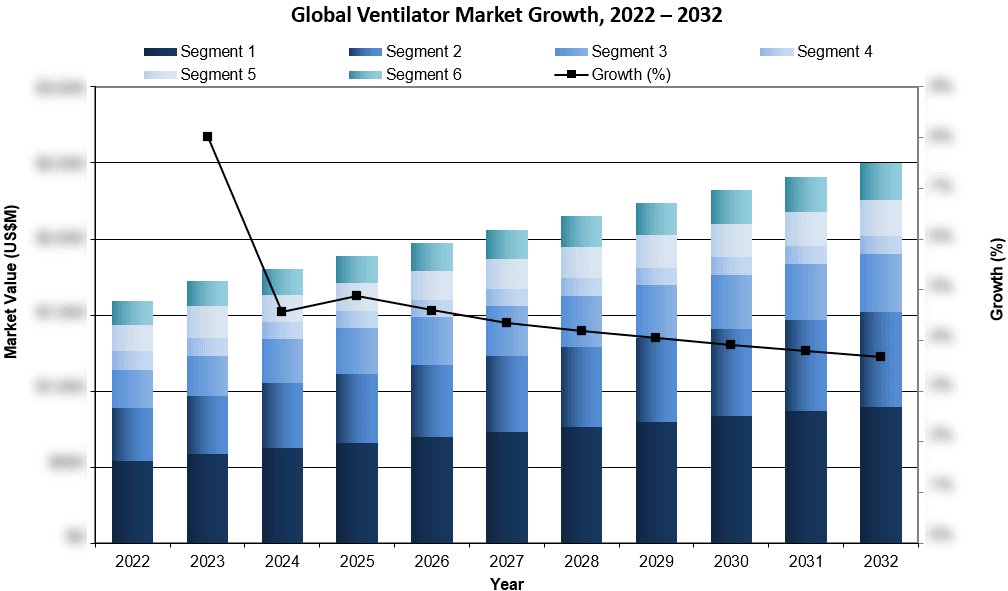
Acute care and sub-acute care ventilators represent the largest segments of the market due to their essential role in intensive care units and hospital respiratory management. These systems are widely used to support patients experiencing respiratory failure, severe infections, trauma and post-operative complications.
Global Ventilator Market Share Insights

- ResMed is a leading competitor in the global ventilator market, with a dominant position in the home care ventilator segment and a meaningful presence in non-invasive ventilation. The company’s portfolio includes a range of ventilator products, such as the AirCurve™, Astral™, Elisée™, Lumis™ and Stellar™ families, which are primarily designed to support long-term respiratory care in home and sub-acute settings. This strong positioning in home-based ventilation differentiates ResMed from competitors that are more focused on acute care or hospital-based ventilation. ResMed also maintains a presence in adjacent ventilator segments, including other ventilator categories, though its exposure to acute care and neonatal ventilation remains limited compared to hospital-focused players such as Dräger and Getinge. The company complements its ventilator offering with a broad portfolio of patient interfaces, humidifiers and ventilation accessories, supporting a more integrated respiratory care ecosystem. A key differentiator for ResMed is its emphasis on digital health and remote patient monitoring. Through its ResScan™ and AirView™ platforms, the company enables cloud-based data management and remote monitoring of ventilator usage and patient compliance. The expansion of AirView™ across Europe has further strengthened ResMed’s ability to support connected care models, aligning with broader industry trends toward homecare delivery and data-driven respiratory management.
- Hamilton held the second-leading position in the global market for ventilators; Hamilton Medical is a major global manufacturer of advanced mechanical ventilators and respiratory monitoring technologies. The company is particularly well known for its strong presence in intensive care ventilation and is widely recognized as one of the leading suppliers of high-end ICU ventilators worldwide. Hamilton Medical offers a comprehensive portfolio of ventilators designed for a range of clinical settings, including intensive care units, sub-acute care environments and emergency transport. Key products in its portfolio include the HAMILTON-C6, HAMILTON-G5 and HAMILTON-S1, which are advanced ICU ventilators capable of providing both invasive and non-invasive ventilation. These systems incorporate sophisticated monitoring tools and automated ventilation technologies that help clinicians optimize respiratory support for critically ill patients.
- ZOLL Medical has strengthened its position in the global ventilator market following its acquisition of select ventilator product lines from Vyaire Medical in October 2024. Through this transaction, ZOLL acquired several established ventilator platforms, including the bellavista™, fabian™, LTV™ and 3100 HFOV product lines, along with associated consumables, accessories, service parts and related service programs. These ventilators serve a wide range of clinical settings, including sub-acute care, neonatal intensive care and emergency transport environments. In addition to these active product platforms, ZOLL also obtained Vyaire’s remaining inventory of legacy ventilators such as AVEA™, ReVel™, SiPAP™ and VELA™. While these devices continue to be available in certain markets until existing inventory is depleted, they are no longer being actively manufactured. As a result of the acquisition, Vyaire now retains only a limited presence in the ventilator market. The integration of Vyaire’s ventilator portfolio significantly expands ZOLL’s presence across several key segments, particularly sub-acute care, neonatal ventilation and emergency transport ventilators, where Vyaire previously held a strong market position. By incorporating these established product lines into its respiratory care portfolio, ZOLL is expected to increase its global market share and strengthen its position among leading ventilator manufacturers. This shift in the competitive landscape has also occurred alongside the withdrawal of Philips from the ventilator market. Following the resolution of its Respironics recall and broader restructuring within its respiratory care business, Philips has largely exited the ventilator segment, creating opportunities for other manufacturers to capture market share. As a result, companies such as ZOLL have been able to expand their presence in the ventilator market by integrating existing technologies and product portfolios previously held by competitors. With the addition of Vyaire’s ventilator product lines and the changing competitive landscape, ZOLL is expected to play an increasingly important role in the global ventilator market, particularly in segments where Vyaire historically maintained strong adoption.
Global Ventilator Market Segmentation Summary
- Ventilator Market – Further Segmented Into:
- Device Type: Acute Care, Sub-Acute Care, Home Care, Neonatal, Non-Invasive, and Emergency Transport.
Research Scope Summary
| Report Attribute | Details |
|---|---|
| Regions | North America (Canada, United States) Latin America (Argentina, Bolivia, Brazil, Chile, Colombia, Costa Rica, Dominican Republic, Ecuador, Guatemala, Mexico, Panama, Paraguay, Peru, Puerto Rico, Uruguay, Venezuela) Western Europe (Austria, Benelux, France, Germany, Italy, Portugal, Scandinavia, Spain, Switzerland, United Kingdom) Central & Eastern Europe (Azerbaijan, Baltic States, Belarus, Bulgaria, Croatia, Czech Republic, Georgia, Greece, Hungary, Kazakhstan, Poland, Romania, Russia, Serbia, Slovakia, Slovenia, Turkey, Ukraine) Middle East (Bahrain, Iran, Israel, Kuwait, Oman, Qatar, Saudi Arabia, United Arab Emirates) Asia Pacific (Australia, Cambodia, China, Hong Kong, India, Indonesia, Japan, Kyrgyzstan, Macao, Malaysia, Mongolia, Myanmar, New Zealand, Pakistan, Philippines, Singapore, South Korea, Sri Lanka, Taiwan, Thailand, Uzbekistan, Vietnam) Africa (Algeria, Egypt, Ethiopia, Ghana, Kenya, Libya, Morocco, Nigeria, South Africa, Sudan, Uganda) |
| Base Year | 2025 |
| Forecast | 2026-2032 |
| Historical Data | 2022-2024 |
| Quantitative Coverage | Market Size, Market Shares, Market Forecasts, Market Growth Rates, Units Sold, and Average Selling Prices. |
| Qualitative Coverage | Market Growth Trends, Market Limiters, Competitive Analysis & SWOT for Top Competitors, Mergers & Acquisitions, Company Profiles, Product Portfolios, FDA Recalls, Disruptive Technologies, Disease Overviews. |
| Data Sources | Primary Interviews with Industry Leaders, Government Physician Data, Regulatory Data, Hospital Private Data, Import & Export Data, iData Research Internal Database. |
CONTACT US FOR ADDITIONAL INFORMATION
For full segmentation and any questions regarding research coverage, please contact us for a complimentary demo of the full report.