Product Description
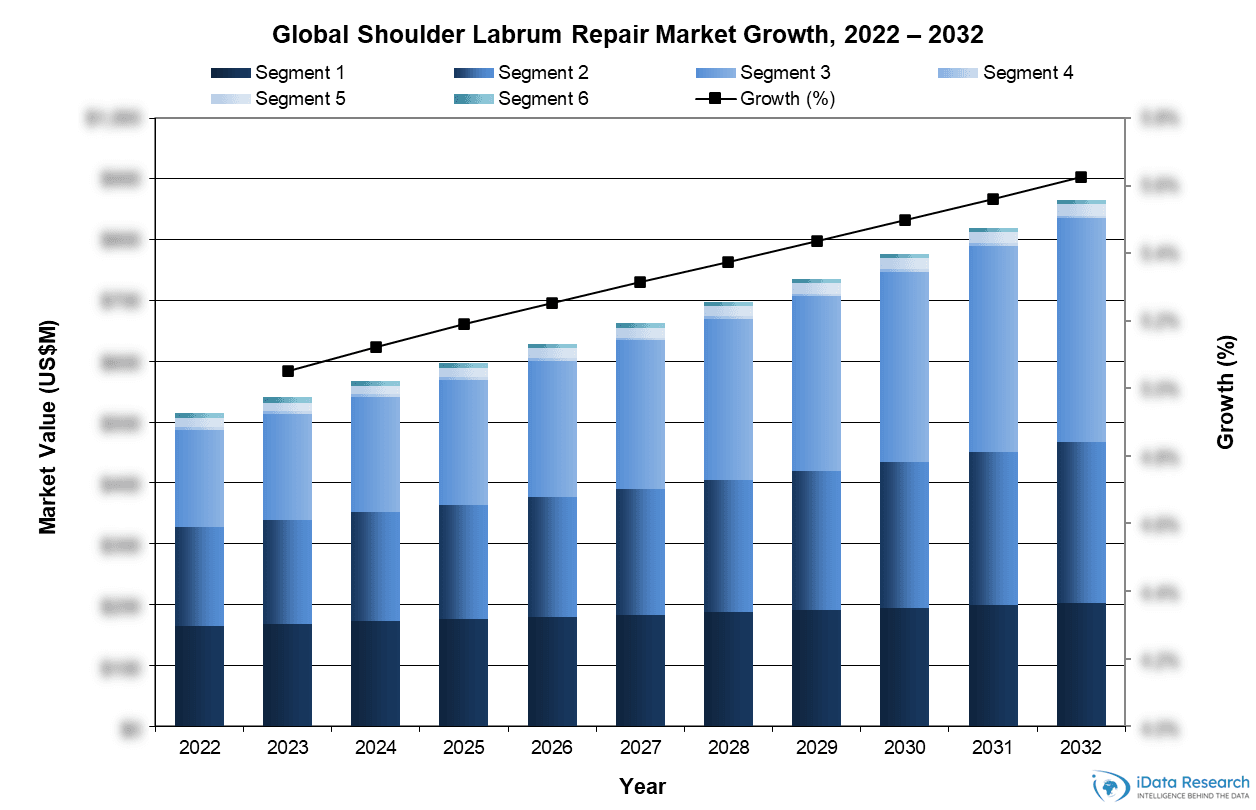
The global shoulder labrum repair market was valued at just under $600 million in 2025. This is expected to increase over the forecast period at a CAGR of 5.4% to reach almost $870 million by 2032.
The full report suite on the global market for shoulder labrum repair includes subsegments for resorbable and non-resorbable sutures (i.e., biocomposite, polyether ether ketone (PEEK), all-suture, polylactic acid (PLA), PEEK carbon fiber, metal).
The report includes data for 65 countries across 7 different regions which include North America, Latin America, Western Europe, Central & Eastern Europe, Middle East, Asia-Pacific, and Africa.
Data Types Included
- Unit Sales, Average Selling Prices, Market Size & Growth Trends
- Procedure Numbers
- Market Drivers & Limiters
- Market Forecasts Until 2032, and Historical Data to 2022
- Recent Mergers & Acquisitions
- Company Profiles and Product Portfolios
- Leading Competitors
Global Shoulder Labrum Repair Market Trends
In recent years, the clinical preference has shifted significantly from superior labrum anterior and posterior (SLAP) repair to biceps tenodesis (BT). While SLAP repair was traditionally the standard for younger, active patients, surgeons have increasingly opted for BT due to concerns over high reoperation rates and slower recovery timelines. Recent research indicates that BT often provides more predictable pain relief and higher patient satisfaction scores, as it directly addresses a primary source of shoulder pain.
Global Shoulder Labrum Repair Market Share Insights

- Arthrex remained the leader in the shoulder labrum repair market in 2025, holding over a third of the total market share. The company has secured its dominance by evolving its portfolio from traditional biocomposite suture anchors like the FASTak™ to advanced all-suture solutions. Current growth is largely supported by the Knotless 1.8 FiberTak®, which allows for precise tensioning without the need for manual knots. Arthrex® also continues to provide a comprehensive range of surgical tools, including the QuickPass™ and SutureLasso™ suture passers, which are essential for efficient labral repairs. For surgeons who prefer rigid fixation, the Labral SwiveLock® and PushLock™ systems remain standard options for maximizing stability and strength during arthroscopic procedures.
- DePuy Synthes continues to hold its position as the second-leading competitor in the shoulder labrum repair market as of early 2026. The company’s portfolio remains centered on the GRYPHON® anchor with PROKNOT™ technology, which provides a hybrid solution for instability by combining the strength of a knotted anchor with the efficiency of a knotless design. For all-suture applications, the VERSALOOP™ soft anchor serves as their primary offering. While the company still provides established biocomposite and traditional options like the BIOCRYL® RAPIDE®, LUPINE® and PANALOK® systems, much of the recent market focus has been on the potential separation of the orthopedics unit from Johnson & Johnson. Reports in February 2026 indicate that the parent company is exploring a possible sale of DePuy Synthes valued at over $20 billion, a strategic pivot that could reshape its future investment in sports medicine innovation.
- Smith & Nephew remained a top competitor in the shoulder labrum repair market in 2025. Its TWINFIX™ line is available in various materials and can be preloaded with the ULTRABRAID™ suture. In July 2025, it expanded its soft anchor portfolio with the Q-FIX® Knotless all-suture anchor, which is designed for high fixation strength and low displacement. The company also maintains a diverse range of options including the BIORAPTOR™, OSTEORAPTOR™, HEALICOIL™, SPEEDLOCK™ and the SUTUREFIX™ all-suture anchors.
Global Shoulder Labrum Repair Market Segmentation Summary
- Biocomposite Suture Anchor Market
- PEEK Suture Anchor Market
- All-Suture Anchor Market
- PLA Suture Anchor Market
- PEEK CF Suture Anchor Market
- Metal Suture Anchor Market
Research Scope Summary
| Report Attribute | Details |
|---|---|
| Regions | North America (Canada, United States) Latin America (Argentina, Bolivia, Brazil, Chile, Colombia, Costa Rica, Dominican Republic, Ecuador, Guatemala, Mexico, Panama, Paraguay, Peru, Puerto Rico, Uruguay, Venezuela) Western Europe (Austria, Benelux, France, Germany, Italy, Portugal, Scandinavia, Spain, Switzerland, United Kingdom) Central & Eastern Europe (Azerbaijan, Baltic States, Belarus, Bulgaria, Croatia, Czech Republic, Georgia, Greece, Hungary, Kazakhstan, Poland, Romania, Russia, Serbia, Slovakia, Slovenia, Turkey, Ukraine) Middle East (Bahrain, Iran, Israel, Kuwait, Oman, Qatar, Saudi Arabia, United Arab Emirates) Asia Pacific (Australia, Cambodia, China, Hong Kong, India, Indonesia, Japan, Kyrgyzstan, Macao, Malaysia, Mongolia, Myanmar, New Zealand, Pakistan, Philippines, Singapore, South Korea, Sri Lanka, Taiwan, Thailand, Uzbekistan, Vietnam) Africa (Algeria, Egypt, Ethiopia, Ghana, Kenya, Libya, Morocco, Nigeria, South Africa, Sudan, Uganda) |
| Base Year | 2025 |
| Forecast | 2026-2032 |
| Historical Data | 2022-2024 |
| Quantitative Coverage | Procedure Numbers, Market Size, Market Shares, Market Forecasts, Market Growth Rates, Units Sold, and Average Selling Prices. |
| Qualitative Coverage | Market Growth Trends, Market Limiters, Competitive Analysis & SWOT for Top Competitors, Mergers & Acquisitions, Company Profiles, Product Portfolios, FDA Recalls, Disruptive Technologies, Disease Overviews. |
| Data Sources | Primary Interviews with Industry Leaders, Government Physician Data, Regulatory Data, Hospital Private Data, Import & Export Data, iData Research Internal Database. |
CONTACT US FOR ADDITIONAL INFORMATION
For full segmentation and any questions regarding research coverage, please contact us for a complimentary demo of the full report.