Product Description
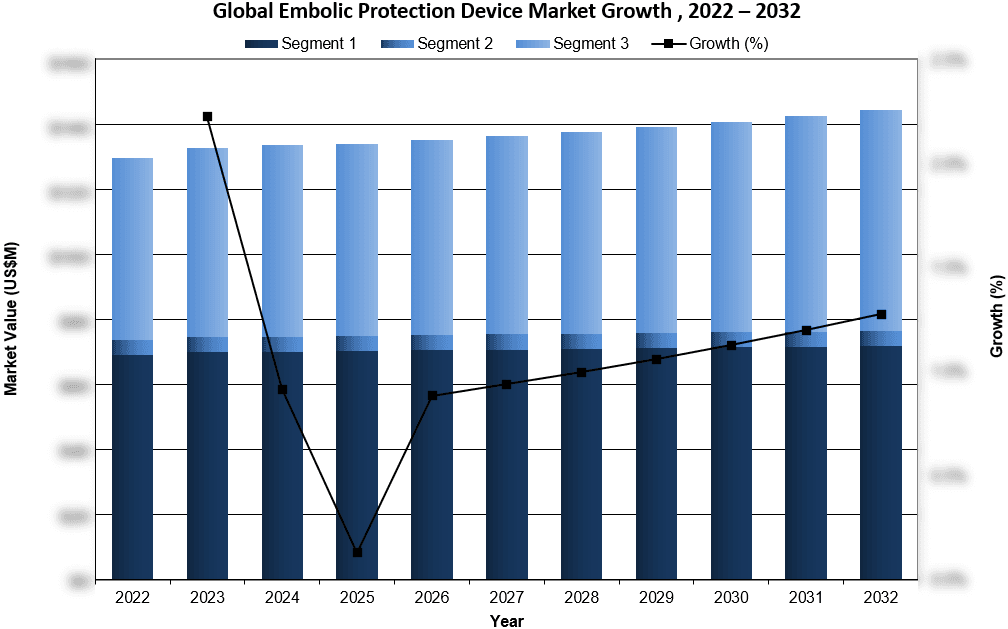
Overall, the global EPD market was valued at $134 million in 2025. This is expected to increase over the forecast period at a CAGR of 1.1% to reach $144 million by 2032.
The full report suite on the global market for embolic protection devices (EPDs) covers seven geographical regions: North America, Latin America, Western Europe, Central and Eastern Europe, the Middle East, Asia-Pacific and Africa. For each region, the report provides market valuation, unit analysis and ASP. Moreover, the report will extend its projections up to the year 2032, thereby providing a comprehensive and anticipatory understanding of the market trends and trajectories for the given period.
This report is part of a larger suite that covers the global market for complex peripheral vascular (PV) devices including PV stents, percutaneous transluminal angioplasty (PTA) balloon catheters, drug-coated balloons (DCBs), atherectomy devices, intravascular lithotripsy (IVL) systems, chronic total occlusion (CTO) devices, surgical grafts, stent grafts, embolic protection devices (EPDs), peripheral thrombus management and peripheral intravascular ultrasound (IVUS) catheters.
Data Types Included
- Unit Sales, Average Selling Prices, Market Size & Growth Trends
- Procedure Numbers
- Market Drivers & Limiters
- Market Forecasts Until 2032, and Historical Data to 2022
- Recent Mergers & Acquisitions
- Company Profiles and Product Portfolios
- Leading Competitors
Global Embolic Protection Device Market Trends
An emerging trend in the global EPD market is the integration of advanced imaging and navigation technologies. These innovations are enhancing the precision and effectiveness of embolic protection procedures by providing real-time visualization and guidance during interventions. With the incorporation of techniques like intravascular ultrasound (IVUS) and optical coherence tomography (OCT), physicians can accurately assess vessel anatomy, plaque composition and device positioning, leading to better decision-making and reduced complications. This trend is driving the development of next-generation EPDs that offer improved patient outcomes, reduced procedural risks and increased operator confidence in complex endovascular interventions.
Global Embolic Protection Device Market Share Insights

- Medtronic entered the U.S. EPD market with its acquisition of Covidien in January 2015, gaining access to the SpiderFX™ device acquired through ev3. The SpiderFX™ EPD, featuring a radiopaque band for placement assistance and a stable braided filter design, holds approvals for carotid, lower limb and saphenous vein grafting indications. Leading the alternative EPD market in 2025, Medtronic’s SpiderFX™ stands as the sole standalone EPD approved for lower-limb procedures.
- Abbott Vascular entered the EPD market in 2006 through the acquisition of Guidant’s EPD and carotid stent platforms, becoming the first to offer a carotid-approved EPD. Its strong market presence and physician familiarity have contributed to its enduring market position. In 2009, Abbott launched the Emboshield® NAV6 embolic protection system’s sixth generation, featuring the proprietary BareWire™ technology for independent wire movement, improved basket design and retrieval system. In 2011, Abbott expanded the indication of its RX Accunet® EPD.
- Boston Scientific‘s FilterWire EZ™ device is designed for carotid and saphenous vein graft (SVG) indications, offering embolic protection across various vessel sizes with a uniform micro-pore filter for continuous blood flow. The company acquired Claret Medical in 2018, adding the Sentinel™ cerebral protection system for transcatheter aortic valve replacement (TAVR) procedures to its portfolio. The device catches loose emboli during TAVR and has been bundled with Boston Scientific’s TAVR product line, enhancing its market position through device synergy.
Global Embolic Protection Device Market Segmentation Summary
- Embolic Protection Device Market – Further Segmented Into:
- Device Type: Carotid, Renal, and Lower Limb.
Research Scope Summary
| Report Attribute | Details |
|---|---|
| Regions | North America (Canada, United States) Latin America (Argentina, Bolivia, Brazil, Chile, Colombia, Costa Rica, Dominican Republic, Ecuador, Guatemala, Mexico, Panama, Paraguay, Peru, Puerto Rico, Uruguay, Venezuela) Western Europe (Austria, Benelux, France, Germany, Italy, Portugal, Scandinavia, Spain, Switzerland, United Kingdom) Central & Eastern Europe (Azerbaijan, Baltic States, Belarus, Bulgaria, Croatia, Czech Republic, Georgia, Greece, Hungary, Kazakhstan, Poland, Romania, Russia, Serbia, Slovakia, Slovenia, Turkey, Ukraine) Middle East (Bahrain, Iran, Israel, Kuwait, Oman, Qatar, Saudi Arabia, United Arab Emirates) Asia Pacific (Australia, Cambodia, China, Hong Kong, India, Indonesia, Japan, Kyrgyzstan, Macao, Malaysia, Mongolia, Myanmar, New Zealand, Pakistan, Philippines, Singapore, South Korea, Sri Lanka, Taiwan, Thailand, Uzbekistan, Vietnam) Africa (Algeria, Egypt, Ethiopia, Ghana, Kenya, Libya, Morocco, Nigeria, South Africa, Sudan, Uganda) |
| Base Year | 2025 |
| Forecast | 2026-2032 |
| Historical Data | 2022-2024 |
| Quantitative Coverage | Market Size, Market Shares, Market Forecasts, Market Growth Rates, Units Sold, and Average Selling Prices. |
| Qualitative Coverage | Market Growth Trends, Market Limiters, Competitive Analysis & SWOT for Top Competitors, Mergers & Acquisitions, Company Profiles, Product Portfolios, FDA Recalls, Disruptive Technologies, Disease Overviews. |
| Data Sources | Primary Interviews with Industry Leaders, Government Physician Data, Regulatory Data, Hospital Private Data, Import & Export Data, iData Research Internal Database. |
CONTACT US FOR ADDITIONAL INFORMATION
For full segmentation and any questions regarding research coverage, please contact us for a complimentary demo of the full report.