The global laparoscopic device market is growing, but expansion is becoming harder to capture. With a projected CAGR of 3.2%, the market is steady but mature, meaning competitors must fight for share rather than rely on rapid growth.
Competition is tightening across key segments like closure and energy devices, where a few players dominate.
This creates a landscape where strategy, not scale alone, determines success.
Find growth niches in minutes, not months.
Explore quick, actionable insights from the select markets.
Table of Contents
➜ Laparoscopic device market size growth and segment trends
➜ Stryker laparoscopic device portfolio expansion
➜ Karl Storz laparoscopic device market strategy
➜ Olympus laparoscopic visualization and AI strategy
➜ Ethicon laparoscopic technology strategy
➜ Medtronic laparoscopic device market position
➜ Frequently asked questions about laparoscopic device market leaders
➜ How to compete in the laparoscopic device market
➜ Summary and competitive outlook
Key Takeaways
- The market reached $12.6B in 2025 and is projected to hit $15.8B, signaling steady but moderate growth
- Closure devices dominate with 36% share, shaping competitive focus
- Medtronic and Ethicon lead through energy and stapling technologies
- Reusable vs disposable device strategies are creating clear positioning differences
- Digital platforms and AI are emerging as differentiators in visualization
Laparoscopic device market size growth and segment trends
The global laparoscopic device market was valued at over $12.6 billion in 2025 and is expected to reach nearly $15.8 billion. This signals steady demand but limited room for rapid expansion. In this environment, gaining share often means displacing competitors rather than entering new high-growth segments.
The closure device segment alone represents about 36% of total market value, making it the most critical area for competition.
Direct energy devices follow as the second-largest segment, reinforcing the importance of advanced surgical technologies.
Smaller segments each account for less than 10% of the market, with some contributing under 1%. This fragmentation limits the impact of niche innovation and pushes companies to focus on core revenue drivers.
As a result, success depends on defending leading positions in high-value categories while selectively expanding into adjacent technologies.
👉 For complete forecasts, procedure volumes, and competitor shares by segment, see the Global Laparoscopy Device Market Report.
#5: Stryker laparoscopic device portfolio expansion

Stryker has built a competitive position through targeted strength in select segments.
The company leads in suction-irrigation devices and maintains a presence in laparoscopes, hand instruments and insufflation systems. This diversified approach allows Stryker to stay relevant across multiple procedure types without dominating a single category.
Its broader growth strategy focuses on expanding within the hospital ecosystem. The acquisition of Inari Medical in 2025 reflects a move toward high-acuity procedural care, even outside traditional laparoscopy.
Quick summary: Stryker maintains relevance across laparoscopic care through targeted strengths in select device segments, but its broader hospital‑focused growth strategy means it is less dominant in core laparoscopy than top competitors.
#4: Karl Storz laparoscopic device market strategy

Karl Storz built its position in the laparoscopic device market through a strong focus on reusable instruments. The company holds over one-fourth of the hand instrument segment, supported by durable products designed for long-term use. This approach appeals to hospitals aiming to manage costs over time, especially in regions where reusability remains a priority.
Karl Storz also maintains a presence in energy devices with reusable options like its RoBi® instruments. However, this strategy contrasts with the broader industry shift toward disposable devices, which offer convenience and reduced sterilization requirements.
As purchasing preferences evolve, this positioning may limit growth in segments driven by single-use adoption.
Quick summary: Karl Storz maintains a strong position through its focus on reusable laparoscopic instruments, but this strategy may limit future growth as the market increasingly shifts toward disposable, single‑use devices.

#3: Olympus laparoscopic visualization and AI strategy

Olympus holds a leading position in the video laparoscope segment and competes across several device categories. Its strength lies in visualization, where high-quality imaging systems play a central role in minimally invasive surgery. This foundation has helped Olympus maintain a strong and consistent market presence.
The company has expanded into AI-enabled platforms such as CADDIE™ and the OLYSENSE™ ecosystem. These technologies support image analysis, workflow efficiency and clinical decision-making. While Olympus has not focused on robotic-assisted surgery, its investment in digital tools reinforces its role in data-driven surgical environments.
Quick summary: Olympus leads in visualization and strengthens its role in minimally invasive surgery through advanced imaging and AI‑enabled platforms, even as it remains less focused on robotic-assisted approaches than some competitors.
#2: Ethicon laparoscopic technology strategy
Ethicon ranked as the second-leading competitor, closely competing with Medtronic in both energy and closure devices. The company is known for premium-priced products, reflecting strong brand trust and consistent performance in clinical settings. This positioning allows Ethicon to maintain margins while targeting high-value procedures.
The company is also investing in future growth through its OTTAVA™ robotic-assisted surgery platform. Although not commercially available in 2025, it highlights a long-term strategy focused on integrated surgical systems. However, delayed commercialization may limit near-term impact as competitors continue advancing in adjacent technologies.
Quick summary: Ethicon remains a top competitor with strong positions in energy and closure devices, but its long‑term strategy around the OTTAVA™ robotic platform has limited near‑term impact due to delayed commercialization.
#1: Medtronic laparoscopic device market position

Medtronic was the leading competitor in 2025, supported by a broad and well-established portfolio. The company leads the direct energy segment through its LigaSure™ vessel sealing system, a widely adopted platform in minimally invasive surgery. It also holds a strong position in closure devices with its Endo GIA™ stapling line, benefiting from decades of clinical use and continuous improvement.
Its Tri-Staple™ technology enhances tissue interaction and staple line integrity, helping maintain consistent outcomes across procedures. Medtronic also competes in access devices with its SILS™ platform, expanding its presence across the surgical workflow. This breadth allows the company to remain competitive across multiple segments, though differentiation in emerging digital areas remains more limited.
Quick summary: Medtronic leads the market with a broad, well‑established portfolio spanning energy, closure, and access devices, though its strength in traditional platforms is offset by more limited differentiation in emerging digital technologies.
Frequently asked questions about laparoscopic device market leaders
Who are the top competitors in the global laparoscopic device market?
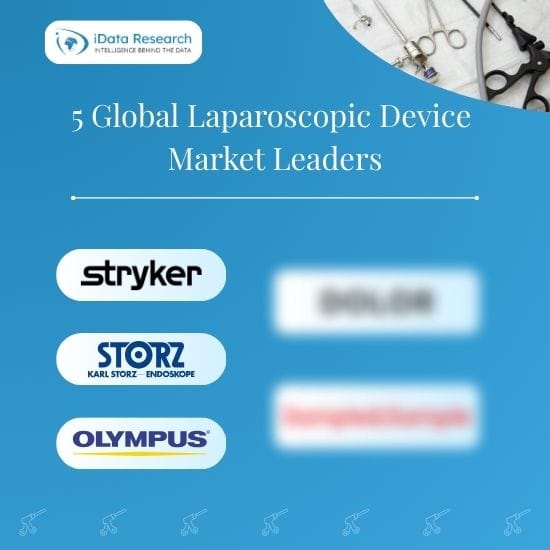
The top competitors in the global laparoscopic device market are Medtronic, Ethicon, Karl Storz, Olympus and Stryker.
Medtronic and Ethicon lead in high-value segments such as closure and energy devices, while Karl Storz and Olympus specialize in instruments and visualization.
Stryker competes across multiple categories with a diversified portfolio.
What is driving growth in the laparoscopic device market?
Growth in the laparoscopic device market is driven by increasing demand for minimally invasive procedures.
These procedures offer shorter recovery times, less pain and reduced hospital stays compared to open surgery.
However, the market is growing at a moderate pace, meaning competition for market share is increasing.
Which segment dominates the laparoscopic device market?
Closure devices dominate the laparoscopic device market, accounting for about 36% of total market value.
This makes the segment a key focus area for leading competitors like Medtronic and Ethicon.
Energy devices are the second-largest segment, also attracting strong competition.
How are companies differentiating in the laparoscopic device market?
Companies are differentiating through technology, pricing and product strategy.
Some focus on premium devices and advanced energy platforms, while others emphasize reusable instruments or cost efficiency.
Increasingly, companies are also investing in AI, visualization and workflow tools to stand out.
What are the biggest challenges in the laparoscopic device market?
The biggest challenges include slow market growth, high competition in core segments and pricing pressure from hospitals.
Since a large portion of the market is concentrated in a few categories, gaining share often requires displacing established competitors.
Companies must balance innovation with cost efficiency to remain competitive.
What opportunities exist in the laparoscopic device market?
Opportunities exist in high-value segments like energy devices and in emerging areas such as AI-enabled visualization and workflow optimization.
Companies can also expand by offering integrated solutions across the surgical workflow.
Aligning products with hospital cost and efficiency needs is another key growth area.
How to compete in the laparoscopic device market
To compete effectively, companies must focus on high-value segments such as closure and energy devices, where most revenue is concentrated.
These areas require continuous innovation and strong clinical validation to maintain or gain share. At the same time, opportunities exist in adjacent technologies like AI, visualization and workflow optimization tools.
Manufacturers should also align product strategies with hospital priorities, balancing cost efficiency with performance.
Reusable and disposable device strategies should reflect regional demand and purchasing behavior.
Expanding across the surgical workflow can help strengthen customer relationships and create more stable revenue streams in a competitive market.
Summary and competitive outlook
The global laparoscopic device market is controlled by a small group of dominant players, with Medtronic and Ethicon leading the most valuable segments.
At the same time, companies like Karl Storz, Olympus and Stryker compete through specialization and strategic expansion.
Growth remains steady, but capturing share requires targeted execution and clear differentiation.
As competition intensifies, success will depend on focusing on high-impact segments, investing in innovation and adapting to evolving hospital needs.
Companies that align their strategies with these trends will be better positioned to compete in a mature but opportunity-driven market.
Turn market painpoints into opportunities
Explore how procedure trends and competitor positioning create clear openings for industry experts in the market.
Related News
If you enjoyed this post, explore these related insights next:
(POPULAR) Medical Market Research: Complete Guide to Methods, Companies, and Market Applications
Healthcare Market Research Explained: Why It Matters More Than Ever
How Healthcare Market Research Helps MedTech Companies Grow Revenue


