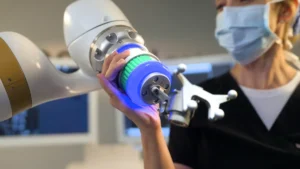
The Enovis eCential Robotics deal puts one of spine surgery’s most experienced robot developers inside Enovis, a company whose first robot launches will target the knee and shoulder.
Enovis signed a binding offer on August 31, 2026 to acquire eCential Robotics at an enterprise value of about €155 million, and the deal is expected to close by the end of 2026.
For spine surgeons, the near-term message is continuity, because eCential says it will keep supporting its existing spine implant partners.
The competitive picture stays anchored by the U.S. leaders in robotic-assisted spine surgery, which iData Research ranks as Globus Medical, Medtronic, and Zimmer Biomet.
Find growth niches in minutes, not months.
Explore quick, actionable insights from the select markets.
Table of Contents
➜ What does the Enovis eCential Robotics deal mean for spine surgery?
➜ What is eCential Robotics and what spine robots has it built?
➜ Why is Enovis buying eCential Robotics?
➜ What happens to VELYS Spine and Spineart after the deal?
➜ Who leads spine robotics and navigation in the U.S.?
➜ How big is the U.S. spine and surgical robotics market?
Key Takeaways
- The Enovis eCential Robotics deal carries an upfront enterprise value of about €155 million, plus up to €35 million in milestone payments.
- eCential developed the robot behind Johnson & Johnson’s VELYS Spine and its own Op.n spine platform, which the FDA cleared in July 2026.
- Enovis plans to launch a knee robot in late 2028 and a shoulder robot in 2029, while eCential’s spine partnerships continue.
- iData Research ranks Globus Medical, Medtronic, and Zimmer Biomet as the top three U.S. robotic-assisted spine surgery system companies in 2025.
- The U.S. surgical navigation and robotics market was valued at nearly $8.2 billion in 2025 and is forecast to reach just over $20.1 billion by 2032.
What does the Enovis eCential Robotics deal mean for spine surgery?
The Enovis eCential Robotics deal means a proven spine robotics platform now has a well-funded orthopedic owner.
eCential’s technology is already cleared for spine in the U.S., and its partners use it to place pedicle screws in fusion procedures.
Enovis plans to use that same engineering base to build its own robots for joint replacement.
iData Research classifies the offer as a spine robotics event in its U.S. surgical navigation and robotics market report.
eCential’s open platform keeps serving its spine implant partners, while Enovis builds a broader robotics roadmap on top of it.
What is eCential Robotics and what spine robots has it built?
eCential Robotics is headquartered in Gières, France, with U.S. commercial operations in Franklin, Tennessee.
The company brings more than 15 years of work in computer-assisted surgery and orthopedic robotics.
Its Op.n platform combines surgical navigation and active robotics in a single system.
eCential developed the spine robot behind Johnson & Johnson’s VELYS Spine system.
On July 22, 2026, the FDA cleared the Op.n Spine Navigation and Robotic Guidance system for posterior screw placement in the thoracolumbar and sacral spine.
The cleared system includes a robotic arm with seven degrees of freedom and works with 3D imaging systems from Ziehm, GE, Medtronic, Siemens, and eCential itself.
Its software configuration runs Spineart’s Perla application, and the clearance includes a change control plan for adding new third-party implant partners.
Why is Enovis buying eCential Robotics?
Enovis is buying eCential Robotics to add robotic automation to its ASTRA enabling technology platform.
ASTRA currently includes an augmented reality headset and procedure planning software.
Enovis aims to launch a knee robot in late 2028 and a shoulder robot in 2029, according to MedTech Dive.
Analysts at BTIG called the deal a fix for Enovis’s “most notable competitive gap.”
eCential has roughly 50 employees in France and can build 75 to 100 robots a year.
Under the terms in Enovis’s SEC filing, about €176 million in cash goes to eCential shareholders at closing, with up to €35 million more tied to milestones.
The companies signed the definitive purchase agreement on September 28, 2026, after the required French works council consultation.
Enovis also plans to create a robotics center of excellence in Grenoble, France.

What happens to VELYS Spine and Spineart after the deal?
eCential says the combined company will continue to support its existing partnerships after the Enovis eCential Robotics deal closes.
That commitment covers spine implant partners using the newly cleared Op.n Spine platform.
Spineart is a partner of eCential, and its Perla software and navigated instruments are part of the July 2026 FDA clearance.
VELYS Spine is a Johnson & Johnson product that DePuy Synthes developed in collaboration with eCential.
Johnson & Johnson also announced in October 2025 its plan to spin off DePuy Synthes as an independent orthopedic company, according to iData Research.
Enovis’s own spine footprint sits in electrical stimulation, where iData Research ranks it third in the U.S. behind Orthofix and Highridge Medical.
That gives Enovis an existing presence in the U.S. spine market even as its robot roadmap starts with joints.
Who leads spine robotics and navigation in the U.S.?
Globus Medical led the U.S. robotic-assisted spine surgery system market in 2025, followed by Medtronic and Zimmer Biomet, according to iData Research.
Medtronic led U.S. spinal surgical navigation, followed by Stryker and Orthofix-SeaSpine.
Globus Medical’s ExcelsiusGPS platform drives implant use among its growing base of robot-enabled spine surgeons.
Medtronic received FDA clearance in February 2026 for Stealth AXiS, an integrated planning, navigation, and robotics platform for spine.
In August 2026, VB Spine acquired exclusive rights to Augmedics’ CT-to-fluoroscopy technology for its xvision platform.
Stryker sold its U.S. spinal implant business to VB Spine in April 2025 but kept its enabling technologies business.
For a wider view of the robotics race, see our breakdown of Medtronic’s Hugo, da Vinci SP, and the new robotic surgery race.
How big is the U.S. spine and surgical robotics market?
The U.S. surgical navigation and robotics market was valued at nearly $8.2 billion in 2025, according to iData Research.
iData forecasts a 13.8% CAGR, taking the market to just over $20.1 billion by 2032.
The U.S. spinal implant and VCF market was valued at nearly $6.4 billion in 2025 and is expected to reach $7.3 billion at a 1.9% CAGR.
iData identifies the integration of navigation, robotics, imaging, and software into one connected ecosystem as a leading trend in this market.
That trend fits the Enovis eCential Robotics strategy of pairing a robot with planning software and augmented reality.
The clinical case for robots also keeps building, with a 2025 meta-analysis of 18 studies and 1,566 patients finding advantages for robot-assisted screw placement in accuracy, complications, and revision rates.
AI is the other major theme, which we cover in AI surgical planning in 2026 and robotic vs laparoscopic surgery adoption.
FAQ
How much is the Enovis eCential Robotics deal worth?
Enovis agreed to pay an upfront enterprise value of about €155 million, which equals roughly €176 million in cash to shareholders at closing.
Up to €35 million more is payable if certain milestones are met.
Has the Enovis eCential Robotics acquisition closed?
The definitive agreement was signed on September 28, 2026, and closing is expected by the end of 2026, subject to regulatory approvals.
Did eCential Robotics make VELYS Spine?
Yes, eCential Robotics developed the VELYS Spine robot in collaboration with DePuy Synthes, the orthopedics company of Johnson & Johnson.
Will Enovis launch a spine robot?
Enovis’s announced launch plan covers a knee robot in late 2028 and a shoulder robot in 2029.
eCential’s FDA-cleared Op.n Spine platform continues to serve spine implant partners such as Spineart.
Who is the top spine robotics company in the U.S.?
Globus Medical led the U.S. robotic-assisted spine surgery system market in 2025, according to iData Research.
Turn market painpoints into opportunities
Explore how procedure trends and competitor positioning create clear openings for industry experts in the market.


