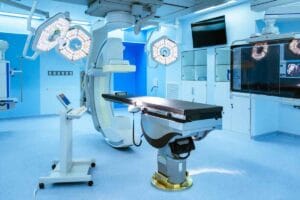
Hybrid operating room technology is redefining how complex cardiovascular, neurosurgical, and orthopedic procedures are performed. According to iData Research, the global video and integrated operating room equipment market was valued at over $10.7 billion in 2025 and is expected to grow at a CAGR of 6.6% to reach approximately $16.8 billion by 2032. This guide breaks down the five technologies driving that growth.
Find growth niches in minutes, not months.
Explore quick, actionable insights from the select markets.
Key Takeaways
- The five key hybrid operating room technologies in 2026 are advanced imaging systems, robotic navigation, integrated digital infrastructure, patient monitoring equipment, and workflow optimization tools.
- Getinge, STERIS, and KARL STORZ lead the global hybrid operating room market, while Siemens, Philips, and GE Healthcare lead hybrid OR imaging systems, per iData Research 2025 rankings.
- The number of integrated and hybrid OR units worldwide is projected to grow from 10,200 in 2025 to 17,500 by 2032.
- Recent moves, including Philips’ agreement to acquire SpectraWAVE and Canon Medical’s FDA clearance for a hybrid angio-CT platform, signal accelerating investment in the space.
Table of Contents
➜ What are the key hybrid operating room technologies in 2026
➜ Why advanced imaging systems power the hybrid operating room
➜ How robotic navigation improves precision in hybrid ORs
➜ What integrated digital infrastructure does in a hybrid OR
➜ Why patient monitoring matters in hybrid operating rooms
➜ How workflow optimization tools boost hybrid OR efficiency
➜ How big is the hybrid operating room market
➜ Frequently asked questions about hybrid operating rooms
What are the key hybrid operating room technologies in 2026
The five key hybrid operating room technologies in 2026 are advanced imaging systems, robotic navigation, integrated digital infrastructure, patient monitoring equipment, and workflow optimization tools.
Together, these systems let surgical teams image, navigate, monitor, and coordinate complex procedures inside a single suite.
Peer-reviewed evidence supports a reduction in perioperative risk and improved patient safety outcomes when procedures are consolidated in a hybrid OR, according to a 2024 review in the Journal of International Medical Research.
Why advanced imaging systems power the hybrid operating room
Advanced imaging is the foundation of hybrid operating room functionality.
These systems integrate fixed C-arm fluoroscopy, cone-beam computed tomography (CBCT), and three-dimensional angiography directly into the surgical suite, so patients no longer move between diagnostic and procedural areas.
Real-time feedback lets teams adjust instrument positioning, confirm implant placement, and assess vascular access without interrupting workflow.
According to iData Research, Siemens, Philips, and GE Healthcare lead the global hybrid OR imaging system market in 2025.
The segment is moving fast.
In November 2025, Canon Medical received FDA clearance for its integrated Alphenix 4D CT and Aquilion ONE / Insight Edition system, a hybrid interventional angio-CT platform.
In December 2025, Philips agreed to acquire SpectraWAVE, adding intravascular imaging and AI-enabled physiological assessment tools expected to integrate with its Azurion image-guided therapy platform.
How robotic navigation improves precision in hybrid ORs
Robotic navigation platforms combine optical tracking, electromagnetic navigation, and machine vision to guide instrument trajectories with submillimeter accuracy.
They continuously calculate instrument position against preoperative imaging and alert teams to trajectory errors before they occur.
The result is smaller incisions, less tissue trauma, and access to anatomical targets once considered too complex for minimally invasive approaches.
Key platforms include Medtronic’s Mazor X Stealth Edition for spinal procedures, Stryker’s Mako for joint replacement, and Zimmer Biomet’s Rosa Knee for total knee arthroplasty.
These systems are gaining traction in ambulatory surgery centers and specialty orthopedic hospitals, where efficiency and consistent outcomes drive reimbursement.
For a closer look at the companies behind these platforms, see our ranking of the top robotic surgery companies in the United States.

What integrated digital infrastructure does in a hybrid OR
Integrated digital infrastructure is the central nervous system of the hybrid operating room.
It connects imaging equipment, surgical devices, patient monitoring, and electronic health records through unified networks that share information in real time.
Video feeds, vital signs, device telemetry, and documentation are aggregated into single-screen displays accessible from wall-mounted monitors or tablets.
Leading integration platforms include KARL STORZ’s OR1 Fusion, Stryker’s iSuite, and Brainlab’s Digital O.R.
AI is the next layer.
In November 2025, KARL STORZ announced it is developing an AI-powered platform under the SurgicalAIHubGermany project to objectively analyze surgical performance using endoscopic video data.
The same month, GE HealthCare agreed to acquire Intelerad, expanding its enterprise imaging and PACS software capabilities across diagnostic and interventional care settings.
Why patient monitoring matters in hybrid operating rooms
Hybrid OR procedures often involve patients with significant cardiovascular comorbidities undergoing high-risk interventions such as transcatheter aortic valve replacement (TAVR) and endovascular aneurysm repair.
Rapid hemodynamic shifts can occur without warning, and standard vital signs monitoring may miss early signs of cardiac compromise or inadequate organ perfusion.
Advanced monitoring platforms integrate arterial pressure waveform analysis, transesophageal echocardiography, and cerebral oximetry to deliver beat-to-beat assessment of cardiac output and tissue perfusion.
Systems like Edwards Lifesciences’ FloTrac sensor and Masimo’s Radical-7 platform use minimally invasive techniques that avoid the risks of traditional pulmonary artery catheterization.
This makes continuous hemodynamic monitoring feasible for a broader range of surgical patients.
How workflow optimization tools boost hybrid OR efficiency
Workflow optimization tools use artificial intelligence, predictive analytics, and automated scheduling to reduce non-operative time and standardize procedural steps.
These platforms analyze historical case data to predict procedure duration, flag supply bottlenecks, and recommend room configurations based on surgeon preference cards.
Key technologies include automated instrument tracking, digital surgical checklists, and room turnover management software that coordinates environmental services and patient transport.
For hybrid operating rooms, where equipment complexity and multidisciplinary coordination add workflow challenges, these tools help ensure high-cost imaging and robotic systems maintain maximum utilization.
iData Research identifies OR efficiency, OR integration, and digitalization as key positive drivers across the hybrid OR and integrated OR equipment segments.
How big is the hybrid operating room market
According to iData Research, the global video and integrated operating room equipment market was valued at over $10.7 billion in 2025.
It is expected to grow at a CAGR of 6.6% to reach approximately $16.8 billion by 2032.
The number of integrated and hybrid OR units worldwide is projected to rise from 10,200 in 2025 to 17,500 by 2032.
Growth is driven by the increasing volume of complex, image-guided procedures and the adoption of surgical robotics, which require a highly coordinated and digitally connected operating environment.
North America represents the largest and fastest-growing region, followed by Western Europe and Asia-Pacific.
Getinge, STERIS, and KARL STORZ lead the global hybrid operating room market in 2025.
Full market sizing, forecasts, and competitive shares are available in the iData Research Global Video and Integrated Operating Room Equipment Market Report.
Frequently asked questions about hybrid operating rooms
What is a hybrid operating room?
A hybrid operating room is a surgical suite that combines advanced fixed imaging systems, such as angiography and CT, with a fully equipped operating environment, allowing diagnostic imaging and open or minimally invasive surgery to happen in one place.
What imaging is used in a hybrid operating room?
Hybrid ORs typically use fixed C-arm fluoroscopy, cone-beam CT, three-dimensional angiography, and in some configurations intraoperative MRI or angio-CT platforms.
Which companies lead the hybrid operating room market?
According to iData Research, Getinge, STERIS, and KARL STORZ lead the global hybrid operating room market in 2025, while Siemens, Philips, and GE Healthcare lead the hybrid OR imaging system segment.
How many hybrid and integrated operating rooms are there?
iData Research estimates 10,200 integrated and hybrid OR units globally in 2025, projected to reach 17,500 by 2032.
For complete unit, pricing, and competitive data across all 14 segments, explore the Global Video and Integrated Operating Room Equipment Market Report from iData Research.
Turn market painpoints into opportunities
Explore how procedure trends and competitor positioning create clear openings for industry experts in the market.


