
Product Description
The global tip placement system market was valued at $42.6 million in 2025. This is expected to increase over the forecast period at a CAGR of 4.9% to reach $59 million by 2032.
The full report suite on the global market for tip placement systems includes essential equipment used during tip-guidance procedures.
The report includes data for 65 countries across 7 different regions which include North America, Latin America, Western Europe, Central & Eastern Europe, Middle East, Asia-Pacific, and Africa.
Data Types Included
- Unit Sales, Average Selling Prices, Market Size & Growth Trends
- Market Drivers & Limiters
- Market Forecasts Until 2032, and Historical Data to 2022
- Recent Mergers & Acquisitions
- Company Profiles and Product Portfolios
- Leading Competitors
Global Tip Placement System Market Trends
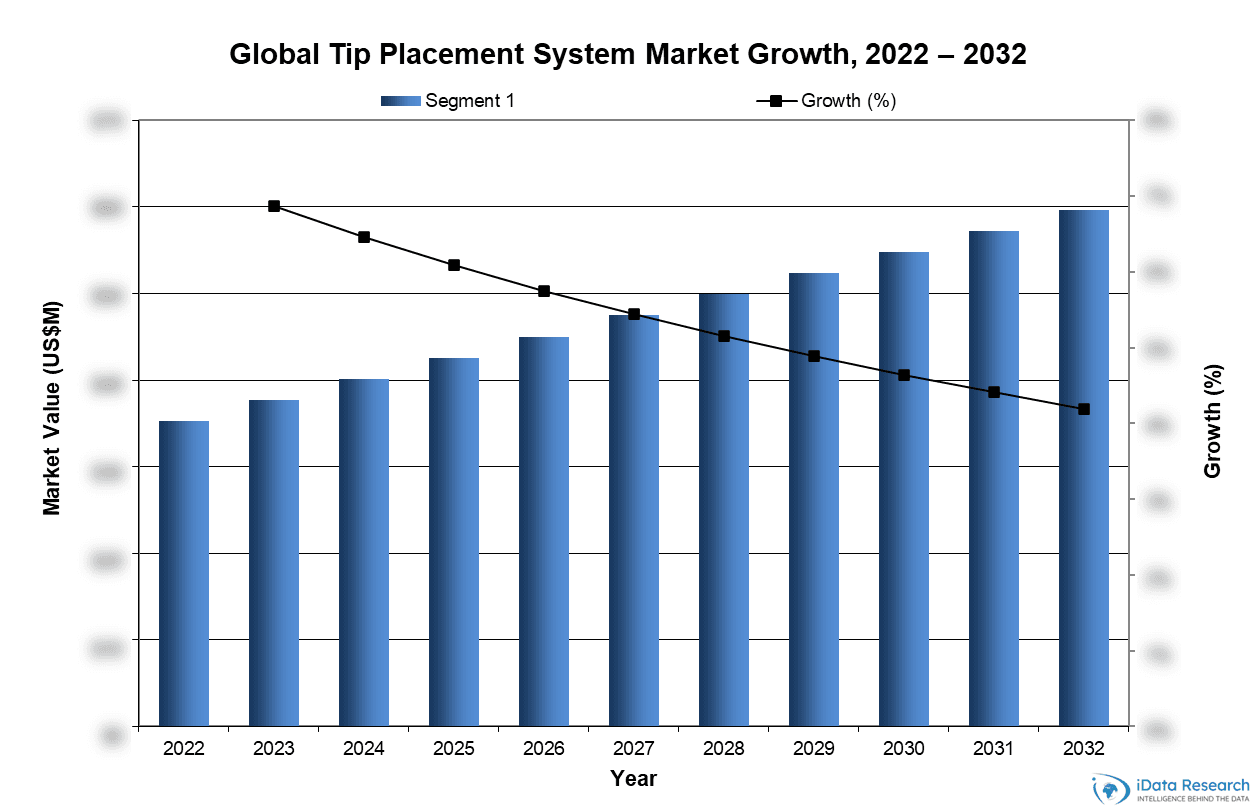
Growing clinical acceptance and workflow advantages are driving broader use of tip-placement for PICC insertion. Tip-placement systems significantly improve accuracy in achieving optimal catheter tip position compared with blind placement, reducing procedure time and increasing clinician confidence. In addition, these systems offer a cost-effective alternative to radiographic confirmation, supporting faster line placement and reducing reliance on imaging resources. As vascular access teams increasingly incorporate tip-placement into standard practice, procedure volumes using these systems are expected to rise, supporting ongoing demand for both capital equipment and disposable components.
Global Tip Placement System Market Share Insights

- Becton Dickinson (BD) maintained its leading position in the realm of tip placement systems market in 2025. It offered the Sherlock 3CG™ Tip Confirmation System and Sherlock® II Tip Location System, often bundled with power-injectable PICCs preloaded with Sherlock® stylets. BD’s leadership in the PICC market allowed the company to leverage sales of tip placement devices. While concerns arose over the hypersensitivity of the Sherlock® II, requiring controlled electromagnetic environments and careful proximity to implantable devices, its real-time data benefit during catheter advancement was appreciated. The recent Sherlock 3CG® tip confirmation system combined Sapiens® TCS and Sherlock® II TLS technologies, saving costs and time by eliminating X-ray confirmation. BD’s tip-placement technology was exclusive to its proprietary PICCs. BD stood as the sole major contender in the integrated tip placement system market, integrating Site~Rite ultrasound systems with the Sherlock 3CG system, enhancing clinician convenience.
- Teleflex held the second spot in the tip placement system market with the ARROW® VPS G4™ system and ARROW VPS® Stylets, allowing tip-placement confirmation for PICCs and central venous catheters (CVCs). The company’s acquisition of Nostix, LLC aimed to expand its presence in tip-confirmation technology for various catheters and ports. Teleflex’s ARROW® VPS Rhythm™ tip-confirmation system targeted catheter placement in the SVC, enhancing its global portfolio. Unlike BD, Teleflex offered disposable tip placement products independently from PICC kits, providing flexibility for hospitals.
Global Tip Placement System Market Segmentation Summary
- Tip Placement System Market
Research Scope Summary
| Report Attribute | Details |
|---|---|
| Regions | North America (Canada, United States) Latin America (Argentina, Bolivia, Brazil, Chile, Colombia, Costa Rica, Dominican Republic, Ecuador, Guatemala, Mexico, Panama, Paraguay, Peru, Puerto Rico, Uruguay, Venezuela) Western Europe (Austria, Benelux, France, Germany, Italy, Portugal, Scandinavia, Spain, Switzerland, United Kingdom) Central & Eastern Europe (Azerbaijan, Baltic States, Belarus, Bulgaria, Croatia, Czech Republic, Georgia, Greece, Hungary, Kazakhstan, Poland, Romania, Russia, Serbia, Slovakia, Slovenia, Turkey, Ukraine) Middle East (Bahrain, Iran, Israel, Kuwait, Oman, Qatar, Saudi Arabia, United Arab Emirates) Asia Pacific (Australia, Cambodia, China, Hong Kong, India, Indonesia, Japan, Kyrgyzstan, Macao, Malaysia, Mongolia, Myanmar, New Zealand, Pakistan, Philippines, Singapore, South Korea, Sri Lanka, Taiwan, Thailand, Uzbekistan, Vietnam) Africa (Algeria, Egypt, Ethiopia, Ghana, Kenya, Libya, Morocco, Nigeria, South Africa, Sudan, Uganda) |
| Base Year | 2025 |
| Forecast | 2026-2032 |
| Historical Data | 2022-2024 |
| Quantitative Coverage | Market Size, Market Shares, Market Forecasts, Market Growth Rates, Units Sold, and Average Selling Prices. |
| Qualitative Coverage | Market Growth Trends, Market Limiters, Competitive Analysis & SWOT for Top Competitors, Mergers & Acquisitions, Company Profiles, Product Portfolios, FDA Recalls, Disruptive Technologies, Disease Overviews. |
| Data Sources | Primary Interviews with Industry Leaders, Government Physician Data, Regulatory Data, Hospital Private Data, Import & Export Data, iData Research Internal Database. |
CONTACT US FOR ADDITIONAL INFORMATION
For full segmentation and any questions regarding research coverage, please contact us for a complimentary demo of the full report.