Product Description
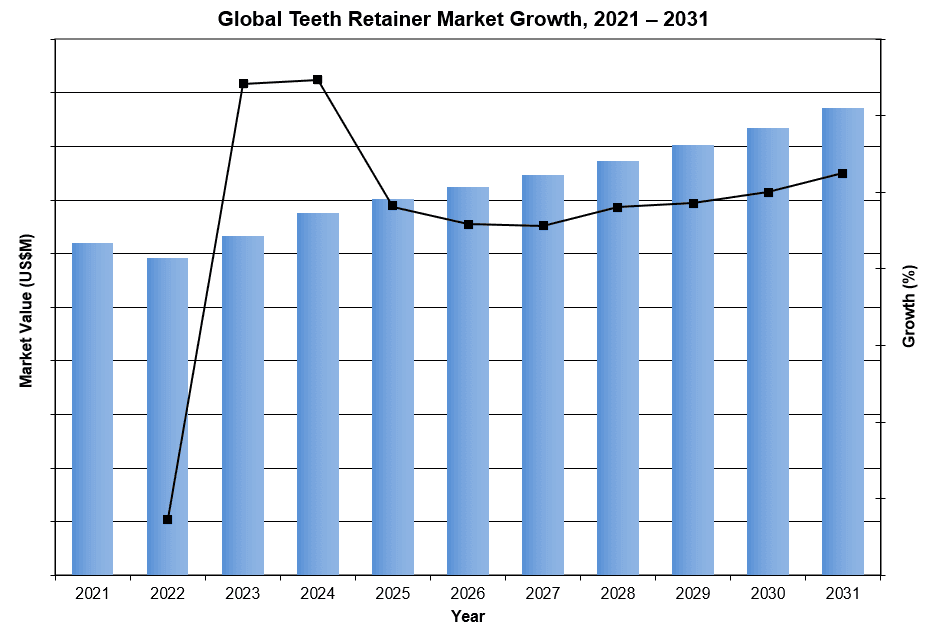
The global teeth retainer market was valued at nearly $3.4 billion in 2024. This is expected to increase over the forecast period at a CAGR of 3.7% to reach nearly $4.4 billion.
The full report suite covers the global market for teeth retainers and includes complete market analyses (units, ASPs and market values).
MARKET REPORT DATA TYPES INCLUDED
- Unit Sales, Average Selling Prices, Market Size & Growth Trends
- Market Drivers & Limiters
- Market Forecasts Until 2031, and Historical Data to 2021
GLOBAL TEETH RETAINER MARKET INSIGHTS

As the unit volume of clear aligners and traditional braces increases, the demand for teeth retainers is also expected to rise. Retainers are typically worn for a period ranging from four months to over a year after malocclusion treatment, depending on the orthodontist’s or dentist’s recommendation, to ensure that the teeth remain securely in their corrected positions.
MARKET SEGMENTATION SUMMARY
RESEARCH SCOPE SUMMARY
| Report Attribute |
Details |
| Regions |
North America (Canada, United States)
Latin America (Brazil)
Western Europe (Benelux, France, Germany, Italy, Nordics, Spain, United Kingdom)
Central & Eastern Europe (Poland, Russia)
Asia Pacific (Australia, China, India, Japan, South Korea) |
| Base Year |
2024 |
| Forecast |
2025-2031 |
| Historical Data |
2021-2023 |
| Quantitative Coverage |
Market Size, Market Shares, Market Forecasts, Market Growth Rates, Units Sold, and Average Selling Prices. |
| Qualitative Coverage |
Market Growth Trends, Market Limiters, Competitive Analysis & SWOT for Top Competitors, Mergers & Acquisitions, Company Profiles, Product Portfolios, FDA Recalls, Disruptive Technologies, Disease Overviews. |
| Data Sources |
Primary Interviews with Industry Leaders, Government Physician Data, Regulatory Data, Hospital Private Data, Import & Export Data, iData Research Internal Database. |
CONTACT US FOR ADDITIONAL INFORMATION
For full segmentation and any questions regarding research coverage, please contact us for a complimentary demo of the full report.
FREE Sample Report
iData’s 9-Step Research Methodology
Our reports follow an in-depth 9-step methodology which focuses on the following research systems:
- Original primary research that consists of the most up-to-date market data
- Strong foundation of quantitative and qualitative research
- Focused on the needs and strategic challenges of the industry participants
Step 1: Project Initiation & Team Selection During this preliminary investigation, all staff members involved in the industry discusses the topic in detail.
Step 2: Prepare Data Systems and Perform Secondary Research The first task of the research team is to prepare for the data collection process: Filing systems and relational databases are developed as needed.
Step 3: Preparation for Interviews & Questionnaire Design The core of all iData research reports is primary market research. Interviews with industry insiders represent the single most reliable way to obtain accurate, current data about market conditions, trends, threats and opportunities.
Step 4: Performing Primary Research At this stage, interviews are performed using contacts and information acquired in the secondary research phase.
Step 5: Research Analysis: Establishing Baseline Estimates Following the completion of the primary research phase, the collected information must be synthesized into an accurate view of the market status. The most important question is the current state of the market.
Step 6: Market Forecast and Analysis iData Research uses a proprietary method to combine statistical data and opinions of industry experts to forecast future market values.
Step 7: Identify Strategic Opportunities iData analysts identify in broad terms why some companies are gaining or losing share within a given market segment.
Step 8: Final Review and Market Release An integral part of the iData research methodology is a built-in philosophy of quality control and continuing improvement is integral to the iData philosophy.
Step 9: Customer Feedback and Market Monitoring iData philosophy of continuous improvement requires that reports and consulting projects be monitored after release for customer feedback and market accuracy.
Click Here to Read More About Our Methodology