Product Description
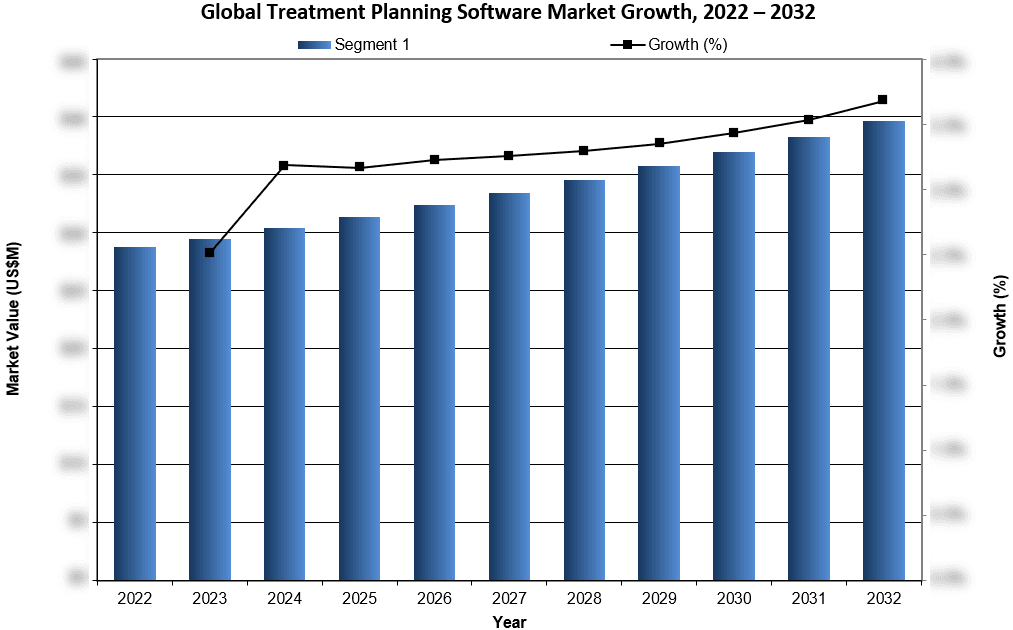
The global treatment planning software market was valued at over $30 million in 2025. This is expected to increase over the forecast period at a CAGR of 3.4% to reach nearly $40 million by 2032.
The full report suite includes treatment planning software. The market is analyzed as a whole and not further segmented.
The report includes data for 65 countries across 7 different regions which include North America, Latin America, Western Europe, Central & Eastern Europe, Middle East, Asia-Pacific, and Africa.
Data Types Included
- Unit Sales, Average Selling Prices, Market Size & Growth Trends
- Market Drivers & Limiters
- Market Forecasts Until 2032, and Historical Data to 2022
- Recent Mergers & Acquisitions
- Company Profiles and Product Portfolios
- Leading Competitors
Global Treatment Planning Software Market Trends
An ongoing trend supporting growth in the treatment planning software market is the increasing participation of general practitioners in implant dentistry. As implant placement becomes more integrated into the routine clinical workflow of general dental practices, the demand for efficient, standardized and repeatable planning solutions is increasing. Historically, many general practitioners placed implants infrequently and were less inclined to invest in treatment planning software. However, as implantology training becomes more widespread and procedure volumes increase at the GP level, investments in digital planning tools that enhance efficiency, accuracy and predictability are becoming more attractive, supporting gradual growth in software adoption.
Global Treatment Planning Software Market Share Insights

- Dentsply Sirona led the market for treatment planning software in 2025. Dentsply Sirona has positioned itself as a leader in the digital transformation of the dental industry, and the company is confident that its business fundamentals will remain strong in the current downturn. Dentsply Sirona’s customer base consists mainly of specialists, including periodontists and oral surgeons, who place a high volume of dental implants. Dentsply Sirona’s first-mover advantage is likely to help the company maintain its market leadership in the treatment planning software market.
- Envista was the second-leading competitor in the treatment planning software market in 2025. Similar to Dentsply Sirona, the company leverages its strong position in the premium implant segment to drive adoption of its digital planning solutions. Envista’s software strategy is centered on the DTX Studio™ platform, which integrates implant planning, diagnostics, restorative design and laboratory collaboration within a connected digital workflow. This ecosystem enables seamless data exchange across Nobel Biocare, Kerr and Ormco products and supports guided surgery and full-arch treatment protocols. As with other implant manufacturers, software adoption is frequently supported through bundled pricing and promotional programs tied to implant purchases in order to strengthen customer loyalty and increase workflow utilization. While standalone software license growth is expected to remain stable, revenue expansion will be driven primarily by increased utilization of the integrated digital workflow and associated design and manufacturing services, reflecting the ongoing shift toward a more recurring, platform-based business model.
- Straumann Group is a leading provider of digital dentistry solutions. Its coDiagnostiX® software has continued to gain adoption in parallel with the group’s strong implant and restorative performance and forms a core component of its guided surgery workflow. Positioned as an open platform, coDiagnostiX® is compatible with a wide range of implant systems and enables users to source surgical guides through both local laboratories and centralized manufacturing partners. The software has been further integrated into Straumann’s broader digital ecosystem through the Straumann AXS cloud platform, which supports AI-assisted planning, cloud-based case collaboration and standardized workflows across multi-site clinical environments.
Global Treatment Planning Software Market Segmentation Summary
- Treatment Planning Software Market
Research Scope Summary
| Report Attribute | Details |
|---|---|
| Region | North America (Canada, United States) Latin America (Argentina, Bolivia, Brazil, Chile, Colombia, Costa Rica, Dominican Republic, Ecuador, Guatemala, Mexico, Panama, Paraguay, Peru, Puerto Rico, Uruguay, Venezuela) Western Europe (Austria, Benelux, France, Germany, Italy, Portugal, Scandinavia, Spain, Switzerland, United Kingdom) Central & Eastern Europe (Azerbaijan, Baltic States, Belarus, Bulgaria, Croatia, Czech Republic, Georgia, Greece, Hungary, Kazakhstan, Poland, Romania, Russia, Serbia, Slovakia, Slovenia, Turkey, Ukraine) Middle East (Bahrain, Iran, Israel, Kuwait, Oman, Qatar, Saudi Arabia, United Arab Emirates) Asia Pacific (Australia, Cambodia, China, Hong Kong, India, Indonesia, Japan, Kyrgyzstan, Macao, Malaysia, Mongolia, Myanmar, New Zealand, Pakistan, Philippines, Singapore, South Korea, Sri Lanka, Taiwan, Thailand, Uzbekistan, Vietnam) Africa (Algeria, Egypt, Ethiopia, Ghana, Kenya, Libya, Morocco, Nigeria, South Africa, Sudan, Uganda) |
| Base Year | 2025 |
| Forecast | 2026-2032 |
| Historical Data | 2022-2024 |
| Quantitative Coverage | Market Size, Market Shares, Market Forecasts, Market Growth Rates, Units Sold, and Average Selling Prices. |
| Qualitative Coverage | Market Growth Trends, Market Limiters, Competitive Analysis & SWOT for Top Competitors, Mergers & Acquisitions, Company Profiles, Product Portfolios, FDA Recalls, Disruptive Technologies, Disease Overviews. |
| Data Sources | Primary Interviews with Industry Leaders, Government Physician Data, Regulatory Data, Hospital Private Data, Import & Export Data, iData Research Internal Database. |
CONTACT US FOR ADDITIONAL INFORMATION
For full segmentation and any questions regarding research coverage, please contact us for a complimentary demo of the full report.