
Product Description
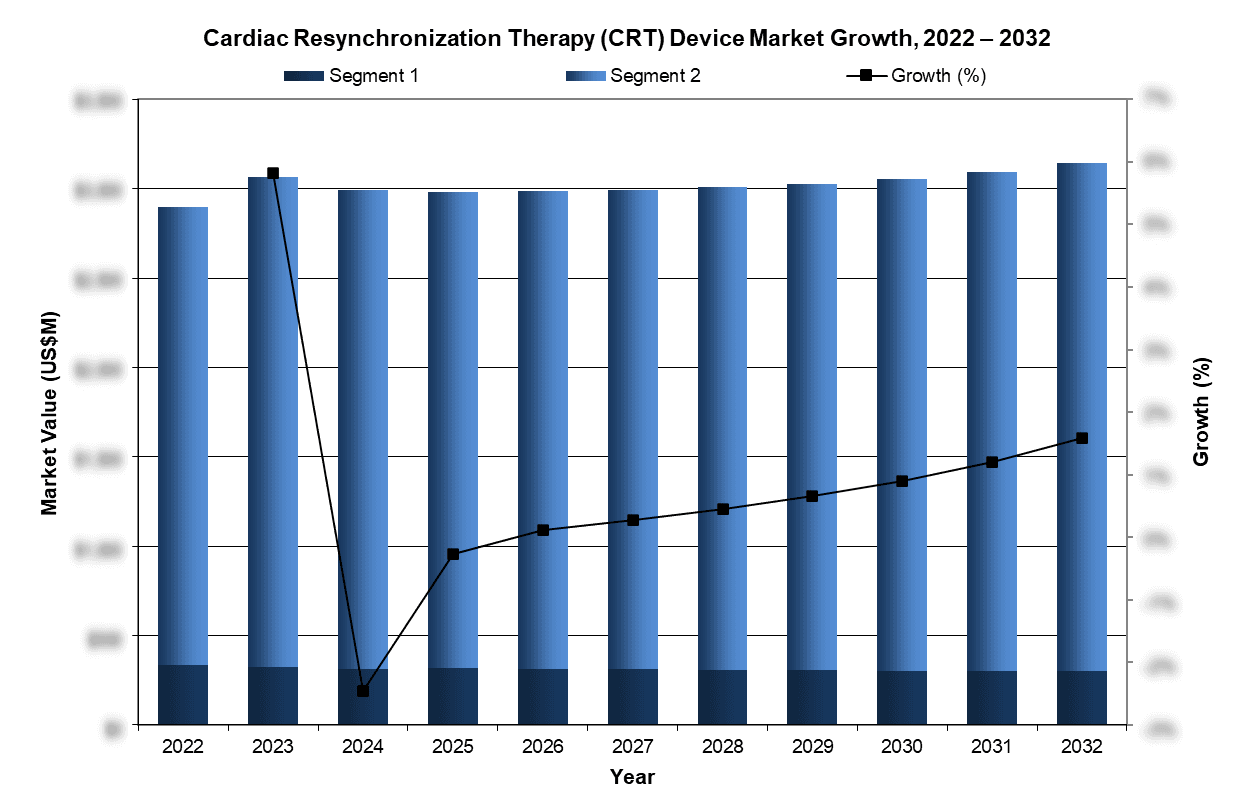
The global cardiac resynchronization therapy (CRT) market was valued at $2.98 billion in 2025. This is expected to increase over the forecast period at a CAGR of 0.7% to reach $3.1 billion by 2032.
The full report suite on the global market for cardiac resynchronization therapy (CRT) devices includes cardiac resynchronization therapy-pacemakers (CRT-Ps) and cardiac resynchronization therapy-defibrillators (CRT-Ds).
The report includes data for 65 countries across 7 different regions which include North America, Latin America, Western Europe, Central & Eastern Europe, Middle East, Asia-Pacific, and Africa.
Data Types Included
- Unit Sales, Average Selling Prices, Market Size & Growth Trends
- Procedure Numbers
- Market Drivers & Limiters
- Market Forecasts Until 2032, and Historical Data to 2022
- Recent Mergers & Acquisitions
- Company Profiles and Product Portfolios
- Leading Competitors
Cardiac Resynchronization Therapy Devices Market Trends
 Cardiovascular disease burden rises sharply with age, and population ageing remains a durable structural tailwind for defibrillation therapy. The global population aged 60+ increased from 1.0B in 2020 toward 1.4B by 2030 and 2.1B by 2050, expanding the pool of patients at risk for malignant ventricular arrhythmias and sudden cardiac arrest. In out-of-hospital cardiac arrest, survival deteriorates rapidly when CPR and defibrillation are delayed, with published estimates indicating a 5%–10% decline in survival per untreated minute and overall survival rates that remain in the single digits across many health systems. ICD and CRT-D therapy directly address this gap through continuous rhythm surveillance and high-probability termination of VT/VF, with contemporary post approval data commonly reporting >90% first shock defibrillation success and randomized trials demonstrating meaningful reductions in all-cause mortality. As a result, despite high upfront device costs, ICDs and CRT-Ds retain a strong global health economic rationale, supported by avoided sudden death and reduced downstream acute-care utilization.
Cardiac Resynchronization Therapy Devices Market Share Insights

- Medtronic remains the global leader in the CRT market across both CRT-D and CRT-P segments. The company’s current portfolio includes the Cobalt™, Crome™, Percepta™, Serena™ and Solara™ platforms, all of which incorporate Medtronic’s adaptive CRT algorithms, heart failure diagnostics and proven long-term device longevity. These systems continue to anchor Medtronic’s dominant presence across major implanting centers and reinforce its leadership position through 2025.
- Boston Scientific is the second largest competitor in the global CRT market, supported by a modern portfolio that has largely transitioned beyond the legacy ENERGEN™ and PUNCTUA™ The company now competes with its contemporary CRT-D platforms, including the RESONATE™ and VIGILANT™ systems, which emphasize extended battery longevity and advanced heart failure diagnostics. In the CRT-P segment, Boston Scientific offers updated devices within the VALITUDE™ and INGENIO™ product families, providing broad MRI conditional labeling and reliable pacing performance. This refreshed CRT lineup continues to support Boston Scientific’s stable share position across major heart failure programs through 2025.
- Abbott maintains the third-largest share of the global CRT market, supported by contemporary CRT families such as Entrant™, Gallant™, Quadra Allure MP™ and other recently refreshed CRT-D and CRT-P systems. The portfolio emphasizes multipoint pacing, advanced heart failure management features and strong remote monitoring capabilities. Consistent reliability and updated platform performance have enabled Abbott to sustain a strong competitive position in 2025.
Cardiac Resynchronization Therapy Devices Market Segmentation Summary
- Cardiac Resynchronization Therapy-Pacemaker (CRT-P) Market – Further Segmented Into:
- Placement Type: Initial Placement and Replacement.
- Cardiac Resynchronization Therapy-Defibrillator (CRT-D) Market – Further Segmented Into:
- Placement Type: Initial Placement and Replacement.
Research Scope Summary
| Report Attribute | Details |
|---|---|
| Regions | North America (Canada, United States) Latin America (Argentina, Bolivia, Brazil, Chile, Colombia, Costa Rica, Dominican Republic, Ecuador, Guatemala, Mexico, Panama, Paraguay, Peru, Puerto Rico, Uruguay, Venezuela) Western Europe (Austria, Benelux, France, Germany, Italy, Portugal, Scandinavia, Spain, Switzerland, United Kingdom) Central & Eastern Europe (Azerbaijan, Baltic States, Belarus, Bulgaria, Croatia, Czech Republic, Georgia, Greece, Hungary, Kazakhstan, Poland, Romania, Russia, Serbia, Slovakia, Slovenia, Turkey, Ukraine) Middle East (Bahrain, Iran, Israel, Kuwait, Oman, Qatar, Saudi Arabia, United Arab Emirates) Asia Pacific (Australia, Cambodia, China, Hong Kong, India, Indonesia, Japan, Kyrgyzstan, Macao, Malaysia, Mongolia, Myanmar, New Zealand, Pakistan, Philippines, Singapore, South Korea, Sri Lanka, Taiwan, Thailand, Uzbekistan, Vietnam) Africa (Algeria, Egypt, Ethiopia, Ghana, Kenya, Libya, Morocco, Nigeria, South Africa, Sudan, Uganda) |
| Base Year | 2025 |
| Forecast | 2026-2032 |
| Historical Data | 2022-2024 |
| Quantitative Coverage | Procedure Numbers, Market Size, Market Shares, Market Forecasts, Market Growth Rates, Units Sold, and Average Selling Prices. |
| Qualitative Coverage | Market Growth Trends, Market Limiters, Competitive Analysis & SWOT for Top Competitors, Mergers & Acquisitions, Company Profiles, Product Portfolios, FDA Recalls, Disruptive Technologies, Disease Overviews. |
| Data Sources | Primary Interviews with Industry Leaders, Government Physician Data, Regulatory Data, Hospital Private Data, Import & Export Data, iData Research Internal Database. |
CONTACT US FOR ADDITIONAL INFORMATION
For full segmentation and any questions regarding research coverage, please contact us for a complimentary demo of the full report.