
Product Description
Overall, the global anti-reflux device market was valued at nearly $199 million in 2025. This is expected to increase over the forecast period at a CAGR of 16.2% to reach over $567 million.
The full report suite on the global market for anti-reflux devices includes a variety of procedure techniques to treat GERD, such as transoral incisionless fundoplication (TIF), transesophageal radiofrequency and the LINX®
Data Types Included
- Unit Sales, Average Selling Prices, Market Size & Growth Trends
- Procedure Numbers
- Market Drivers & Limiters
- Market Forecasts Until 2032, and Historical Data to 2022
- Recent Mergers & Acquisitions
- Company Profiles and Product Portfolios
- Leading Competitors
Global Anti-Reflux Device Market Trends
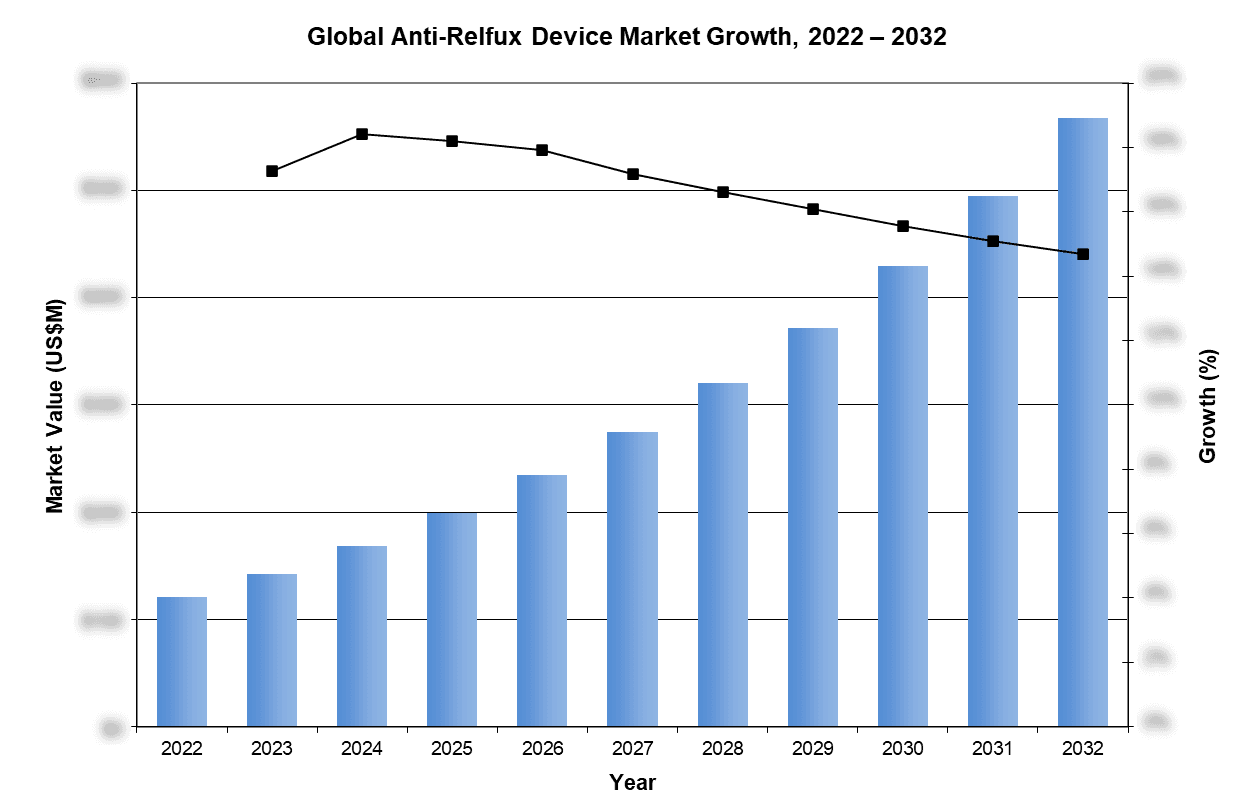
While newly identified side effects of proton-pump inhibitors (PPIs) support demand for anti-reflux devices, the well-established and widely accessible PPI market continues to constrain growth for these devices. Advances in PPI formulations could mitigate the impact of these side effects. In addition, generic PPIs, which may cost as little as 10% of brand-name options, provide an affordable alternative for patients who might not pursue more costly anti-reflux devices. The potential development of new PPI medications that are more effective for individuals who previously did not respond to treatment further limits the expansion of the anti-reflux device market.
Global Anti-Reflux Device Market Share Insights

- Johnson & Johnson ranking first in 2025, offers the LINX® Reflux Management System, which consists of a flexible band of interlinked titanium beads with magnetic cores, wrapped around the lower esophagus. The magnetic properties allow the band to separate when food passes down the esophagus, while remaining interlinked to resist the upward pressure of stomach acid.
- EndoGastric Solutions was the second-leading competitor in the anti-reflux device market in 2025. The company has significantly increased its market share and maintains a strong global presence, though its primary focus remains on the U.S. market.
- Restech was ranked as the third-leading competitor in the anti-reflux device market in 2025. The company acquired Mederi Therapeutics in 2018, which had previously acquired Curon Medical and its Stretta® technology following Curon’s bankruptcy and reintroduction of the procedure in 2010. Since then, Restech has gradually expanded its market share in Europe and globally. Unlike EsophyX® and LINX®, the Stretta® procedure uses radiofrequency energy to strengthen and restore the lower esophageal sphincter’s barrier function.
Research Scope Summary
| Report Attribute | Details |
|---|---|
| Regions | North America (Canada, United States) Latin America (Argentina, Bolivia, Brazil, Chile, Colombia, Costa Rica, Dominican Republic, Ecuador, Guatemala, Mexico, Panama, Paraguay, Peru, Puerto Rico, Uruguay, Venezuela) Western Europe (Austria, Benelux, France, Germany, Italy, Portugal, Scandinavia, Spain, Switzerland, United Kingdom) Central & Eastern Europe (Azerbaijan, Baltic States, Belarus, Bulgaria, Croatia, Czech Republic, Georgia, Greece, Hungary, Kazakhstan, Poland, Romania, Russia, Serbia, Slovakia, Slovenia, Turkey, Ukraine) Middle East (Bahrain, Iran, Israel, Kuwait, Oman, Qatar, Saudi Arabia, United Arab Emirates) Asia Pacific (Australia, Cambodia, China, Hong Kong, India, Indonesia, Japan, Kyrgyzstan, Macao, Malaysia, Mongolia, Myanmar, New Zealand, Pakistan, Philippines, Singapore, South Korea, Sri Lanka, Taiwan, Thailand, Uzbekistan, Vietnam) Africa (Algeria, Egypt, Ethiopia, Ghana, Kenya, Libya, Morocco, Nigeria, South Africa, Sudan, Uganda) |
| Base Year | 2025 |
| Forecast | 2026-2032 |
| Historical Data | 2022-2024 |
| Quantitative Coverage | Market Size, Market Shares, Market Forecasts, Market Growth Rates, Units Sold, and Average Selling Prices. |
| Qualitative Coverage | Market Growth Trends, Market Limiters, Competitive Analysis & SWOT for Top Competitors, Mergers & Acquisitions, Company Profiles, Product Portfolios, FDA Recalls, Disruptive Technologies, Disease Overviews. |
| Data Sources | Primary Interviews with Industry Leaders, Government Physician Data, Regulatory Data, Hospital Private Data, Import & Export Data, iData Research Internal Database. |
CONTACT US FOR ADDITIONAL INFORMATION
For full segmentation and any questions regarding research coverage, please contact us for a complimentary demo of the full report.


