
Top 5 Market Trends in In vitro Diagnostics
The U.S. in vitro diagnostics (IVD) market continues to play a central role in modern healthcare. These tests, performed on blood, urine, and other samples, help guide clinical decisions quickly and accurately.
This blog discusses which 5 market trends in In Vitro Diagnostics are developing the market in 2026 and beyond.
Find growth niches in minutes, not months.
Explore quick, actionable insights from the select markets.
Table of Contents
➜ In Vitro Diagnostics Market Growth in the U.S.
➜ Molecular Diagnostics Market Growth in the U.S.
➜ Immunochemistry Market Trends and Forecast
➜ Point-of-Care Diagnostics Market Expansion
➜ Hematology and Blood Gas Market Growth Areas
➜ Automation Trends in the In Vitro Diagnostics Market
➜ Pricing Pressure in the U.S. IVD Market
➜ FAQ: Market Trends in In Vitro Diagnostics
Key Takeaways
- Molecular diagnostics remains the largest and fastest-growing segment.
- Point-of-care testing is expanding due to decentralized healthcare models.
- Automation is shaping purchasing and replacement cycles across labs.
- Pricing pressure continues to influence margins and adoption rates.
In Vitro Diagnostics Market Growth in the U.S.
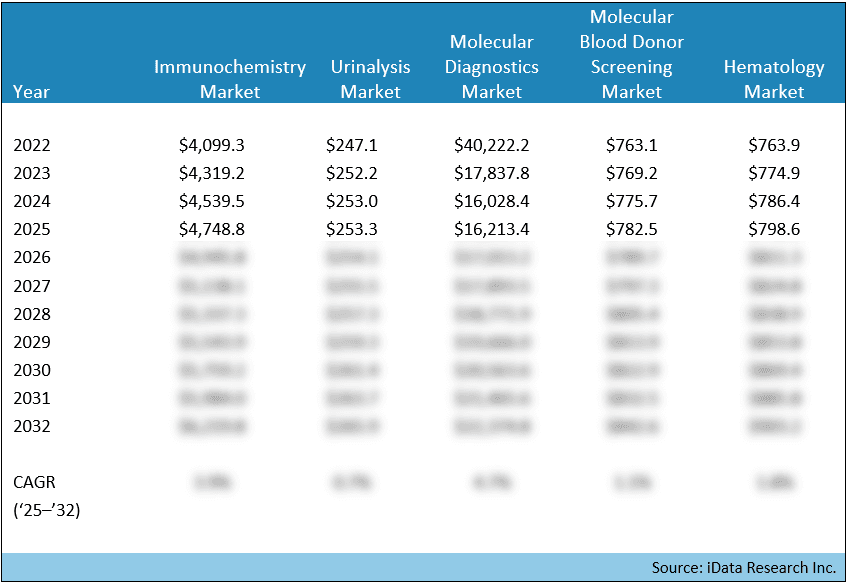
In Vitro Diagnostics Market Growth by Segment, U.S., 2022-2032 – iData Research
In 2025, the U.S. IVD market reached $23.9 billion, with projections suggesting it could grow to $31.8 billion at a CAGR of 4.2%. While this growth is steady, it is not uniform across all segments. Some areas are expanding faster due to innovation, clinical demand, and care delivery shifts.
Molecular diagnostics market growth in the U.S.
Molecular diagnostics held the largest share of the IVD market in 2025 and is expected to maintain that position.
Growth is largely tied to increased testing in infectious diseases, oncology, and women’s health.
Recent advancements in PCR and next-generation sequencing have improved both speed and accuracy.
According to the Centers for Disease Control and Prevention, molecular testing continues to play an important role in tracking infectious diseases and supporting early detection strategies, particularly post-pandemic.
This segment is also benefiting from newer automated platforms that simplify workflows.
Hospitals and labs are gradually adopting these systems as they expand testing menus without replacing entire infrastructures.
A real-world example can be seen in large U.S. hospital networks that expanded molecular testing capacity during COVID-19.
Many of these systems are now being repurposed for respiratory panels, oncology biomarkers, and STI testing, extending their long-term value.
Learn more in the U.S. In Vitro Diagnostics Market Report.
Immunochemistry market trends in the U.S.
Immunochemistry is the second-largest segment and remains a core component of hospital laboratories. Nearly every hospital operates at least one immunochemistry analyzer, often with backup systems in place.
Despite its size, growth here is more moderate.
The market is highly saturated, and many analyzers have extended lifespans, now averaging 8 years or more.
Still, innovation is occurring at the point-of-care level.
Smaller, faster immunochemistry systems are supporting rapid diagnostics in emergency rooms and outpatient settings.
These systems allow clinicians to make decisions faster, which may influence patient outcomes.
Manufacturers such as Abbott and Roche continue to invest in expanding test menus and improving throughput, even within a mature market.
Point-of-care diagnostics market expansion in the U.S.
Point-of-care (POC) diagnostics is one of the fastest-growing areas within the IVD market.
This growth is closely tied to the shift toward decentralized healthcare.
Hospitals are expanding outpatient centers and satellite clinics, increasing the need for compact, easy-to-use diagnostic systems. POC testing allows results to be delivered within minutes rather than hours.
The National Institutes of Health highlighted in 2024 that decentralized testing improves access to care, particularly in rural or underserved areas.
This shift is also visible in cardiovascular care. Rapid troponin testing at the point of care allows faster diagnosis of heart conditions.
📋 Additional insights can be explored through iData’s cardiovascular insights page, which examines how diagnostics intersect with cardiac treatment pathways.
Hematology and blood gas market growth areas in the U.S.
While smaller in size, hematology and point-of-care blood gas testing are expected to see higher relative growth.
These tests are critical in acute care settings, especially for critically ill patients.
Blood gas analyzers, for example, provide immediate information about oxygen and carbon dioxide levels, essential for ICU decision-making.
Growth in these segments is often tied to rising hospital admissions and the need for real-time monitoring tools.
As patient acuity increases, so does reliance on rapid diagnostic insights.
Automation trends in the in vitro diagnostics market
Automation continues to be one of the strongest drivers across the IVD market. Following the COVID-19 pandemic, many hospitals invested heavily in high-throughput systems that combine multiple testing functions.
These systems are now widely installed, which may slow new instrument sales in the short term. However, they also create long-term revenue opportunities through reagent contracts.
Many manufacturers provide analyzers at low or no upfront cost, recovering revenue through reagent agreements over 5–7 years. This model now accounts for over 80% of placements in large hospitals.
Companies like Danaher Corporation and Bio-Rad Laboratories continue to innovate in automation, focusing on workflow efficiency and integration.
Pricing pressure in the U.S. in vitro diagnostics market
Despite steady growth, pricing pressure remains a key challenge. Healthcare systems are focused on cost containment, which affects how diagnostic products are purchased and adopted.
Advanced instruments and specialized tests can be expensive, limiting accessibility in smaller labs. At the same time, stable instrument pricing means manufacturers rely more heavily on consumables and reagents for revenue.
This dynamic may shape how companies approach innovation. Some organizations are exploring ways to expand test menus within existing systems rather than introducing entirely new platforms.
FAQ: Market Trends in In Vitro Diagnostics
What is driving growth in the U.S. in vitro diagnostics market?
Growth is mainly driven by automation, increased testing demand, and expansion of point-of-care diagnostics. Molecular testing is also a major contributor.
Which segment is growing the fastest?
Molecular diagnostics is the fastest-growing and largest segment, supported by advancements in PCR and sequencing technologies.
Why is point-of-care testing becoming more popular?
It allows faster results and supports decentralized healthcare, especially in outpatient and rural settings.
How do reagent rental contracts work in the IVD market?
Manufacturers provide analyzers at low cost and generate revenue through long-term reagent supply agreements.
Are smaller segments like hematology still important?
Yes, they play a critical role in acute and critical care, and some are expected to grow steadily due to clinical demand.
Turn market painpoints into opportunities
Explore how procedure trends and competitor positioning create clear openings for industry experts in the market.
Other News
If you enjoyed this post, explore these related insights next:
(POPULAR) Medical Market Research: Complete Guide to Methods, Companies, and Market Applications
Healthcare Market Research Explained: Why It Matters More Than Ever
How Healthcare Market Research Helps MedTech Companies Grow Revenue


