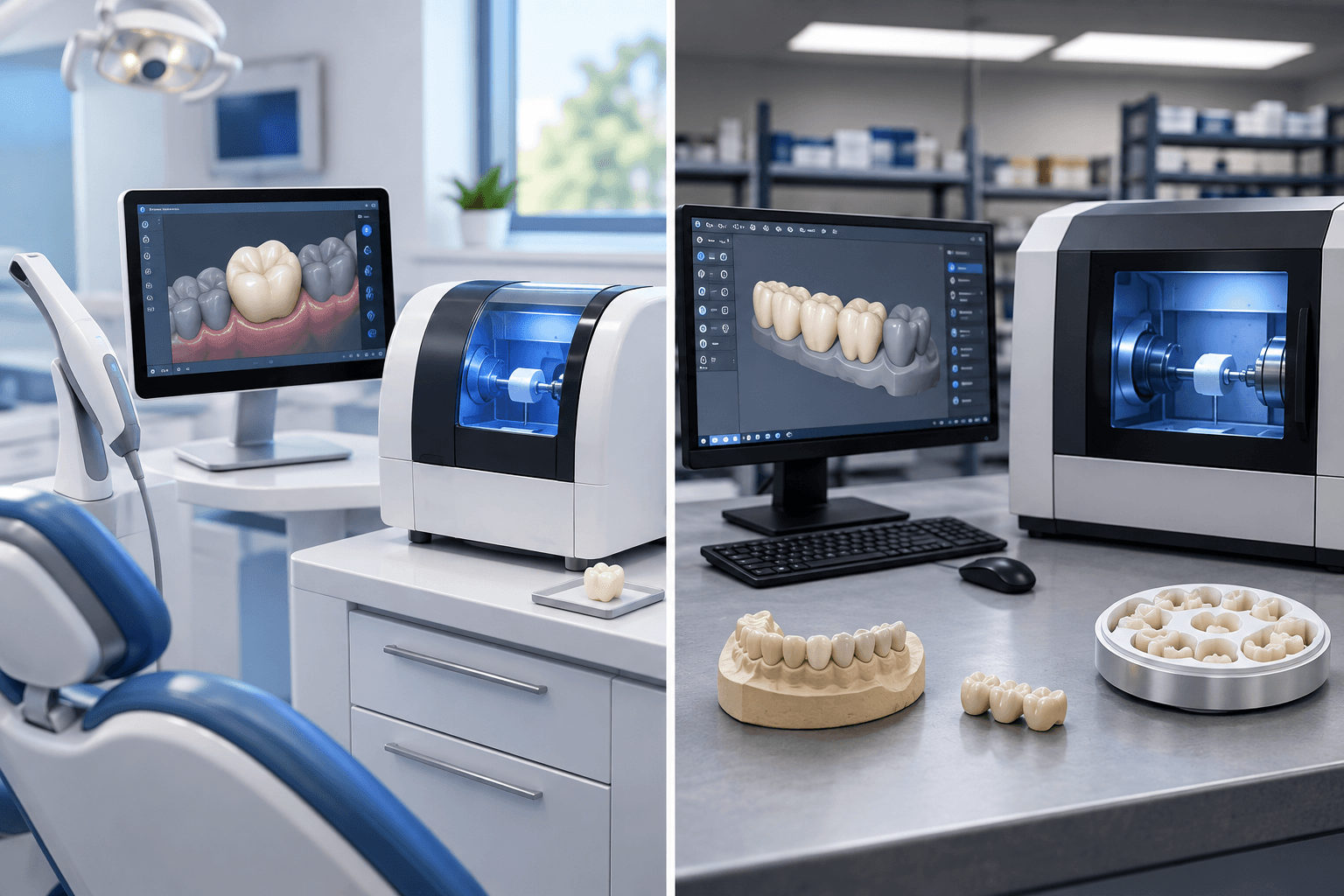
Chairside CAD/CAM and laboratory CAD/CAM are no longer separate worlds.
Both now run on the same intraoral scans, the same design software, and often the same milling materials.
iData Research values the U.S. digital dentistry market at roughly $1.2 billion in 2025, growing at a 4.6% CAGR to just over $1.6 billion by 2032.
Here is how each workflow is changing and which companies are pulling ahead.
Find growth niches in minutes, not months.
Explore quick, actionable insights from the select markets.
Table of Contents
➜ What is the difference between chairside CAD/CAM and lab CAD/CAM
➜ Why Dentsply Sirona leads the chairside CAD/CAM market
➜ What makes Align Technology a top chairside CAD/CAM company
➜ Why Ivoclar leads the materials side of lab CAD/CAM
➜ Is chairside CAD/CAM replacing the dental lab
➜ Where chairside CAD/CAM and lab CAD/CAM are heading next
➜ Frequently asked questions about chairside CAD/CAM
Key Takeaways
- Chairside CAD/CAM lets a practice scan, design, and mill a restoration in the office, often in a single visit.
- Lab CAD/CAM sends the same digital file to a dental laboratory or milling center for production.
- The two workflows are converging rather than competing, and both now depend on the same scans, software and materials.
- Dentsply Sirona, Align Technology and Ivoclar are the three largest competitors in the U.S. digital dentistry market in 2025, according to iData Research.
- Dentsply Sirona leads the CAD/CAM device market, Ivoclar leads CAD/CAM materials, and 3Shape leads CAD/CAM software.
- The U.S. dental 3D printing materials market was worth about $88.5 million in 2025.
What is the difference between chairside CAD/CAM and lab CAD/CAM
Chairside CAD/CAM is the workflow where a dental practice scans the tooth, designs the restoration, and mills it in the office, often in one appointment.
Lab CAD/CAM is the workflow where the practice sends that same digital file to a dental laboratory or milling center, which produces the restoration and ships it back.
The two workflows are converging on a shared digital pipeline, and the three companies leading that convergence in 2026 are Dentsply Sirona, Align Technology, and Ivoclar, based on iData Research market share data for the U.S. digital dentistry market.
Leadership splits by segment rather than by setting.
Dentsply Sirona holds the top position in the CAD/CAM device market, followed by Align Technology and 3Shape.
Ivoclar leads the CAD/CAM material market ahead of Dentsply Sirona and Argen.
3Shape leads the CAD/CAM software market, with Align Technology second and CIM Systems third.
SprintRay, Carbon and Formlabs lead the dental 3D printer market, a segment that serves clinics and laboratories alike.
CAD/CAM devices remain the largest segment of U.S. digital dentistry, reflecting their role in restorative production across both clinical and laboratory settings.
Why Dentsply Sirona leads the chairside CAD/CAM market
Dentsply Sirona remained the leading competitor in the U.S. digital dentistry market in 2025 and holds a dominant position in the CAD/CAM device market.
The reason is coverage.
Its product ecosystem spans both chairside CAD/CAM systems in the operatory and laboratory production workflows, which makes it a natural fit for practices and labs that want one connected pipeline.
That breadth also carries into scanning, where its Primescan intraoral scanner ranks among the leading systems in 2026.
iData Research notes that Dentsply Sirona has faced moderate competitive pressure as the digital dentistry market becomes more fragmented, even while holding the top spot.
What makes Align Technology a top chairside CAD/CAM company
Align Technology ranked as the second largest competitor in U.S. digital dentistry in 2025.
Its position rests on software rather than milling hardware, and it holds the leading share within the CAD/CAM software segment as ranked by iData Research.
The company’s advantage is an integrated digital orthodontic ecosystem anchored by the Invisalign platform and iTero scanners.
That model turns a chairside CAD/CAM scan into recurring revenue from clear aligner treatment rather than a one-off restoration.
Growth of clear aligners is one of the positive factors iData Research identifies across the CAD/CAM device, dental 3D printer,r and CAD/CAM software segments.
Why Ivoclar leads the materials side of lab CAD/CAM
Ivoclar ranked third overall in the U.S. digital dentistry market in 2025 and first in CAD/CAM materials.
Its strength comes from a restorative portfolio led by the IPS e.max lithium disilicate system, which remains widely used for esthetic restorations in both chairside CAD/CAM and laboratory production.
Between 2023 and 2025, Ivoclar focused on product launches and digital workflow partnerships rather than major merger or acquisition activity.
Materials matter more than they used to because the same blocks and discs feed both settings.
A 2025 review published in the National Library of Medicine catalogues the widening range of chairside CAD/CAM materials now indicated for crowns, inlays, onlays and veneers.
Is chairside CAD/CAM replacing the dental lab?
Chairside CAD/CAM is merging with laboratory production into one connected workflow, and the market data supports integration over replacement.
iData Research identifies laboratory consolidation and dental support organizations as factors shaping the CAD/CAM device, materials, ls and 3D printing segments at the same time.
Larger labs and DSO-backed groups are absorbing production volume while equipping more operatories with scanners.
One emerging model makes the link explicit.
Laboratories are placing intraoral scanners in practices at little or no upfront cost in exchange for ongoing case volume or minimum monthly lab spend, an approach Dandy uses with its Vision scanner while retaining ownership of the hardware.
Dandy extended that strategy in December 2025 by acquiring Neem, a cloud-based practice management software provider, to speed up its chair-to-lab workflow.
Production hardware is blurring the line too.
Planmeca introduced the Creo X dental 3D printer in November 2025 as a single high-precision system designed for use in both clinics and laboratories.
Investment cost still limits chairside CAD/CAM adoption more than it limits laboratory adoption, which is why many practices scan in-office and outsource production.
Where chairside CAD/CAM and lab CAD/CAM are heading next
Three shifts are shaping the next phase.
The first is masked stereolithography, or MSLA, 3D printing.
iData Research reports MSLA platforms are gaining traction on faster print speeds, higher throughput, and better economics for labs and chairside users alike, with recent launches pushing larger build areas.
The second is AI inside CAD/CAM software.
AI is automating selected design steps and cutting manual design time rather than replacing conventional workflows, which opens digital production to a wider user base.
Clinical work is starting to test that claim: a 2025 study in the National Library of Medicine compared the fit accuracy of AI-designed complete crowns against conventionally designed ones.
The third is material approvals that widen what each setting can produce.
Rapid Shape launched RS VIVO in February 2026, a premium resin line with FDA approval covering flexible denture, high-impact denture, and splint materials.
SprintRay acquired the ETEC dental portfolio in September 2025, consolidating printing capability further.
Milling hardware still matters: a 2025 analysis in the National Library of Medicine found the number of milling axes influenced restoration survival for lithium disilicate crowns.
The pattern holds across all three shifts.
The same companies now sell into both the operatory and the laboratory, and the winners are those whose files move cleanly between them.
For full segment forecasts, unit analysis and competitor share, see the iData Research U.S. Digital Dentistry Market Report.
Turn market painpoints into opportunities
Explore how procedure trends and competitor positioning create clear openings for industry experts in the market.
Frequently asked questions about chairside CAD/CAM
What is chairside CAD/CAM in dentistry
Chairside CAD/CAM is a workflow in which a dental practice scans a prepared tooth, designs the restoration on software in the office,ce and mills or prints it on site, often during the same appointment.
Who is the largest chairside CAD/CAM company
Dentsply Sirona is the leading competitor in the U.S. digital dentistry market and holds the dominant position in the CAD/CAM device market, according to iData Research 2025 data.
How big is the U.S. digital dentistry market
The U.S. digital dentistry market was valued at approximately $1.2 billion in 2025 and is forecast to reach just over $1.6 billion by 2032 at a 4.6% CAGR.
Is chairside CAD/CAM cheaper than sending work to a lab
Investment cost is listed by iData Research as a limiting factor for CAD/CAM device adoption, so the economics depend on case volume rather than on unit price alone.
Which companies lead dental 3D printing
SprintRay, Carbon and Formlabs lead the U.S. dental 3D printer market, while Carbon, 3D Systems and Asiga lead the dental 3D printing material market.
What is driving growth in lab CAD/CAM
Laboratory consolidation, dental support organizations, productivity enhancements, and new material development are the main positive factors iData Research identifies across the CAD/CAM segments.
Where can I read more iData Research dental rankings
Related coverage includes the top dental implant companies leading the global market and the top intraoral scanner companies in 2026.


