
Product Description
Overall, the U.S. dental prosthetics market was valued at $10.1 billion in 2025. This is expected to increase over the forecast period at a CAGR of 0.7% to reach $10.6 billion.
The U.S. dental prosthetics market encompasses crowns and bridges, inlays and onlays, veneers, dentures, denture teeth and computer-aided design/computer-aided manufacturing (CAD/CAM) milled prosthetics. These product categories collectively represent the restorative solutions used to address tooth loss, structural damage and aesthetic requirements across both clinical and laboratory settings.
Data Types Included
- Unit Sales, Average Selling Prices, Market Size & Growth Trends
- Market Drivers & Limiters
- Market Forecasts Until 2032, and Historical Data to 2022
- Recent Mergers & Acquisitions
- Company Profiles and Product Portfolios
- Leading Competitors
U.S. Dental Prosthetics Market Trends
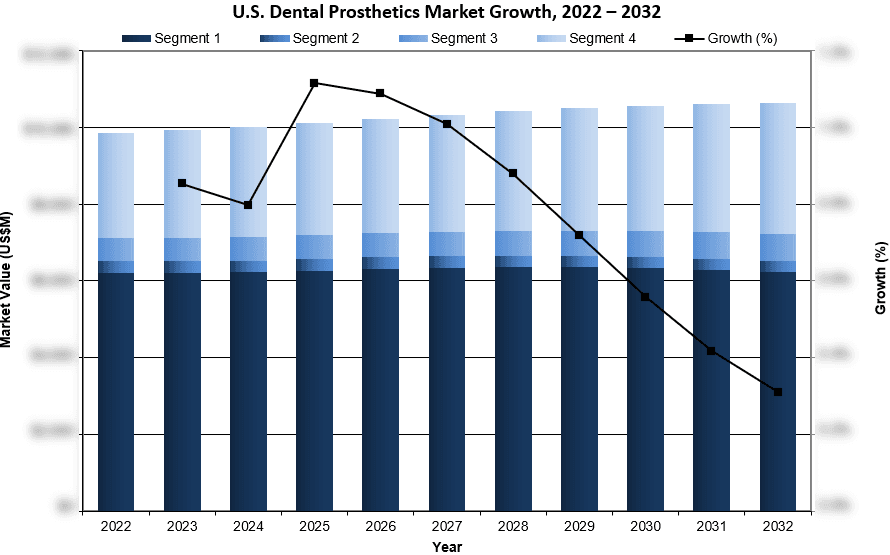
Digital dentistry remains a central transformative force within the U.S. dental prosthetics market and is increasingly embedded across laboratory and clinical workflows. CAD/CAM systems enable higher precision, improved consistency and faster turnaround times compared to traditional fabrication methods, while chairside systems allow for same-day restorations in select indications. Adoption of digital dentures continues to increase, offering improved fit, reproducibility and reduced chair time relative to conventional workflows. Dental 3D printing is also gaining traction across prosthetic applications, including dentures, crowns and bridges, primarily for provisional and transitional restorations.
U.S. Dental Prosthetics Market Share Insights

- Glidewell Dental was the leading competitor in the U.S. dental prosthetics market in 2025. The company maintains a strong presence across crowns and bridges, inlays and onlays, veneers and dentures, supported by its scale, vertically integrated manufacturing capabilities and broad digital product ecosystem. In addition to being the largest dental laboratory in the U.S., Glidewell continues to invest heavily in digital workflows, proprietary CAD/CAM materials and chairside solutions, reinforcing its competitive positioning across both laboratory and clinical channels. Glidewell’s extensive zirconia portfolio, digital denture offerings and integrated in-office solutions are expected to support continued leadership as digital adoption accelerates.
- National Dentex remained one of the largest competitors in the U.S. dental prosthetics market in 2025, operating across all major prosthetic segments. The company benefits from the largest network of affiliated laboratories in the U.S. and continues to pursue a growth strategy centered on laboratory acquisitions and operational scale. National Dentex’s competitive strengths include broad product coverage, pricing flexibility and the ability to serve dental service organizations (DSOs), group practices and independent dentists. Its vertically coordinated laboratory network and continued consolidation strategy are expected to sustain its position as a leading national laboratory operator.
- Aspen Dental was also a notable competitor in the U.S. dental prosthetics market in 2025, with its position supported primarily by the denture segment. Unlike laboratory-focused competitors, Aspen Dental’s presence is driven by its large clinic network and strong exposure to removable prosthetics through integrated patient care and high-volume general dentistry services. The company’s scale in the denture market reflects its broad geographic footprint, strong brand visibility and ability to serve a large base of edentulous and aging patients. Although Aspen Dental has more limited participation across fixed prosthetic categories, its established role in removable restorations is expected to support its continued relevance in the broader dental prosthetics market.
U.S. Dental Prosthetics Market Segmentation Summary
- Crown and Bridge Market – Further Segmented Into:
- Prosthetic Type: Crown, and Bridge.
- Material Type: Full-Cast, PFM, and Ceramic.
- Fabrication Method: Traditional, and Digital.
- Inlay and Onlay Market – Further Segmented Into:
- Material Type: Gold, Zirconia, Other Ceramic, Composite Resin.
- Technique Type: Direct, and Indirect.
- Fabrication Method: Traditional, and Digital.
- Veneer Market – Further Segmented Into:
- Material Type: Porcelain/Ceramic, Composite Resin, and Zirconia.
- Fabrication Method: Traditional, and Digital.
- Denture Market – Further Segmented Into:
- Denture Type: Full, and Partial.
- Denture Teeth Market – Further Segmented Into:
- Grade: Premium, Standard, and Economy.
- Material: Acrylic, Porcelain/Ceramic, and Composite Resin.
- CAD/CAM Milled Prosthetics Market – Further Segmented Into:
- Device Type: Crown and Bridge, Inlay and Onlay, Veneer, and Denture.
Research Scope Summary
| Report Attribute | Details |
|---|---|
| Region | United States |
| Base Year | 2025 |
| Forecast | 2026-2032 |
| Historical Data | 2022-2024 |
| Quantitative Coverage | Market Size, Market Shares, Market Forecasts, Market Growth Rates, Units Sold, and Average Selling Prices. |
| Qualitative Coverage | Market Growth Trends, Market Limiters, Competitive Analysis & SWOT for Top Competitors, Mergers & Acquisitions, Company Profiles, Product Portfolios, FDA Recalls, Disruptive Technologies, Disease Overviews. |
| Data Sources | Primary Interviews with Industry Leaders, Government Physician Data, Regulatory Data, Hospital Private Data, Import & Export Data, iData Research Internal Database. |
CONTACT US FOR ADDITIONAL INFORMATION
For full segmentation and any questions regarding research coverage, please contact us for a complimentary demo of the full report.


