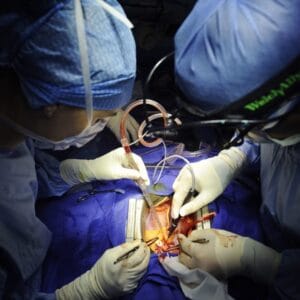
Open heart surgery is heart surgery performed while a heart-lung bypass machine does the work of your heart and lungs, and its most common forms are coronary artery bypass grafting (CABG), heart valve surgery, and repair of heart defects present at birth.
The three largest cardiac surgery device companies supplying these operations are Edwards Lifesciences, Abbott, and Medtronic, based on iData Research market share data for 2025.
iData Research valued the global cardiac surgery device market at $20 billion in 2025 and expects it to reach $29.5 billion at a CAGR of 5.6%.
This guide covers the types of open heart surgery, how long it takes, recovery time, common complications, survival data, and how TAVR and other less invasive options are changing heart care.
Find growth niches in minutes, not months.
Explore quick, actionable insights from the select markets.
Table of Contents
➜ What are the main types of open heart surgery
➜ How long does open heart surgery take
➜ How long is open heart surgery recovery
➜ What does an open heart surgery scar look like
➜ What is the most common complication after open-heart surgery
➜ What is the open heart surgery survival rate
➜ Is bypass surgery the same as open heart surgery
➜ Is TAVR replacing open-heart surgery
➜ Who are the top cardiac surgery device companies in 2026
➜ Why Edwards Lifesciences leads the cardiac surgery device market
➜ What makes Abbott a top cardiac surgery device company
➜ How Medtronic ranks in cardiac surgery devices
➜ How big is the cardiac surgery device market
➜ Frequently asked questions about open heart surgery
Key Takeaways
- The operation uses a heart-lung bypass machine, and the most common types are CABG, valve surgery, and congenital defect repair.
- In a 2026 study of 2,935 bypass patients, the median hospital stay was 6 to 7 days, and the median intensive care stay was 1 day.
- Breastbone precautions after surgery have traditionally lasted 6 to 8 weeks, and some centers advise up to 12 weeks.
- Atrial fibrillation is the most common complication, with reported rates ranging from 10% to 65% depending on the procedure and patient.
- Median survival after bypass surgery was 13.7 years in a Finnish cohort whose patients averaged about 68 to 70 years old.
- Edwards Lifesciences, Abbott, and Medtronic are the three leading cardiac surgery device companies, according to iData Research.
- iData Research values the global cardiac surgery device market at $20 billion in 2025, growing at a 5.6% CAGR to $29.5 billion.
What is open heart surgery?
Heart surgery is any operation on the heart muscle, valves, arteries, or the aorta and other large arteries connected to the heart.
According to MedlinePlus from the National Library of Medicine, the term open heart surgery means you are connected to a heart-lung bypass machine during the operation.
Your heart is stopped while the machine adds oxygen to your blood, moves blood through your body, and removes carbon dioxide.
Most surgeons reach the heart through a median sternotomy, a cut down the center of the breastbone, which remains the most common approach in cardiac surgery centers.
Newer procedures reach the heart through smaller cuts, and some are done while the heart is still beating.
What are the main types of open heart surgery?
The most common types are coronary artery bypass grafting, heart valve surgery, and surgery to correct a congenital heart defect.
CABG is an established treatment for multivessel coronary artery disease, in which surgeons use grafts to route blood around blocked arteries.
Valve surgery repairs or replaces a damaged valve using tissue heart valves, mechanical heart valves, or annuloplasty repair devices.
Congenital repairs fix defects present at birth, although iData Research notes that catheter-based closure has become the preferred option in many cases for defects such as patent foramen ovale and patent ductus arteriosus.
Behind each operation sits a wide range of devices, including heart-lung bypass disposables, off-pump stabilizers, autotransfusion systems, endoscopic vessel harvesting tools and extracorporeal membrane oxygenation (ECMO) systems.
iData Research tracks all of these segments in its Global Cardiac Surgery Device Market Report.
How long does open heart surgery take
Operating time depends on the procedure, the number of repairs, and your overall health.
In a 2026 Finnish study of 2,935 bypass patients, the median time on the heart-lung machine was 96 minutes for on-pump CABG.
The median time the aorta was clamped, which is when the heart is stopped, was 75 minutes in the same group.
The full operation runs longer than the bypass time alone, so your surgical team is the best source for a personal estimate.
Some newer catheter-based valve repairs are not quick either, since iData Research notes that transcatheter mitral and tricuspid procedures often average several hours.
How long is open heart surgery recovery
Recovery starts in intensive care, where the median stay was 1 day in the 2026 Finnish cohort.
The median total hospital stay in that study was 6 days after on-pump bypass and 7 days after off-pump bypass.
Once home, most patients follow sternal precautions, which limit lifting, pushing, and pulling while the breastbone heals.
These precautions have traditionally lasted 6 to 8 weeks after a median sternotomy.
A 2026 scoping review of 12 studies found that many patients are advised to follow them for 8 to 12 weeks.
The same review found that less restrictive precautions did not worsen wound infections, sternal stability, pain, or readmissions, and they improved functional status.
In practice, plan for a recovery measured in weeks to a few months rather than days, and follow the schedule your surgeon sets.
What does an open heart surgery scar look like
A traditional sternotomy scar is a vertical line down the center of the chest, because the median sternotomy divides the breastbone lengthwise.
Minimally invasive approaches use smaller cuts, which usually leave shorter scars.
Keeping the incision clean matters, because a deep sternal wound infection occurred in 1.2% of on-pump patients in the Finnish cohort.
What is the most common complication after open heart surgery
Atrial fibrillation, an irregular heart rhythm, is the most common complication after heart surgery.
A 2026 systematic review put its incidence at 10% to 65% and linked it to higher risks of stroke, longer hospital stays, and death.
In the Finnish bypass cohort, atrial fibrillation affected 41% of on-pump patients and 39% of off-pump patients.
The same study reported pneumonia in 6.4% of on-pump patients, delirium in 10% and cerebral infarction in 2.3%.
Your risk depends heavily on your age, heart function, and other conditions, so ask your team how these numbers apply to you.

What is the open-heart surgery survival rate
Survival in the first month after bypass surgery is high.
In the 2026 Finnish cohort, 30-day mortality was 1.4% after on-pump CABG and 0.5% after off-pump CABG.
Median survival across all 2,935 patients was 13.7 years, in a group whose average age at surgery was about 68 to 70.
Diabetes, chronic lung disease, weaker heart pumping function, and kidney impairment were each linked to a higher risk of death in that study.
A 2025 meta-analysis of bypass survival trends found that beyond 10 years, life expectancy falls below that of the general population, most of all in men.
Managing blood pressure, cholesterol, diabetes, and kidney health after surgery is one of the most practical ways to protect long-term results.
Is bypass surgery the same as open heart surgery
Bypass surgery is one type of open heart surgery, which is the broader term that also covers valve and congenital repairs.
CABG can be done on-pump, with the heart-lung machine, or off-pump, on a beating heart.
Off-pump surgery is technically demanding, and in the Finnish cohort surgeons made a median of 3 graft connections off-pump compared with 4 on-pump.
Even so, the study found comparable survival between the two approaches over follow-up extending up to 20 years.
Is TAVR replacing open-heart surgery?
Transcatheter aortic valve replacement (TAVR) replaces a narrowed aortic valve through a catheter instead of opening the chest.
iData Research identifies the growing number of minimally invasive treatment options as a key driver across cardiac surgery, because they reduce surgical trauma, shorten hospital stays and speed recovery.
These options have widened care for elderly and high-risk patients who may not be good candidates for a traditional operation.
In May 2025, Edwards Lifesciences’ SAPIEN 3 TAVR platform received FDA approval for patients with asymptomatic severe aortic stenosis.
In August 2025, Abbott’s Navitor TAVI system received a CE Mark for patients in Europe at low or intermediate surgical risk.
Surgery is not going away, though, and iData Research’s 2026 update revised its tissue and mechanical heart valve estimates upward while taking a more conservative view of the transcatheter valve replacement market.
Surgical and catheter valves also work together, since Medtronic’s Avalus Ultra surgical valve is designed to support a future transcatheter valve placed inside it.
Who are the top cardiac surgery device companies in 2026
The three leading cardiac surgery device companies are Edwards Lifesciences, Abbott, and Medtronic.
That ranking comes from iData Research market share data for 2025, published in its 2026 global report.
For earlier context on how these three built their positions, see our top 3 market share leaders in the global cardiac surgery device market.
Why Edwards Lifesciences leads the cardiac surgery device market
Edwards Lifesciences was the leading cardiac surgery device company in 2025, according to iData Research.
It competes in five cardiac surgery segments and leads most of them, with transcatheter mitral and tricuspid repair as the exceptions.
Its SAPIEN 3 approval for asymptomatic severe aortic stenosis in May 2025 reinforced its lead in structural heart care.
In December 2025, Edwards announced FDA approval of its SAPIEN M3 system, the first transcatheter therapy using a transseptal approach to win FDA approval for mitral regurgitation.
Its growth plans also met a regulatory limit, as the FTC won a court order in January 2026 blocking its proposed acquisition of JenaValve, and Edwards said it would not complete the deal.
What makes Abbott a top cardiac surgery device company
Abbott ranked second in the global cardiac surgery device market in 2025, according to iData Research.
It holds a broad, diversified portfolio across multiple cardiac surgery segments and competes strongly in most regions.
Its Navitor TAVI system gained an expanded CE Mark indication in August 2025.
In July 2025, Abbott received regulatory approval for its TriClip system in Japan, which iData Research expects to strengthen its position in transcatheter mitral and tricuspid repair.
How Medtronic ranks in cardiac surgery devices
Medtronic ranked third in the global cardiac surgery device market in 2025, according to iData Research.
Its portfolio spans tissue and mechanical heart valves, annuloplasty repair systems, transcatheter heart valves, on-pump and off-pump bypass devices, autotransfusion systems and pre-shaped guidewires.
In 2024, Medtronic launched the VitalFlow ECMO system and introduced Avalus Ultra, its next-generation surgical aortic tissue valve.
In October 2025, it launched Avalus Ultra in India, expanding its surgical aortic valve portfolio in the Asia-Pacific region.
How big is the cardiac surgery device market
iData Research valued the global cardiac surgery device market at $20 billion in 2025.
It forecasts the market to reach $29.5 billion, growing at a CAGR of 5.6%.
Better CT and MRI imaging is helping doctors find structural heart and valve disease earlier, which is increasing referrals for both surgical and transcatheter treatment.
An aging population is also lifting demand for bypass support devices, vessel harvesting tools, and mechanical circulatory support.
Innovation continues in the operating room itself, as Spectrum Medical received FDA 510(k) clearance for its Quantum Micro-Cardioplegia Delivery System in August 2025.
For procedure volume context, read our analysis of how many cardiac surgeries are performed each year.
Segment sizes, procedure numbers, and full competitor shares are available in the iData Research Global Cardiac Surgery Device Market Report.
Frequently asked questions about open heart surgery
How long does it take to recover from open heart surgery?
Most patients spend about a week in the hospital and then follow breastbone precautions for 6 to 12 weeks, depending on their surgeon’s advice.
How long do you stay in the hospital after open heart surgery?
In a 2026 study of 2,935 bypass patients, the median hospital stay was 6 to 7 days, including a median of 1 day in intensive care.
What is the most common complication after open heart surgery?
Atrial fibrillation is the most common complication, with reported rates of 10% to 65% depending on the procedure and patient group.
How long can you live after open heart surgery?
Median survival after bypass surgery was 13.7 years in a large Finnish cohort, although individual outcomes depend on age and other health conditions.
Is bypass surgery the same as open heart surgery?
Yes, bypass surgery is one type, and the category also includes valve surgery and congenital defect repair.
Can a heart valve be replaced without open heart surgery?
Yes, TAVR and other transcatheter procedures replace or repair some heart valves through a catheter without opening the chest.
Which company leads the cardiac surgery device market?
Edwards Lifesciences led the global cardiac surgery device market in 2025, followed by Abbott and Medtronic, according to iData Research.
Turn market painpoints into opportunities
Explore how procedure trends and competitor positioning create clear openings for industry experts in the market.


