Ventricular Assist Device Market Size, Share & Trends Analysis | Global | 2026-2032| MedCore | Includes: Implantable and Percutaneous VAD Markets

  • Year: 2026
  • Scope: 10 Years
  • Region: Global
  • Published Date: 12/24/2025
  • Type: MedCore

Product Description

The global ventricular assist device market was valued at $1.8 billion in 2025. This is expected to decrease over the forecast period at a CAGR of -0.4% to reach $1.77 billion by 2032.

The full report suite on the global market for ventricular assist devices (VADs) includes percutaneous VADs (pVADs) and implantable VADs.

The report includes data for 65+ countries across 7 different regions which include North America, Latin America, Western Europe, Central & Eastern Europe, Middle East, Asia-Pacific and Africa.

Data Types Included

  • Unit Sales, Average Selling Prices, Market Size & Growth Trends
  • Procedure Numbers
  • Market Drivers & Limiters
  • Market Forecasts Until 2032, and Historical Data to 2022
  • Recent Mergers & Acquisitions
  • Company Profiles and Product Portfolios
  • Leading Competitors

Global Ventricular Assist Device Market Trends
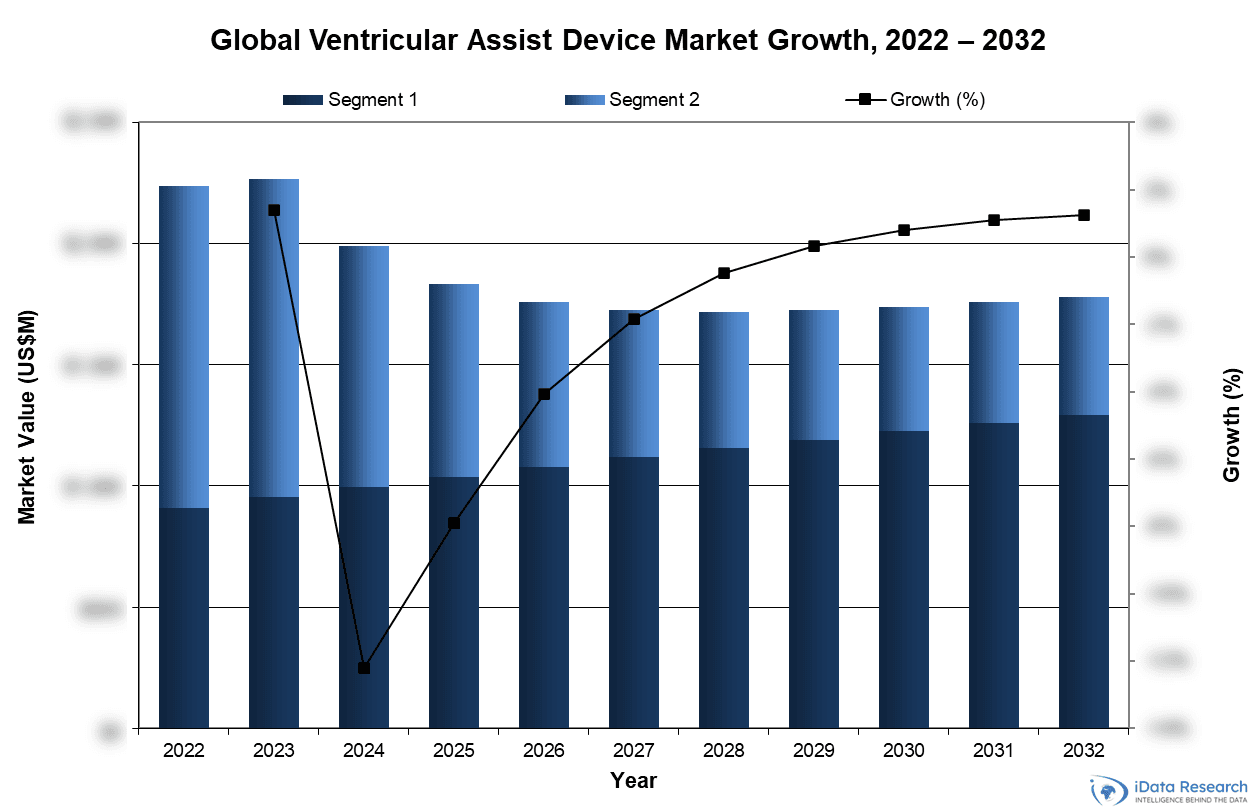
Global Ventricular Assist Device Market Growth, 2022-2032

Ventricular assist devices (VADs) provide mechanical support for patients with advanced heart failure as a bridge to, or replacement for, definitive therapy. However, the availability of alternative treatments, including partial and total artificial heart systems and advancing heart failure therapies, is expected to limit the growth of the ventricular assist device market over the forecast period.

Global Ventricular Assist Device Market Share Insights

Top Global Ventricular Assist Device Market Share Leaders

  • Abbott was the leading competitor in the ventricular assist device market. The company offers the HeartMate® VAD product line. It is likewise expected that Abbott will increase its share of the market after the exit of Medtronic. As of 2025, Abbott was the largest competitor in the ventricular assist device market. The company offers implantable VADs through its HeartMate 2™ and HeartMate 3™ products. HeartMate 3™, Abbott’s latest-generation implantable VAD, launched in August 2017, has seen widespread adoption in the U.S., particularly after receiving FDA approval for DT use in patients with advanced heart failure. However, in May 2018, Abbott initiated a recall for the HeartMate 3™ due to a malfunction involving the outflow graft. The FDA classified this as a Class I recall, the most serious level, indicating that use of the device could lead to severe injury or death. In the external ventricular assist device segment, Abbott markets the CentriMag® Acute Circulatory Support System, which is FDA-approved to provide up to six hours of short-term circulatory support during cardiac surgery.
  • Abiomed was the second-leading competitor in the ventricular assist device market. Abiomed, now part of Johnson & Johnson MedTech, held the second-leading position in the global ventricular assist device market in 2025, with a primary focus on percutaneous VADs through its Impella™ product line, including the Impella 2.5®, CP®, 5.0®, 5.5®, LD®, and RP®. The company has steadily expanded its platform since the initial FDA approval of the Impella 2.5® in 2008, supported by clinical evidence demonstrating benefits over intra-aortic balloon pumps in high-risk PCI patients. More recently, Abiomed introduced the Impella® 5.5 and continued development of the Impella Bridge to Recovery (BTR™) pump. From 2023 to 2025, Abiomed faced several FDA Class I recalls affecting its Impella systems, including a major recall in March 2024 related to the risk of left ventricular wall perforation, which led to updated usage guidelines and increased clinical scrutiny. Despite these challenges, Abiomed strengthened its clinical position in March 2025 when the ACC/AHA upgraded the Impella recommendation to Class IIa for the treatment of STEMI-associated cardiogenic shock, supporting longer-term adoption of the platform.
  • Berlin Heart, in 2025 was ranked as the third-leading competitor in the U.S. ventricular assist device market. The company’s flagship product, the EXCOR Pediatric VAD, is an external VAD specifically designed to support pediatric patients suffering from severe ventricular dysfunction while awaiting heart transplantation. The device is versatile in its application and can function as a left ventricular assist device (LVAD), right ventricular assist device (RVAD) or biventricular assist device (BiVAD), depending on the patient’s clinical needs. EXCOR received FDA approval in December 2011 under a humanitarian device exemption (HDE), reflecting its critical role in treating a small but high-risk population for whom few alternative therapies exist.

Global Ventricular Assist Device Market Segmentation Summary

  • Implantable Ventricular Assist Device Market
  • Percutaneous Ventricular Assist Device Market

Research Scope Summary

Report Attribute Details
Regions North America  (Canada, United States)
Latin America  (Argentina, Bolivia, Brazil, Chile, Colombia, Costa Rica, Dominican Republic, Ecuador, Guatemala, Mexico, Panama, Paraguay, Peru, Puerto Rico, Uruguay, Venezuela)
Western Europe  (Austria, Benelux, France, Germany, Italy, Portugal, Scandinavia, Spain, Switzerland, United Kingdom)
Central & Eastern Europe  (Azerbaijan, Baltic States, Belarus, Bulgaria, Croatia, Czech Republic, Georgia, Greece, Hungary, Kazakhstan, Poland, Romania, Russia, Serbia, Slovakia, Slovenia, Turkey, Ukraine)
Middle East  (Bahrain, Iran, Israel, Kuwait, Oman, Qatar, Saudi Arabia, United Arab Emirates)
Asia Pacific  (Australia, Cambodia, China, Hong Kong, India, Indonesia, Japan, Kyrgyzstan, Macao, Malaysia, Mongolia, Myanmar, New Zealand, Pakistan, Philippines, Singapore, South Korea, Sri Lanka, Taiwan, Thailand, Uzbekistan, Vietnam)
Africa  (Algeria, Egypt, Ethiopia, Ghana, Kenya, Libya, Morocco, Nigeria, South Africa, Sudan, Uganda)
Base Year 2025
Forecast 2026-2032
Historical Data 2022-2024
Quantitative Coverage Procedure Numbers, Market Size, Market Shares, Market Forecasts, Market Growth Rates, Units Sold, Average Selling Prices.
Qualitative Coverage Market Growth Trends, Market Limiters, Competitive Analysis for Top Competitors, Mergers & Acquisitions, Emerging Markets & Technologies, Key Analysis Updates.
Data Sources Primary Interviews with Industry Leaders, Government Physician Data, Regulatory Data, Hospital Private Data, Import & Export Data,  iData Research Internal Database.

CONTACT US FOR ADDITIONAL INFORMATION

For full segmentation and any questions regarding research coverage, please contact us for a complimentary demo of the full report.


FREE Sample Report

Table of Contents

List Of Figures
List Of Charts
Research Methodology
Step 1: Project Initiation & Team Selection
Step 2: Prepare Data Systems And Perform Secondary Research
Step 3: Preparation For Interviews & Questionnaire Design
Step 4: Performing Primary Research
Step 5: Research Analysis: Establishing Baseline Estimates
Step 6: Market Forecast And Analysis
Step 7: Identify Strategic Opportunities
Step 8: Final Review And Market Release
Step 9: Customer Feedback And Market Monitoring
Impact Of Global Tariffs
Disease Overview
3.1 Basic Anatomy
3.2 Disease Treatments & Diagnostics
3.2.1 Coronary Artery Disease
3.2.2 Myocardial Infarction
3.2.3 Angina Pectoris
3.2.4 Heart Valve Disease
3.2.5 Congestive Heart Failure
3.2.6 Aortic Stenosis
3.2.7 Degenerative/Functional Mitral Regurgitation
3.3 Patient Demographics
3.3.1 General Statistics
3.3.2 Coronary Artery Disease
3.3.3 Myocardial Infarction
3.3.4 Angina Pectoris
3.3.5 Heart Valve Disease
3.3.6 Congestive Heart Failure
Ventricular Assist Device Market
18.1 Executive Summary
18.1.1 Global Ventricular Assist Device Market Overview
18.1.2 Competitive Analysis
18.1.3 Procedures Included
18.1.4 Markets Included
18.1.5 Regions Included
18.2 Introduction
18.3 Procedure Numbers
18.3.1 Total Ventricular Assist Device Procedures
18.3.2 Percutaneous Vad Procedures
18.3.3 Implantable Vad Procedures
18.4 Market Overview
18.4.1 By Segment
18.4.2 By Region
18.5 Market Analysis And Forecast
18.5.1 Total Ventricular Assist Device Market
18.5.2 Implantable Vad Market
18.5.3 Percutaneous Vad Market
18.6 Drivers And Limiters
18.6.1 Market Drivers
18.6.2 Market Limiters
18.7 Competitive Market Share Analysis
Abbreviations

Companies Included

Abbott Heart Care India
Abiomed Jarvik Heart
Andocor JC Medical
AndraTec JenaValve Technologies
Artivion Labcor
AtriCure Laser Engineering
B. Braun LeMaitre Vascular
Balance Medical Lepu Medical
Balt Extrusion Lifetech Scientific
Becton Dickinson LivaNova
Beijing Jingjing Medical Equipment local companies
Biosense Webster Med Europe
Biosensors MediValve
Biostable Medtronic
Boston Scientific Meril Life Sciences
Braile Biomedica Minntech
Carag Nipro
Cardia NuMed
Cardiac Dimensions Occlutech
Cardio Medical Opsens
CARMAT P&F Products & Features
Chase Medical Peijia Medical
Chinabridge (Shenzhen) Medical Technology Reliant Heart
Cingular Biotech Saphena Medical
Claret Medical Sarstedt
Comed BV Senko Medical
Cook Medical Simeks Medical
Corcym SMT
Edwards Lifesciences Syncardia
EUROSETS Terumo
Fresenius Tokai Medical Products
Genesee Biomedical Toray
Getinge Vascular Interventions
Gore Venus Medtech Zeon Medical
Haemonetics

Chart List

Chart 18-1: Ventricular Assist Device Market, Global, 2025 & 2032
Chart 18-2: Ventricular Assist Device Procedures, Global, 2025
Chart 18-3: Ventricular Assist Device Procedures By Segment, Global, 2022 – 2032
Chart 18-4: Ventricular Assist Device Market By Segment, Global, 2022 – 2032
Chart 18-5: Ventricular Assist Device Market By Region, Global, 2022 – 2032
Chart 18-6: Leading Competitors, Ventricular Assist Device Market, Global, 2025

Figure List

Figure 18-1: Ventricular Assist Device Procedures Covered
Figure 18-2: Ventricular Assist Device Markets Covered
Figure 18-3: Ventricular Assist Device Regions Covered, Global (1 Of 2)
Figure 18-4: Ventricular Assist Device Regions Covered, Global (2 Of 2)
Figure 18-5: Total Ventricular Assist Device Procedures By Type, Global, 2022 – 2032
Figure 18-6: Ventricular Assist Device Procedures By Region, Global, 2022 – 2032
Figure 18-7: Ventricular Assist Device Procedures By Country, North America, 2022 – 2032
Figure 18-8: Ventricular Assist Device Procedures By Country, Latin America, 2022 – 2032 (1 Of 2)
Figure 18-9: Ventricular Assist Device Procedures By Country, Latin America, 2022 – 2032 (2 Of 2)
Figure 18-10: Ventricular Assist Device Procedures By Country, Western Europe, 2022 – 2032
Figure 18-11: Ventricular Assist Device Procedures By Country, Central & Eastern Europe, 2022 – 2032 (1 Of 2)
Figure 18-12: Ventricular Assist Device Procedures By Country, Central & Eastern Europe, 2022 – 2032 (2 Of 2)
Figure 18-13: Ventricular Assist Device Procedures By Country, Middle East, 2022 – 2032
Figure 18-14: Ventricular Assist Device Procedures By Country, Asia-Pacific, 2022 – 2032 (1 Of 3)
Figure 18-15: Ventricular Assist Device Procedures By Country, Asia-Pacific, 2022 – 2032 (2 Of 3)
Figure 18-16: Ventricular Assist Device Procedures By Country, Asia-Pacific, 2022 – 2032 (3 Of 3)
Figure 18-17: Ventricular Assist Device Procedures By Country, Africa, 2022 – 2032
Figure 18-18: Percutaneous Vad Procedures By Region, Global, 2022 – 2032
Figure 18-19: Percutaneous Vad Procedures By Country, North America, 2022 – 2032
Figure 18-20: Percutaneous Vad Procedures By Country, Latin America, 2022 – 2032 (1 Of 2)
Figure 18-21: Percutaneous Vad Procedures By Country, Latin America, 2022 – 2032 (2 Of 2)
Figure 18-22: Percutaneous Vad Procedures By Country, Western Europe, 2022 – 2032
Figure 18-23: Percutaneous Vad Procedures By Country, Central & Eastern Europe, 2022 – 2032 (1 Of 2)
Figure 18-24: Percutaneous Vad Procedures By Country, Central & Eastern Europe, 2022 – 2032 (2 Of 2)
Figure 18-25: Percutaneous Vad Procedures By Country, Middle East, 2022 – 2032
Figure 18-26: Percutaneous Vad Procedures By Country, Asia-Pacific, 2022 – 2032 (1 Of 3)
Figure 18-27: Percutaneous Vad Procedures By Country, Asia-Pacific, 2022 – 2032 (2 Of 3)
Figure 18-28: Percutaneous Vad Procedures By Country, Asia-Pacific, 2022 – 2032 (3 Of 3)
Figure 18-29: Percutaneous Vad Procedures By Country, Africa, 2022 – 2032
Figure 18-30: Implantable Vad Procedures By Region, Global, 2022 – 2032
Figure 18-31: Implantable Vad Procedures By Country, North America, 2022 – 2032
Figure 18-32: Implantable Vad Procedures By Country, Latin America, 2022 – 2032 (1 Of 2)
Figure 18-33: Implantable Vad Procedures By Country, Latin America, 2022 – 2032 (2 Of 2)
Figure 18-34: Implantable Vad Procedures By Country, Western Europe, 2022 – 2032
Figure 18-35: Implantable Vad Procedures By Country, Central & Eastern Europe, 2022 – 2032 (1 Of 2)
Figure 18-36: Implantable Vad Procedures By Country, Central & Eastern Europe, 2022 – 2032 (2 Of 2)
Figure 18-37: Implantable Vad Procedures By Country, Middle East, 2022 – 2032
Figure 18-38: Implantable Vad Procedures By Country, Asia-Pacific, 2022 – 2032 (1 Of 3)
Figure 18-39: Implantable Vad Procedures By Country, Asia-Pacific, 2022 – 2032 (2 Of 3)
Figure 18-40: Implantable Vad Procedures By Country, Asia-Pacific, 2022 – 2032 (3 Of 3)
Figure 18-41: Implantable Vad Procedures By Country, Africa, 2022 – 2032
Figure 18-42: Ventricular Assist Device Market By Segment, Global, 2022 – 2032 (US$M)
Figure 18-43: Ventricular Assist Device Market By Region, Global, 2022 – 2032 (US$M)
Figure 18-44: Ventricular Assist Device Market, Global, 2022 – 2032
Figure 18-45: Units Sold By Region, Ventricular Assist Device Market, Global, 2022 – 2032
Figure 18-46: Average Selling Price By Region, Ventricular Assist Device Market, Global, 2022 – 2032 (US$)
Figure 18-47: Market Value By Region, Ventricular Assist Device Market, Global, 2022 – 2032 (US$M)
Figure 18-48: Implantable Vad Market, Global, 2022 – 2032
Figure 18-49: Units Sold By Region, Implantable Vad Market, Global, 2022 – 2032
Figure 18-50: Average Selling Price By Region, Implantable Vad Market, Global, 2022 – 2032 (US$)
Figure 18-51: Market Value By Region, Implantable Vad Market, Global, 2022 – 2032 (US$M)
Figure 18-52: Percutaneous Vad Market, Global, 2022 – 2032
Figure 18-53: Units Sold By Region, Percutaneous Vad Market, Global, 2022 – 2032
Figure 18-54: Average Selling Price By Region, Percutaneous Vad Market, Global, 2022 – 2032 (US$)
Figure 18-55: Market Value By Region, Percutaneous Vad Market, Global, 2022 – 2032 (US$M)
Figure 18-56: Leading Competitors, Ventricular Assist Device Market, Global, 2025

iData’s 9-Step Research Methodology

Our reports follow an in-depth 9-step methodology which focuses on the following research systems:

  • Original primary research that consists of the most up-to-date market data
  • Strong foundation of quantitative and qualitative research
  • Focused on the needs and strategic challenges of the industry participants

Step 1: Project Initiation & Team Selection During this preliminary investigation, all staff members involved in the industry discusses the topic in detail.

Step 2: Prepare Data Systems and Perform Secondary Research The first task of the research team is to prepare for the data collection process: Filing systems and relational databases are developed as needed.

Step 3: Preparation for Interviews & Questionnaire Design The core of all iData research reports is primary market research. Interviews with industry insiders represent the single most reliable way to obtain accurate, current data about market conditions, trends, threats and opportunities.

Step 4: Performing Primary Research At this stage, interviews are performed using contacts and information acquired in the secondary research phase.

Step 5: Research Analysis: Establishing Baseline Estimates Following the completion of the primary research phase, the collected information must be synthesized into an accurate view of the market status. The most important question is the current state of the market.

Step 6: Market Forecast and Analysis iData Research uses a proprietary method to combine statistical data and opinions of industry experts to forecast future market values.

Step 7: Identify Strategic Opportunities iData analysts identify in broad terms why some companies are gaining or losing share within a given market segment.

Step 8: Final Review and Market Release An integral part of the iData research methodology is a built-in philosophy of quality control and continuing improvement is integral to the iData philosophy.

Step 9: Customer Feedback and Market Monitoring iData philosophy of continuous improvement requires that reports and consulting projects be monitored after release for customer feedback and market accuracy.

Click Here to Read More About Our Methodology

Explore Report Options

Report Summary

FREE

Select License Type

Ventricular assist devices (VADs) are used to aid a failing heart by supplementing the pumping function of the heart. VADs are often used in patients with advanced heart failure (HF). HF is a chronic disease that occurs when degeneration of the heart muscle reduces the pump power of the heart, which causes the heart to become too weak to pump blood at a level sufficient to meet the body’s demands.

  • 2026
  • 10 Years
  • Global
  • MedCore
  • 105
  • 12/24/2025
SKU: iDATA_GLCS24_MC_VAD Categories: ,