Trends in dental operatory equipment are changing how clinics invest, from ergonomics and customization to AI and smart operatories.
The U.S. dental operatory equipment market was valued at over $3.3 billion in 2025, and it’s projected to grow at a CAGR of 4.3% to reach more than $4.4 billion.
For dentists, clinics, and manufacturers, knowing which innovations are actually gaining traction is very important.
In this blog, we’ll break down six of the most important trends shaping the U.S. dental operatory equipment market in 2025 and what they mean for businesses across the industry.
Find growth niches in minutes, not months.
Explore quick, actionable insights from the select markets.
Table of Contents
➜ What role does customization play in dental operatory equipment?
➜ Are ergonomic loupes becoming the new standard?
➜ Why are surgical microscopes moving beyond endodontics?
➜ How is chairside CAD/CAM adoption evolving?
➜ What can AI bring to dental practice management and imaging?
➜ Are smart operatories and connected systems the next frontier?
➜ Trends in Dental Operatory Equipment Driving the Market in 2025
Key Takeaways
- The U.S. dental operatory equipment market is growing steadily, passing $4.4 billion by 2031.
- Customization and ergonomics are raising ASPs while also improving patient and provider experience.
- Emerging technologies like AI-driven imaging and connected operatories are in pilot stages but hold strong long-term potential.
- High costs remain the biggest barrier for CAD/CAM, microscopes, and loupes, slowing mainstream adoption.
- Companies that can balance innovation with affordability will capture the most growth in the coming years.
What role does customization play in dental operatory equipment?
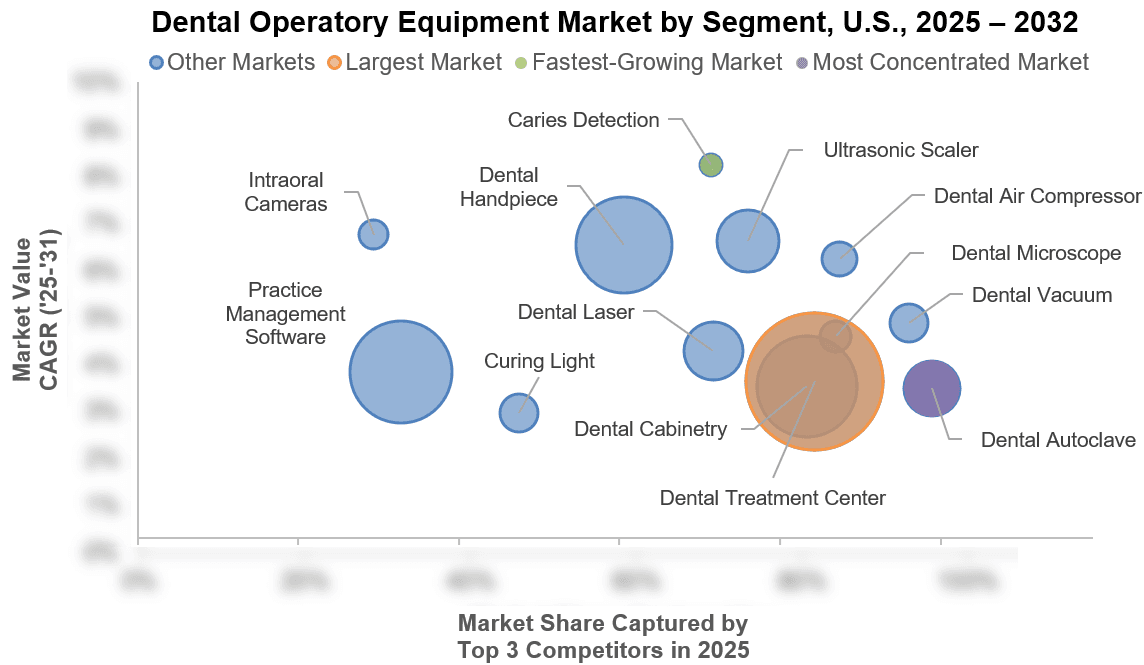
👉 The U.S. Dental Operatory Equipment Market Report 2026 provides competitor shares, and forecasts across every major segment, giving MedTech teams the clarity to target the right niches.
Customization is no longer just a “nice to have” in operatories.
Stools, chairs, and furnishings can be tailored to fit specific practice layouts and brand identities. Options like adjustable armrests, back supports, upholstery materials, and color palettes are giving dentists and clinics more control over ergonomics and aesthetics.
These upgrades carry higher costs, which in turn raise the average selling price (ASP) of equipment.
For manufacturers, this represents a way to stand out and drive revenue in a competitive market.
For buyers, customization is increasingly seen as an investment in both comfort and efficiency.
Are ergonomic loupes becoming the new standard?
While marketed products are already available in the U.S., adoption is still limited because of their higher price tags and adjustment period.
- Over 70% of dentists report musculoskeletal pain at some point in their career (per ADA studies).
- Ergonomic loupes are designed to reduce strain on the neck and back during long procedures.
- Despite their benefits, high costs and the need for training limit adoption to early adopters for now.
Prolonged bending and twisting can lead to back and neck strain, so ergonomic dental loupes are gaining attention as a solution.
Manufacturers are positioning ergonomic loupes as the future standard, but adoption will likely take several years to expand beyond early adopters.
This creates an opportunity for companies to educate dentists and offer tiered product options that ease the transition.
Why are surgical microscopes moving beyond endodontics?
Surgical microscopes have been widely used in endodontics for precision, but they’re now marketed toward general practitioners as well. Newer, compact designs make them more feasible in a wider range of practices.
The challenge is cost and training – two factors that slow adoption in general dentistry.
For manufacturers, this is both a painpoint and an opportunity: those who can lower barriers to entry with more affordable, user-friendly models could expand their market footprint significantly.
How is chairside CAD/CAM adoption evolving?
Dentists like the idea of producing restorations on-site and saving time for patients.
However, the high cost of these systems, combined with workflows still being tested in everyday practice, keeps adoption below mainstream levels.
Nevertheless, chairside CAD/CAM and integrated intraoral scanning remain one of the most talked-about innovations in operatories.
Growth is expected as prices come down and usability improves.
For manufacturers, this is a race to prove ROI and simplify workflows so CAD/CAM becomes a daily tool rather than a niche investment.
What can AI bring to dental practice management and imaging?
Artificial intelligence is beginning to influence both practice management and imaging. From automated scheduling and billing to clinical decision support, AI is being piloted across multiple functions.
In imaging, early FDA approvals for caries and pathology detection are paving the way for broader adoption.
- AI pilots are underway in billing, scheduling, and diagnostic imaging.
- Early FDA approvals for AI-based caries and pathology detection show regulatory momentum.
- Adoption will accelerate once dentists trust clinical decision support tools.
While most solutions are still in pilot or proposal phases, the trend is clear: AI will play a bigger role later in the forecast period.
Companies investing in AI today are positioning themselves for future demand, but market growth depends on regulatory progress and clinical trust.
📌 Learn More About AI in Dental Imaging:
Are smart operatories and connected systems the next frontier?
Systems that connect chairs, delivery units, and lights through IoT integration allow practices to track usage, schedule maintenance, and even enable remote monitoring.
While adoption is limited due to costs and infrastructure needs, these systems represent a clear direction for the industry.
Clinics upgrading to smart operatories will demand equipment that integrates seamlessly, creating both a challenge and an opportunity for manufacturers to build connected ecosystems.
Trends in Dental Operatory Equipment Driving the Market
The U.S. dental operatory equipment market is set to rise from $3.3B in 2025 to over $4.4B by 2031, with customization and ergonomics already lifting ASPs and shaping how practices design their operatories.
Technologies like AI imaging, CAD/CAM, and microscopes show strong potential, though high costs and training needs keep them from full adoption today. Early FDA clearances suggest growth will accelerate later in the forecast period.
Looking ahead, connected operatories, ergonomic tools, and energy-efficient systems point to a smarter, more integrated future.
Turn market painpoints into opportunities
Explore how procedure trends and competitor positioning create clear openings for industry experts in the market.


