Best Dental Implants Market Summary provides a clear overview of the global dental implant industry, highlighting key product segments, competitive dynamics, and emerging trends.
More people look for long-lasting tooth replacement options. Rising access to dental care, aging populations, and better digital tools all make this a key year for implant growth.
Find growth niches in minutes, not months.
Explore quick, actionable insights from the select markets.
Table of Contents
➜ Why the Dental Implants Market Matters
➜ Is the Global Dental Implants Market Growing?
➜ Premium vs. Value vs. Discount Dental Implants
➜ Why Mini-Implants Matter in Today’s Dental Implants Market
➜ Dental Implant Demand Across Global Regions
➜ What Is Driving Dental Implant Market Growth?
➜ What Is Slowing Down the Dental Implants Market?
➜ Best Dental Implants Market Final Thoughts
Key Takeaways
- The dental implants market is valued at over $4 billion in 2025.
- Growth is driven by better access to care and aging populations.
- Mini-implants offer faster, lower-cost options, but long-term stability concerns remain.
- Price sensitivity and imitation products continue to pressure the market.
- Smaller regions are growing the fastest as awareness and affordability improve.
Why the Dental Implants Market Matters
Dental implants are now seen as the closest replacement to natural teeth.
They help protect jawbone health and make eating and speaking easier.
In 2025, more patients are choosing implants because care is becoming more accessible and because many people want better-looking, longer-lasting smiles.
📌 Learn More About Dental Implants Competitors, and Trends
➜ Best Dental Implants in 2025: Trends, Competitors, and Outlook
Is the Global Dental Implants Market Growing?
Yes. The global dental implants market is valued at over $4 billion in 2025 and is expected to reach over $5.5 billion by 2030.
Two main factors drive this rise:
- Aging populations with higher rates of tooth loss.
- Improved access to care in both large and emerging regions.
Many patients who once relied on bridges or removable dentures are now choosing dental implants because they look and feel more natural.
Premium vs. Value vs. Discount Dental Implants
The dental implants market is commonly divided into:
- Premium implants
- Value implants
- Discount implants
- Mini-implants
Premium implants still lead the market, but price pressure is growing. Value and discount brands now compete closely, especially in cost-sensitive regions. Imitation brands also play a role by offering “bioequivalent” alternatives at lower prices.
For dentists, this shift means more choice. For patients, it opens the door to lower-cost implant options.

Why Mini-Implants Matter in Today’s Dental Implants Market
Mini-implants were once temporary devices. Since 1999, they have been approved as permanent, and they now play a useful role in denture support.
Why mini-implants are appealing:
- Less invasive procedure
- Lower cost
- Faster healing and same-day loading
- Helpful for patients with low bone density
Mini-implants are used in fewer procedures overall because long-term stability is still a concern. But their benefits make them a growing option for denture wearers and patients who cannot receive full-size implants.
Dental Implant Demand Across Global Regions
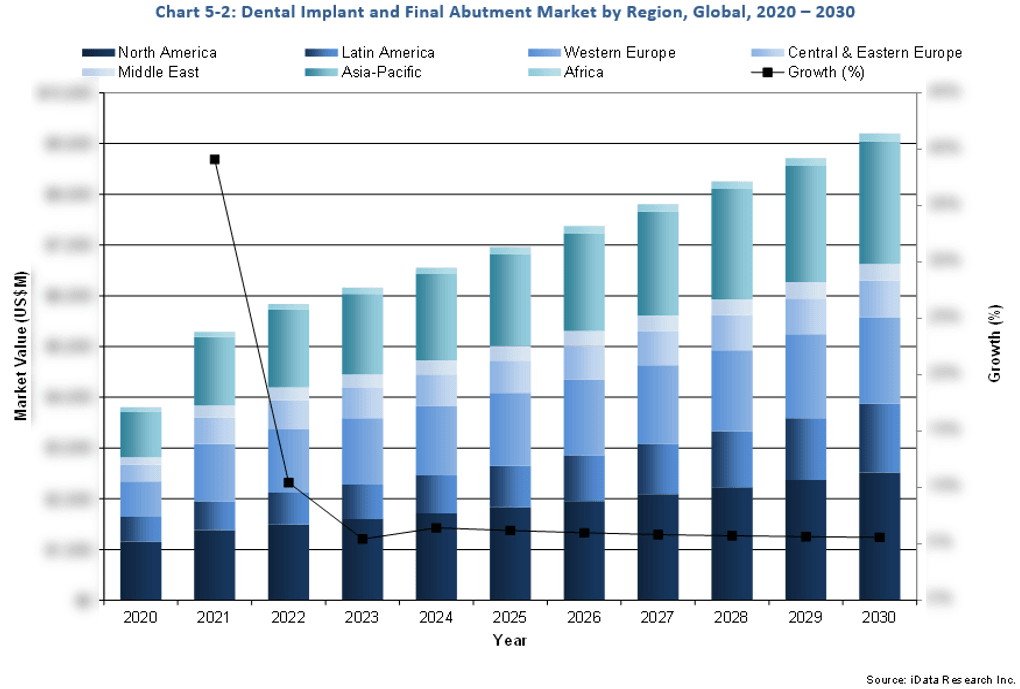
The three largest dental implant regions remain:
- Asia-Pacific
- North America
- Western Europe
Together, these regions make up about three-quarters of global value.
Smaller regions are rising fast
Smaller regions are expected to grow the quickest due to:
- Better access to trained clinicians
- More affordable care
- Higher awareness of implant benefits
As education improves, more patients learn that dental implants help protect bone health and offer better long-term function compared to traditional dentures.
What Is Driving Dental Implant Market Growth?
Aesthetic demand
More patients want natural-looking smiles. Implants support crowns that blend well with real teeth and preserve jawbone health.
Supportive insurance policies
Some countries now offer partial reimbursement for implants. Even limited coverage leads to higher adoption.
Better efficiency with CAD/CAM
Digital tools help reduce costs and speed production. More labs can now produce custom abutments, making advanced options easier to access.
What Is Slowing Down the Dental Implants Market?
Price sensitivity
Premium implants face pressure from value and discount brands. Many regions cannot support higher fees, which limits overall price growth.
Better oral health
As general oral health improves worldwide, fewer people become fully edentulous. This reduces the need for implants in some cases.
Imitation products
Lower-priced “bioequivalent” implants attract some buyers, especially in cost-sensitive markets. While adoption is small, it still creates downward pressure on pricing.
Best Dental Implants Market Final Thoughts
The dental implants market in 2025 is shaped by strong demand, better access to care, and digital improvements that make treatment faster and more predictable. While price sensitivity and competition continue, the global outlook remains positive.
For deeper insights, detailed forecasts, and competitive analyses, explore the iData Dental Implants Market Report.
Turn market painpoints into opportunities
Explore how procedure trends and competitor positioning create clear openings for industry experts in the market.


