
AI in market research is evolving rapidly, with platforms like ChatGPT, DeepSeek, and other large language models now being used to draft reports, summarize market trends, and even estimate forecasts. Their speed and accessibility have made them attractive tools for many industries, including healthcare and MedTech.
But when accuracy, traceability, and methodology matter, especially in a field like MedTech where millions of dollars depend on precision, the real question becomes: Can AI replace experienced market research analysts?
At iData, we put that question to the test.
Find growth niches in minutes, not months.
Explore quick, actionable insights from the select markets.
Table of Contents
➜ Why AI’s Role in HealthCare Market Research Matters
➜ The Test Setup: AI vs iData Analysts
➜ AI vs. Human Results: The Accuracy Table
➜ Bonus Test: How Consistent Is AI Over Time?
➜ Key Takeaways: Where AI Falls Short
➜ Navigate MedTech Markets Backed by Expertise
Key Takeaways
- AI tools like ChatGPT and DeepSeek are increasingly used for market research, but they struggle with accuracy, consistency, and source transparency in high-stakes industries like MedTech.
- Only 25% of AI-generated responses matched verified MedTech market data, highlighting the risks of relying solely on generative models for decision-making.
- AI platforms frequently “hallucinate” numbers and mix up segments, providing conflicting answers across sessions and devices — especially in time-sensitive, geographic-specific data queries.
- Human analysts provide a critical advantage by using proprietary data (e.g., hospital purchase orders, procedure volumes), standardized definitions, and triangulated methodologies.
- AI’s value is built on human-generated datasets — making expert-driven analysis essential for reliable market sizing, forecasts, and strategic planning.
- For accurate, verifiable MedTech insights, expert researchers remain irreplaceable — especially when millions of dollars and strategic decisions are on the line.
Why AI’s Role in HealthCare Market Research Matters
In healthcare and MedTech, decisions depend on precise, and reliable data. When it comes to sizing a market or planning a product launch, even a small error can cost millions.
AI tools like ChatGPT and DeepSeek are impressive, but they weren’t designed for this level of complexity. The data these models use often originates from expert-driven sources like iData, meaning the AI’s value depends on the reliability of the human research it’s trained on.
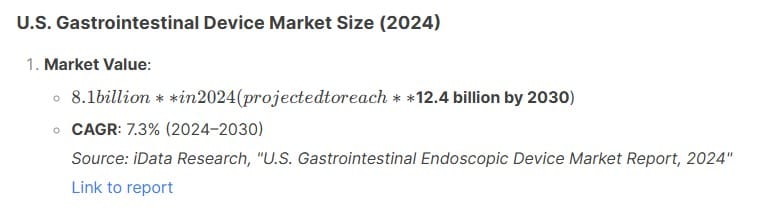
An Example Research Question Answered by DeepSeek.
How do leading AI platforms perform in Market Research?
To test how they perform, we asked ChatGPT, DeepSeek, and our team at iData Research, the same set of real-world MedTech market questions.
The goal was to see how their answers compare to validated figures from our MedSuite publications.
Based on our research, we found that while AI can be helpful, it cannot replace expert-led market research.
The Test Setup: AI vs iData Analysts
We selected 8 quantitative questions across several MedTech segments. Each question had a single, verifiable answer in our database.
To qualify as “Passable,” an AI-generated answer had to land within ±10% of our validated figures. Every figure was time-bound (2023 – 2024) and tied to specific geographic markets.
We asked each question to ChatGPT and DeepSeek, then compared the answers to iData’s internal figures. If an answer was within 10% of the verified number, we marked it “Passable”.
Examples of the questions included:
- What was the average selling price of single-use cystoscopes in Western Europe in 2024?
- How many hysterectomies were performed in the U.S. in 2024?
- What was the U.S. market size for insulin and GLP-1 therapies in 2023?
(Each of these questions has a clear answer in iData’s MedSuite publications.)
AI vs. Human Results: The Accuracy Table
| Question | iData’s Figure | ChatGPT Answer | DeepSeek Answer | Passable? |
| What is the global market value of Cystoscopes in 2023? | $468.7 million | $500 million | $1.2 billion | ✅ ChatGPT only |
| How much did the Global Intravascular Lithotripsy Market grow in 2023? | 46% | 15% | 25% | ❌ |
| What was the average selling price of a Shape Memory Staple Fixation device in the US in 2023? | $1,436 | $1,200 | $450 | ❌ |
| How many Cholecystectomy procedures were performed in the Asia-Pacific in 2023? | 1.9 million procedures | 1.2 million procedures | 1.8 million procedures | ✅ DeepSeek only |
| What was the US market value for Insulin and GLP-1 in 2023? | $30.5 billion | $25 billion | $25 billion | ❌ |
| What was the global market value for the Mechanical Heart Valve Market in 2023? | $197 million | $4.5 billion | $1.8 billion | ❌ |
| How many unit sales were made for Multi-Parameter Vital Signs Devices Globally in 2024? | $1.2 million | $5 million | $6 million | ❌ |
| How many total Neurological Procedures took place in the U.S. in 2024? | 1.1 million | 2.5 million | 9 million | ❌ |
Test Conclusion
Out of 8 questions, only 2 had been answered correctly by the two AI models, resulting in only 25% data accuracy.
Bonus Test: How Consistent Is AI Over Time?
To understand how AI tools behave under repeat conditions, we conducted a follow-up test.
We re-asked the same market questions across different browsers, devices, and user accounts, including incognito mode.
The goal was to simulate what a team might experience when checking the same information days or weeks apart.
The result? Figures shifted dramatically between sessions, sometimes by hundreds of thousands of procedures or entire percentage points in CAGR.
Key Takeaways: Where AI Falls Short

- Access to Proprietary Data: Unlike AI platforms, human analysts often work with datasets unavailable to the public, including hospital purchasing contracts, real-world procedure volumes, and import/export data.
- Grounded in Real-World Validation: Human research teams triangulate findings by interviewing manufacturers, distributors, and clinical end users to align estimates with operational realities.
- Standardization and Verification: Human-led analysis uses consistent definitions, proven methodologies, and internal peer review to ensure accuracy and traceability.
- AI Oversight: Analysts can monitor and assess AI-generated insights, identifying discrepancies and anomalies before they impact decision-making.
AI models are only as reliable as the data they’ve been trained on — and most lack access to high-quality, paid, or verified datasets. Until that changes, expert researchers remain essential for critical, data-driven decisions in high-stakes fields like MedTech.
Navigate MedTech Markets Backed by Expertise
AI can write fast. But it doesn’t understand the data, and it can’t verify what’s real.
In MedTech, the cost of bad data isn’t just theoretical – it’s strategic, financial, and reputational.
If you need real numbers with traceable sources, industry context, and analytical integrity, trust the experts who built the dataset in the first place.
Turn market painpoints into opportunities
Explore how procedure trends and competitor positioning create clear openings for industry experts in the market.


