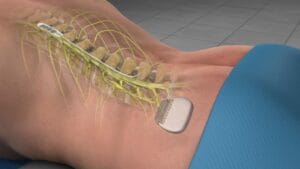
In U.S. spinal cord stimulation, Abbott ranks first, and Medtronic ranks second, according to iData Research.
Both companies build implantable SCS systems that ease chronic pain without relying on opioids.
Each frames implantable stimulation as a durable, drug-free option, a shift iData ties to rising opioid-sparing demand.
This guide compares how Abbott and Medtronic stack up on market share, devices, and growth in 2026.
[[cta-top]]
Table of Contents
➜ Who leads spinal cord stimulation in 2026, Abbott or Medtronic
➜ Why Abbott leads the SCS market
➜ What makes Medtronic a top SCS company
➜ Abbott vs Medtronic: how their SCS devices compare
➜ How big is the U.S. spinal cord stimulation market
Key Takeaways
- Abbott holds the leading share of the U.S. spinal cord stimulation market in 2025, according to iData Research.
- Medtronic ranks second and was the first company to bring an SCS product to market.
- Boston Scientific ranks third in the same iData segment ranking.
- iData Research valued the U.S. market for SCS at $3.8 billion in 2025, forecast to reach $5.0 billion by 2032.
Who leads spinal cord stimulation in 2026: Abbott or Medtronic?
In the U.S. spinal cord stimulation segment, Abbott ranks first and Medtronic ranks second.
That order comes from iData Research market share data for 2025.
Boston Scientific ranks third in the same iData segment ranking.
Medtronic still leads the wider U.S. pain management device market, where Abbott sits second.
So Abbott leads SCS specifically, while Medtronic leads pain management overall.
Why Abbott leads the SCS market?
Abbott leads the U.S. market for SCS on the strength of its Proclaim platform.
iData Research notes that Abbott offers the Proclaim Elite recharge-free system and the Prodigy MRI SCS system.
Abbott’s Proclaim generators connect to mobile devices over Bluetooth, which lets clinicians adjust therapy without new surgery, per iData Research.
Recharge-free generators appeal to patients who would rather not manage a charger, which is central to Abbott’s pitch.
In January 2023, the FDA approved Abbott’s Proclaim XR system for people living with painful diabetic peripheral neuropathy.
That clearance pushed Abbott beyond back and leg pain into a large diabetes-related patient group.
Abbott also markets Eterna, which it describes as a small rechargeable SCS system.
What makes Medtronic a top SCS company?
Medtronic ranks second in the U.S. market for SCS and carries the deepest history in the field.
iData Research notes that Medtronic was the first company to release a spinal cord stimulation product, which built lasting brand recognition and physician relationships.
Medtronic also leads neighboring segments, holding the top U.S. share in deep brain stimulation and intrathecal pumps in the same iData report.
In April 2024, the FDA approved Medtronic’s Inceptiv closed-loop SCS system.
Inceptiv reads the spinal cord’s response about 50 times each second and adjusts stimulation in real time, which Medtronic positions as a fix for movement-related discomfort.
Medtronic calls it the smallest and thinnest fully implantable SCS device and says it offers full-body 1.5T and 3T MRI access.
The company reported new 12-month clinical data in 2025 that it says shows sustained pain relief with the system.
[[cta-mid]]
Abbott vs Medtronic: how their SCS devices compare?
The clearest contrast between Abbott and Medtronic is how their SCS devices handle power and feedback.
Abbott builds its Proclaim line around recharge-free generators, which run for years without a charger, per iData Research.
Medtronic’s Inceptiv is rechargeable and adds closed-loop sensing that tunes each pulse to the body’s response.
iData splits SCS hardware into generators, sorted by battery type and channel count, and leads, offered as paddle or percutaneous designs.
Both companies stress MRI access, a priority for patients who may need future scans.
Medtronic states that Inceptiv gives full-body 1.5T and 3T MRI access, while iData notes that Abbott markets a Prodigy MRI SCS system.
For buyers, the choice often comes down to recharge-free simplicity against closed-loop, self-adjusting therapy.
How big is the U.S. spinal cord stimulation market?
iData Research valued the U.S. spinal cord stimulation market at $3.8 billion in 2025.
The same report forecasts the segment will reach $5.0 billion by 2032.
iData tracks 13 device markets in this pain management report, and SCS is the largest of them by value.
SCS sits inside the wider U.S. pain management device market, which iData valued at $6.2 billion in 2025 and expects to reach $7.8 billion at a 3.4% compound annual growth rate.
Demand is rising as clinicians and payers look for non-opioid ways to treat chronic pain, according to iData Research.
iData also lists the shift toward minimally invasive, outpatient procedures among the segment’s drivers.
Peer-reviewed neuromodulation research continues to examine how spinal cord stimulation fits that opioid-sparing shift.
Boston Scientific anchors its third-place position with its WaveWriter platform, while firms such as Nevro, Saluda Medical and Nalu Medical also appear among the competitors iData researched.
Frequently asked questions
Who is the largest spinal cord stimulation company?
Abbott holds the largest U.S. market share for SCS in 2025, according to iData Research.
Is Abbott bigger than Medtronic in SCS?
Yes, iData ranks Abbott first and Medtronic second in the U.S. market for SCS in 2025.
How big is the U.S. spinal cord stimulation market?
iData Research valued it at $3.8 billion in 2025 and forecasts $5.0 billion by 2032.
What is a closed-loop spinal cord stimulator?
It is a system, such as Medtronic’s Inceptiv, that senses the body’s response and adjusts stimulation automatically.
[[cta-bot]]


